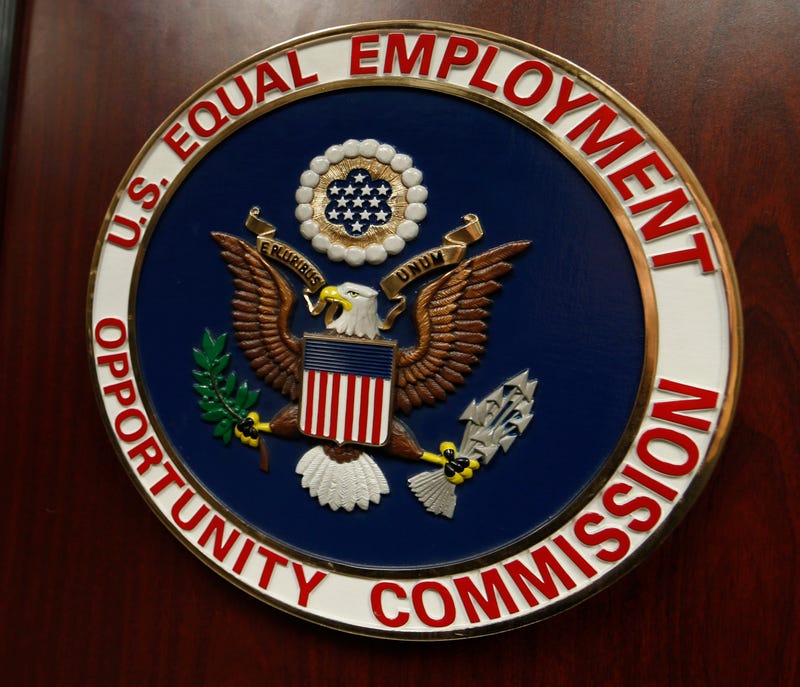
NEW YORK (AP) — A U.S. civil rights agency has determined that the federal government can bar transgender employees from using bathrooms aligned with their gender identity, dismissing an appeal from a transgender woman who worked for the U.S. Army.
The Equal Employment Opportunity Commission decided Thursday against a civilian IT specialist who worked for the Army at Fort Riley, Kansas. The EEOC repeatedly declared her to be man even though the worker informed her managers that she identified as a woman in the summer of 2025 when she asked to use bathrooms and locker rooms aligned with her gender identity. Her request was declined and she filed a complaint with the Army, which was dismissed.
The employee, who was not identified, appealed to the EEOC, which decided against her, citing President Donald Trump's executive order saying the federal government would only recognize two immutable sexes, male and female. The EEOC's sole Democratic commissioner, Kalpana Kotagal, dissented in the 2-1 decision.
The opinion retreated from the EEOC's landmark finding a decade ago that another transgender Army employee had been discriminated against because her employer refused to use her preferred pronouns or allow her to use bathrooms based on her gender identity. In its new finding, the EEOC found that the Army's decision did not violate Title VII of the 1964 Civil Rights Act, which prohibits discrimination on the basis of sex, race, religion and national identity.
EEOC Chair Andrea Lucas has aggressively moved to implement Trump's orders concerning gender identity, dropping lawsuits on behalf of transgender and nonbinary workers who were fired or harassed, and amending harassment guidelines to exclude language stating that deliberately misgendering workers or barring them from bathrooms aligned with their gender identity could constitute harassment. Many Republican lawmakers have welcomed her decisions and criticized the EEOC under previous administrations for overstepping its authority on gender identity issues.
“Today’s opinion is consistent with the plain meaning of ‘sex’ as understood by Congress at the time Title VII was enacted, as well as longstanding civil rights principles: that similarly situated employees must be treated equally,” Lucas said in a statement. “Biology is not bigotry.”
The EEOC's argued that interpreting Title VII as allowing “trans-identifying” employees into bathrooms of their gender identity would be tantamount to doing away with single-sex facilities.
“All bathrooms would be mixed-sex by law, and every employee would be required to perform bodily and other private functions in the presence of the opposite-sex,” the EEOC wrote.
Kotagal condemned the decision in a statement posted on her LinkedIn page.
“I strongly disagree with the decision’s substance and tone. The decision rests on the false premise that transgender workers are not worthy of the agency’s protection from discrimination and harassment and that protecting them threatens the rights of other workers. Worse, it suggests that transgender people do not exist,” Kotagal said.
Several transgender and gender nonconforming federal employees have filed formal discrimination complaints over the Trump administration's policies, which have included stripping government websites of “gender ideology” and reinstituting a ban on transgender service members in the military.
In a quasi-judicial function, the EEOC handles appeals by federal employees whose complaints have been dismissed by their agency's civil rights offices.
Thursday's decision applies to all federal agencies but not to private employers, and it does not set a precedent that U.S. courts must follow. In the case of private sector workers, the EEOC investigates complaints and can decide whether to file lawsuits on their behalf, but does not issue decisions.
The Army employee can file a request with the EEOC for reconsideration within 30 days, or she can file a new case in federal district court with 90 days, according to the EEOC.
In her statement, Kotagal argued that a landmark 2020 Supreme Court ruling, Bostock V. Clayton Country, reinforced that Title VII protects transgender workers from discrimination, and she criticizes the EEOC for “rushing” its decision while a federal district court is addressing similar issues in a class action case filed federal employees.
But in its decision, the EEOC argued that Bostock only established that employers cannot fire transgender employees or refuse to hire them based on their gender identity, making no decision on the issue of bathrooms or locker rooms or on the definition of sex.
Echoing a stance long held by Lucas, the EEOC argued that allowing transgender workers into bathrooms and locker rooms of their choice would be dangerous to women, violating their expectations for privacy in such spaces. That reasoning rested on the EEOC's repeated argument that the U.S. Army employee is not a woman and in fact was demanding “special treatment” by asking to be allowed into a bathroom of “the opposite sex.”
The EEOC cited Trump’s executive order and various dictionary entries in an extensive explanation of its insistence that “the complainant’s sex is male, from the moment of his conception and continuing even after he began to identify as transgender.”
Social conservatives have applauded that view but the American Medical Association and other mainstream medical groups have said extensive scientific research suggests sex and gender are better understood as a spectrum than as an either-or definition. Some biologists have criticized Trump's executive order as scientifically unsound because among other problems, it sidesteps variations that include intersex people, who have physical traits that don’t fit typical definitions for male or female categories. In a footnote, the EEOC said intersex individuals present “rare and unique circumstances” that “can be evaluated on a case-by-case basis.”
The Congressional Equality Caucus and several civil rights advocacy groups, including the Human Rights Campaign and the National Women's Law Center, condemned the decision
“Andrea Lucas has spent her time leading EEOC undermining enforcement of minority workers’ rights — she’s exactly who the Commission was designed to fight back against,” said Rep. Mark Takano, chair of the Congressional Equality Caucus.
The Defense Department referred questions to the Department of Justice and the Army, which did not immediately reply to requests for comment.
_____
AP Business Writer Claire Savage contributed to this report from Chicago.
______
The Associated Press’ women in the workforce and state government coverage receives financial support from Pivotal Ventures. AP is solely responsible for all content. Find AP’s standards for working with philanthropies, a list of supporters and funded coverage areas at AP.org.