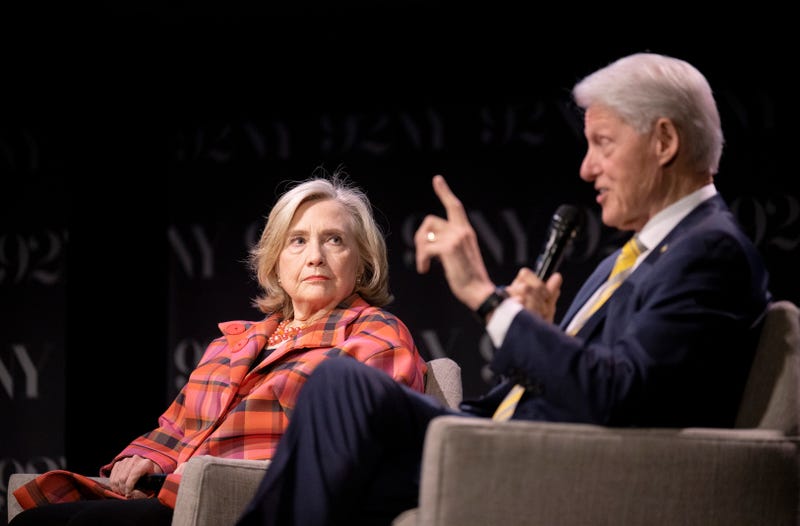
WASHINGTON (AP) — Former President Bill Clinton and former Secretary of State Hillary Clinton finalized an agreement with House Republicans Tuesday to testify in a House investigation into Jeffrey Epstein this month, bowing to the threat of a contempt of Congress vote against them.
Hillary Clinton will testify before the House Oversight Committee on Feb. 26 and Bill Clinton will appear on Feb. 27. It will mark the first time that lawmakers have compelled a former president to testify.
The arrangement comes after months of negotiating between the two sides as Republicans sought to make the Clintons, both Democrats, a focal point in a House committee's investigation into Epstein, a convicted sex offender who killed himself in a New York jail cell in 2019, and Ghislaine Maxwell, his former girlfriend.
“We look forward to now questioning the Clintons as part of our investigation into the horrific crimes of Epstein and Maxwell, to deliver transparency and accountability for the American people and for survivors,” Rep. James Comer, the chair of the House Oversight Committee, said in a statement.
The negotiation with the Clintons
For months, the Clintons resisted subpoenas from the committee, but House Republicans — with support from a few Democrats — had advanced criminal contempt of Congress charges to a potential vote this week. It threatened the Clintons with the potential for substantial fines and even prison time if they had been convicted.
House Speaker Mike Johnson said Tuesday that any effort to hold them in contempt of Congress were "on pause.”
Even as the Clintons bowed to the pressure, the negotiating between GOP lawmakers and attorneys for the Clintons was marked by distrust as they wrangled over the details of the deposition. They agreed to have the closed-door depositions transcribed and recorded on video, Comer said.
The belligerence is likely to only grow as Republicans relish the opportunity to grill longtime political foes under oath.
Comer told The Associated Press that Republicans, in their inquiry with the Clintons, were “trying to figure out how Jeffrey Epstein was able to surround himself with all these rich and powerful people.”
Comer, a Kentucky Republican, also said that the Clintons had expressed a desire to make the proceedings public, but that he would insist on closed-door testimony with a later release of a transcript of the interviews. He added that he was open to holding a later public hearing if the Clintons wanted it.
How Clinton knew Epstein
Clinton, like a number of other high-powered men including President Donald Trump, had a well-documented relationship with Epstein in the late 1990s and early 2000s. Neither Trump nor Clinton has been credibly accused of wrongdoing in their interactions with the late financier.
Both Clintons have said they had no knowledge that Epstein was sexually abusing underage girls before prosecutors brought charges against him.
The Clintons had initially argued the subpoenas for their testimony were invalid and offered to submit sworn declarations on their limited knowledge of Epstein's crimes. But as Comer threatened to proceed with contempt of Congress charges, they began looking for an off-ramp.
Both Clintons have remained highly critical of how Comer has handled the Epstein investigation and argue that he is more focused on bringing them in for testimony rather than holding the Trump administration accountable for how it has handled the release of its files on Epstein.
However, as Comer advanced the contempt charges out of the House Oversight Committee last month, he found a number of Democrats willing to help. A younger generation of more progressive Democrats showed they had few connections with the Clintons, who led the Democratic Party for decades, and were more eager to show voters that they would stand for transparency in the Epstein investigation.
Nine Democrats out of 21 on the Oversight panel voted to advance charges against Bill Clinton, and three Democrats joined with Republicans to support the charges against Hillary Clinton. As the vote loomed this week, House Democratic leaders also made it clear they would not expend much political capital to rally votes against the contempt resolutions.
That left the Clintons with little choice but to agree to testify or face one of the most severe punishments Congress can give.
A precedent set?
Congress has historically shown deference to former presidents. The Clintons' concession, however, prompted some Democrats to suggest that it set a precedent for former presidents to comply with congressional subpoenas.
“We look forward to using this same precedent when we take back the majority in November,” Rep. Daniel Goldman, a New York Democrat, said on social media.
Trump's attorneys successfully resisted a congressional subpoena in 2022, between his first and second terms, issued by a House committee investigating the deadly Jan. 6, 2021, riot by a mob of his supporters at the U.S. Capitol. Trump’s lawyers cited decades of legal precedent they said shielded an ex-president from being ordered to appear before Congress, and the committee ultimately withdrew its subpoena.
At a signing for an unrelated bill later Tuesday, the president told reporters the depositions for the Clintons were “a shame” and “I always liked them.”
He praised Hillary Clinton — his opponent in his first presidential election win in 2016 — for her debate skills and called her a “smart woman.”