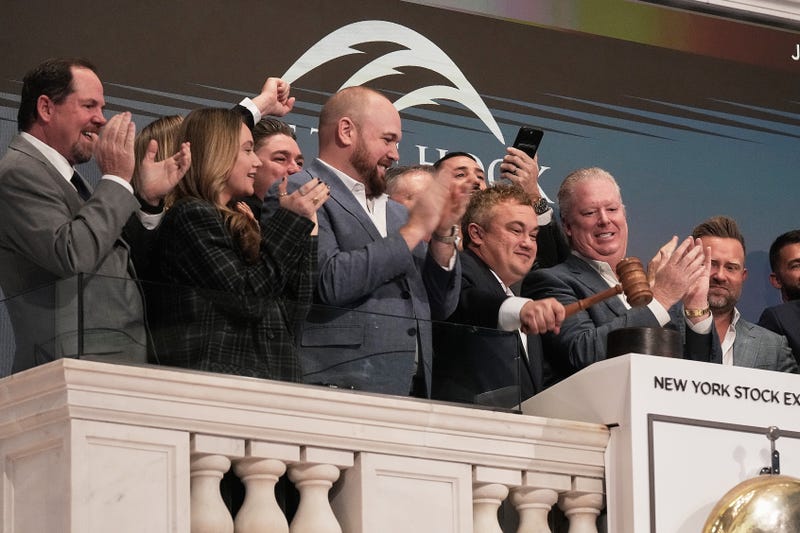
NEW YORK (AP) — Stocks slumped on Wall Street Tuesday after President Donald Trump threatened to hit eight European countries with new tariffs as tensions escalate over his attempts to assert American control over Greenland.
The losses were widespread, with nearly every sector losing ground. Major indexes in the U.S. extended losses from last week in what has been a wobbly start to the year.
The S&P 500 fell 143.15 points, or 2.1%, to 6,796.86. It is the steepest drop for the benchmark index since October.
The Dow Jones Industrial Average fell 870.74 points, or 1.8%, to 48,488.59. The Nasdaq composite fell 561.07 points, or 2.4%, to 22,954.32.
Technology stocks were the heaviest weights on the market. Nvidia, one of the most valuable companies in the world, plunged 4.4%. Apple fell 3.5%.
Retailers, banks and industrial companies also fell sharply. Lowe’s fell 3.3%, JPMorgan Chase fell 3.1%, and Caterpillar lost 2.5%.
European markets and markets in Asia fell. Long-term bond yields in Japan rose to record levels on concerns over the government’s fiscal policy, adding to anxiety in global markets.
Trump’s trade policy has roiled markets since the start of his second term. Stocks have sold off on the threat of steep tariffs, then rallied when Trump delays or cancels a tariff, or negotiates a lower rate.
Trump said Saturday that he would charge a 10% import tax starting in February on goods from Denmark, Norway, Sweden, France, Germany, the United Kingdom, the Netherlands and Finland. The annual combined imports from European Union nations are greater than those from the top two biggest individual importers into the U.S., Mexico and China.
Gold prices surged 3.7% and silver prices soared 6.9%. Such assets are often considered safe havens in times of geopolitical turmoil.
The trade tensions apparently short-circuited a recent rally in bitcoin. The cryptocurrency rose above $96,000 late last week but has dropped back to around $89,700.
Treasury yields were mixed in the bond market. The yield on the 10-year Treasury rose to 4.29% from 4.23% late Friday. The yield on the two-year Treasury held steady at 3.60% from late Friday.
Companies that focus on consumer staples held up better than most of the market. Colgate-Palmolive rose 1.1% and Campbell’s rose 1.5%.
The price of U.S. crude oil rose 1.5% to $60.34 per barrel. The price of Brent crude, the international standard, rose 1.5% to $64.92.
Trump linked his aggressive stance on Greenland to last year’s decision not to award him the Nobel Peace Prize, telling Norway’s prime minister that he no longer felt “an obligation to think purely of Peace,” in a text message released Monday.
Trump’s message to Jonas Gahr Støre appeared to ratchet up a standoff between Washington and its closest allies over his threats to take over Greenland, a self-governing territory of NATO member Denmark.
Trump’s threats have sparked outrage and a flurry of diplomatic activity across Europe, as leaders consider possible countermeasures, including retaliatory tariffs and the first-ever use of the European Union’s anti-coercion instrument.
The trade and political conflict with Europe is heating up just as world leaders meet at the World Economic Forum annual meeting in Davos, Switzerland this week. Wedbush Securities analyst Dan Ives said the new tariff threat “is clearly an overhang on the conference,” but that it would likely simmer over time.
“Our view is just like over the last year the bark will be worse than the bite on this issue and tariff threats as negotiations take place and tensions ultimately calm down between Trump and EU leaders,” Ives wrote in a note to clients.
Tariffs threaten to boost inflation, although so far the increases have been less than many experts feared. Still, the threat of tariffs reigniting already high inflation could further complicate the Federal Reserve’s job.
The central bank cut its benchmark interest rate three times late in 2025 to help bolster the economy as the job market weakened. The Fed has taken a more cautious view because of the risk of rising inflation, which remains above its target of 2%.
Lower interest rates on loans can help bolster economic activity, but they could also fuel inflation, which could counter any benefit from lower interest rates.
The Fed, and Wall Street, will get another update on inflation on Thursday, when the government releases the personal consumption expenditures price index, or PCE. It is the Fed’s preferred measure for inflation.
The Fed will meet next week for its policy meeting on interest rates and Wall Street is betting that the central bank will hold its benchmark interest rate steady.
Wall Street is also in the midst of the latest round of corporate earnings, which could help provide more insight into how companies are handling uncertainty from tariffs, geopolitics and cautious consumers.
Industrial and consumer conglomerate 3M slumped 7% after reporting mixed results for its most recent quarter. Companies from a wide range of industries will report their results this week, including Johnson & Johnson, Halliburton and Intel.
___
AP Business Writers By Yuri Kageyama and Matt Ott contributed to this report.