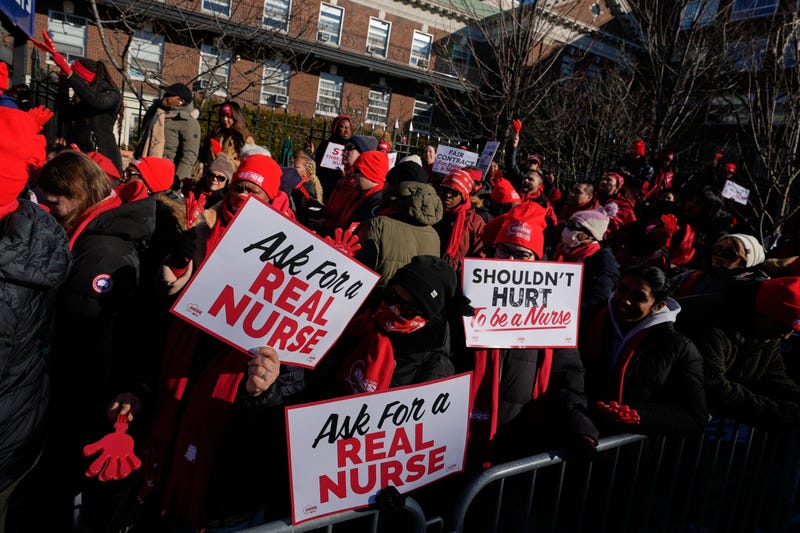
NEW YORK (AP) — Hospital officials and union leaders traded barbs Tuesday, but failed to return to the bargaining table on the second day of New York City’s biggest nursing strike in decades.
The union accused one hospital, Mount Sinai, of illegally firing three nurses, though the medical center claimed the individuals had sabotaged emergency preparedness drills.
Another hospital, Montefiore Medical Center, criticized what it described as the union's “reckless demands” and “troubling proposals” in contract talks.
The hospitals also sought to downplay the strike's impact, with Montefiore claiming it has “not canceled even one patient’s access to care” during the work stoppage. Mt. Sinai said around 20% of its regular nurses have so far opted to remain on duty rather than join the strike line.
But the fired Mt. Sinai nurses maintain they’re being silenced for being outspoken union organizers.
“We will not be bullied,” said Liliana Prestia, speaking at a rally Tuesday at Mount Sinai's flagship campus on Manhattan's Upper East Side. “It was Mount Sinai’s cruel attempt to stop us from joining the strike line and to make us an example to our fellow nurses.”
Union officials said none of the hospitals has agreed to additional bargaining sessions since their last meetings on Sunday. Montefiore, however, said the union hasn't reached out.
The union says roughly 15,000 nurses walked off the job Monday morning at multiple campuses of three hospital systems: NewYork-Presbyterian/Columbia, Montefiore Medical Center and Mount Sinai.
The affected hospitals have hired droves of temporary nurses to try to fill the labor gap. Both nurses and hospital administrators have urged patients not to avoid getting care during the strike.
New York City, like the U.S. as a whole, has had an active flu season. The city logged over 32,000 cases during the week ending Dec. 20 — the highest one-week tally in at least 20 years — though numbers have since declined, the Health Department said last Thursday.
Roy Permaul, an intensive care unit nurse who was among those picketing in front of Mount Sinai's flagship campus in Manhattan, said he and his colleagues are prepared to stay out for as long as needed to secure a better contract.
But Dania Munoz, a nurse practitioner at Mount Sinai, stressed that the union’s fight wasn’t just about better wages.
“We deserve fair pay, but this is about safety for our patients, for ourselves and for our profession,” the 31-year-old Bronx resident said. “The things that we’re fighting for, we need. We need health care. We need safety. We need more staffing.”
The New York State Nurses Association said Mount Sinai unlawfully fired three nurses hours after the strike started and improperly disciplined others for speaking out about workplace violence or discussing the union and contract negotiations with their colleagues.
Mount Sinai responded that the nurses were fired for “deliberately sabotaging” the hospital's emergency preparedness drills ahead of the strike, including hiding supplies from replacement nurses in training. It said the “completely unacceptable behavior” was captured on security footage.
Meanwhile, Montefiore criticized unionized nurses for seeking “troubling proposals” such as demanding that nurses not be terminated, even if found to be compromised by drugs or alcohol while on the job.
The union said Montefiore was “blatantly mischaracterizing” one of its basic workplace proposals, which would have added protections for nurses dealing with substance use disorders and which has already been adopted in other hospitals around the state.
The city Emergency Management Department said it hasn’t seen major impacts to patient care so far.
The Greater New York Hospital Association, an industry group, said hospitals canceled scheduled surgeries, transferred patients from more specialized units and increased discharges in the days leading up to the strike in order to streamline and reduce the number of patients they’re serving, the group said.
Ambulances also routed patients to other hospitals to help ease the burden on busier facilities on the first day of the strike, though no diversions were reported Tuesday, according to Brian Conway, a spokesperson for the association.
The labor action comes three years after a similar strike forced medical facilities to transfer some patients and divert ambulances.
As with the 2023 labor action, nurses have pointed to staffing issues as a major flashpoint, accusing the big-budget medical centers of refusing to commit to provisions for safe, manageable workloads.
The private, nonprofit hospitals say they’ve made strides in staffing in recent years and have cast the union’s demands as prohibitively expensive.