WASHINGTON (AP) — U.S. allies and partners in the Middle East again are urging restraint from both the United States and Iran as the Trump administration warns of a possible strike and builds up its military presence in the region, according to an Arab diplomat familiar with the matter.
Saudi Arabia, Turkey, Oman and Qatar have been in touch with leaders in Washington and Tehran to make the case that an escalation by either or both sides would cause massive destabilization throughout the region and affect energy markets, according to the official, who spoke on condition of anonymity to discuss private diplomatic discussions.
Arab and Muslim states in the region fear that any type of U.S. attack on Iran would prompt a response from Tehran that would, in the immediate term, likely be directed at them or American interests in their countries that could cause collateral damage, the official said.
Saudi Arabia’s defense minister, Khalid bin Salman, said on social media Friday that he discussed “efforts to advance regional and global peace and stability” in Washington with Secretary of State Marco Rubio, Defense Secretary Pete Hegseth, President Donald Trump's envoy to the region Steve Witkoff and Gen. Dan Caine, chairman of the Joint Chiefs of Staff.
The words of caution come as Trump has shifted his rationale for possible U.S. military action against Iran in recent days from a response to the deadly crackdown on nationwide protests to a deterrent of the country's nuclear program. That is even as he insists Iranian nuclear sites were “obliterated” in U.S. strikes in June.
Trump says he wants to make a deal
Trump on Friday said he hoped to make a deal with Iran but told reporters: “If we don’t make a deal, we’ll see what happens.”
He was cryptic when asked if he had given Iran a deadline, saying, “Only they know for sure.” He affirmed that he had communicated his threats to the country’s officials directly but did not offer any details.
Trump’s return to the nuclear issue should not necessarily be considered a shift in tactics, but rather part of a broader approach toward dealing with Iran and the threat the U.S. believes it poses to its people and the region, according to two administration officials who spoke on condition of anonymity to describe the president’s thinking.
One of the officials said Trump had initially focused on the protests inside Iran as a way of both encouraging demonstrators who might at some point force a change in Iranian policies and warning Tehran of consequences for mistreating them.
Trump said Friday that Iran heeded his earlier warnings about holding off from executing protesters, which he said he appreciated, but then acknowledged, “A lot of people are being killed.”
At the same time, Iran’s nuclear threat has remained the larger concern for both the U.S. and the region, particularly Israel. The official said it made sense to Trump to remind Iran’s leadership that the ultimate goal is to eliminate that threat.
“Hopefully Iran will quickly ‘Come to the Table’ and negotiate a fair and equitable deal — NO NUCLEAR WEAPONS — one that is good for all parties,” Trump wrote on his Truth Social platform this week. “Time is running out, it is truly of the essence!”
A senior administration official stressed that Trump “has all options at his disposal.” That official did not offer details about whether the White House had any indications that Iran was taking steps to rebuild its nuclear program.
Iran says it's ready for talks but also ‘ready for war’
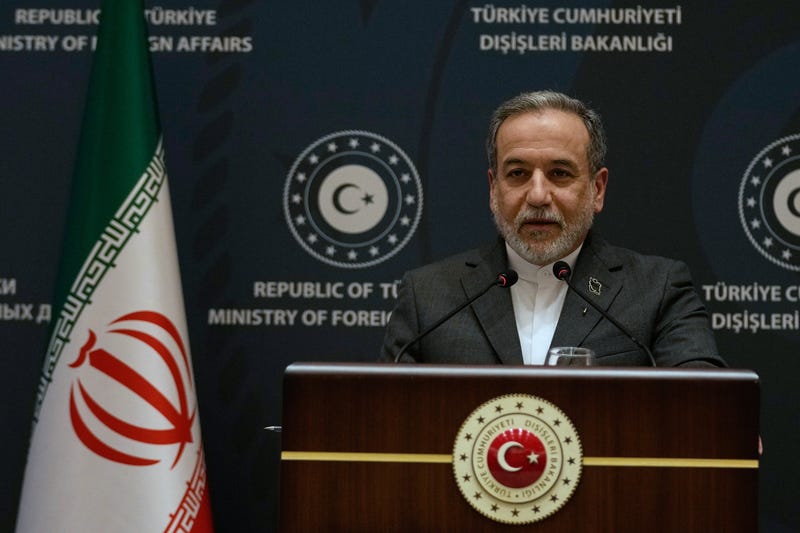
Iranian Foreign Minister Abbas Araghchi said Friday while meeting Turkish officials in Istanbul that his country is ready for dialogue to resolve tensions but that there are no concrete plans for talks with his U.S. counterparts.
“The Islamic Republic of Iran, just as it is ready for negotiations, it is also ready for war,” he added.
Ankara has been working to reduce the tensions, with Turkish President Recep Tayyip Erdogan offering during a telephone call with Iranian President Masoud Pezeshkian earlier Friday to act as a “facilitator” between Iran and the U.S., according to his office.
Trump backed down from ordering any strikes earlier this month after telling Iranians to keep protesting and that “help is on the way,” saying he had received assurances Iran would not execute some 800 protesters.
Nationwide protests in Iran began in late December against economic woes but broadened into a challenge to the Islamic Republic’s theocracy. Activists say the government's crackdown has killed at least 6,540 people.
Trump, meanwhile, repeatedly has touted a “massive armada” of U.S. warships in the region. The U.S. military has bolstered its presence with the aircraft carrier USS Abraham Lincoln and three guided-missile destroyers, which brought thousands of additional service members to join other destroyers and ships in the Middle East.
U.S. Central Command urged Iran to avoid “unnecessary risk to freedom of navigation” during a planned live-fire exercise starting Sunday in the Strait of Hormuz, a waterway where 20% of the world’s oil passes.
The command noted that it would not tolerate “unsafe” actions from Iran, including flying over U.S. military ships engaged in flight operations, high-speed boat approaches or weapons pointed at American forces.
The Arab official said the region's message to the U.S. is that it should proceed with extreme caution, mindful of the havoc that could ensue. The message to Iran is that if the U.S. does strike, it should carefully calibrate how it responds and not take action that would affect its neighbors, the official said.
U.S. assets in Qatar, for instance, were the target of Iranian retaliation after Trump's airstrikes on Iranian nuclear facilities last year.
The official added that ideally nothing would come to pass other than a period of extreme anxiety but said the situation was unpredictable and that no one other than Trump knows if an attack would be coming.
___
Amiri reported from New York. Associated Press writers Mehmet Guzel in Istanbul and Konstantin Toropin in Washington contributed to this report.