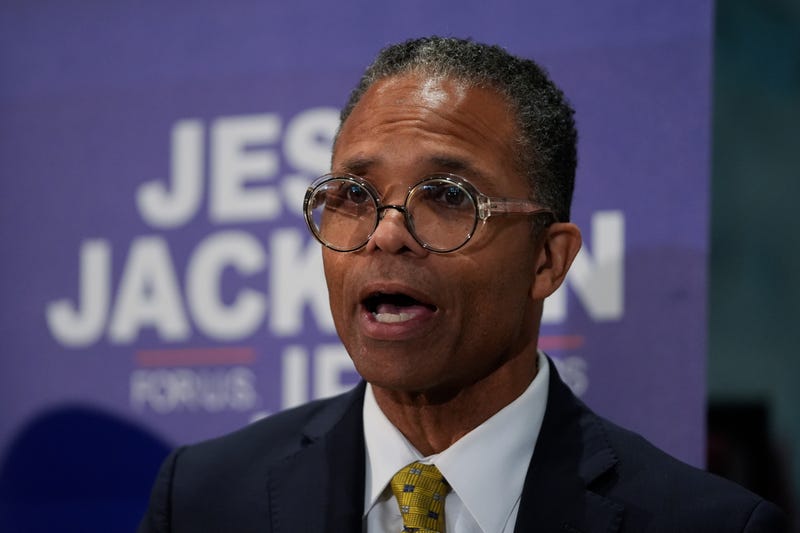
COUNTRY CLUB HILLS, Ill. (AP) — As Jesse Jackson Jr. campaigns for his old U.S. House seat at Chicago-area churches, banquet halls and on Black radio shows, he often takes a moment to address the obvious matter hanging over his political comeback.
The son of the civil rights icon tries to bring it up first: A 2013 campaign fraud conviction that ended his 17-year political career.
“It’s now part of my story,” Jackson told the pastors, elected officials and retirees gathered on a recent Saturday to hear his lofty plan to revive Chicago's sagging south suburbs. “I’ve cried enough. I’m divorced now. I’ve lost my home in foreclosure. I’ve been through everything that comes with that process.”
At 60, Jackson has launched a spirited primary bid in the largely Black district where he started his career, saying his new perspective makes him an ideal candidate at a time when voters have accepted a president and others with serious criminal histories. The theme of redemption is woven through his return in the firmly Democratic territory with stories about incarceration, sparse job prospects and caring for his ailing dad, the Rev. Jesse Jackson.
But the efforts to reclaim the name belonging to one of the nation's most famous political families haven’t been without eyerolls and jabs from candidates in the crowded March primary who say Jackson had his chance in a district plagued by political corruption.
“What I think matters is that trust has to be earned,” Jackson told The Associated Press while campaigning recently. “I’m cognizant of that.”
The reverend’s son energizes crowds
The eldest son of the Rev. Jesse Jackson now sports thick circular glasses and graying hair. He remains a skilled orator in the style of his father, a protégé of the Rev. Martin Luther King Jr. and two-time presidential candidate. Another son, Jonathan, is also a Chicago-area congressman.
Sounding at times like a preacher and others a professor, Jackson Jr. paces among poster boards outlining his vision for a third Chicago airport. The proposed public-private partnership to boost economically depressed areas outside Chicago hasn’t seen traction for years.
But that’s not evident from how Jackson describes it.
Nearly 50 people filed into a suburban school gym to hear how a hypothetical airport might someday compete with O’Hare and Midway.
“The one thing that is missing from this congressional district is access to the global economy,” Jackson said, describing daily flights to Hong Kong.
The extemporaneous talk included Biblical references and warm shoutouts to locals in the audience. Attendees were handed thick packets documenting nearly $1 billion in federal funds Jackson secured over the years. Around the room was church-style signage with Jackson’s portraits under the slogan “A New Hope.”
David Jones, 52, praised Jackson's “tenacity” and “fortitude.” The Flossmoor resident voted for Jackson before and will again. He felt the former congressman had been humbled by the prison sentence.
“Would it sway certain people? Probably,” he said. “But at the same time, to his point, we have a president that had 34 convictions and he’s still president of the United States. So if it didn’t sway people from voting in that regard why should it sway you from voting for him?”
Soon, the crowd was chanting for a 10,000-foot airport runway, with Jackson directing the recitation like a conductor.
Attendees lined up for blue-and-white yard signs. The most popular has one word: “Jr.”
A promising start, a rocky end
Jackson was first elected in a 1995 special election. He easily won each reelection, despite a 2009 ethics inquiry related to former Illinois Gov. Rod Blagojevich. Jackson wasn't charged.
However, in 2012 Jackson disappeared from the public eye, even missing his reelection night. He later disclosed treatment for bipolar disorder at the Mayo Clinic. He resigned in November amid a federal investigation.
The next year Jackson pleaded guilty to charges he engaged in a scheme to spend $750,000 in campaign funds on luxury items including Bruce Lee memorabilia. His then-wife, former Chicago Alderwoman Sandi Jackson, also pleaded guilty.
He served 30 months.
Jackson's time behind bars was isolating. He said he used the time to learn from inmates and write his third book. While incarcerated, relatives waited to disclose his father’s diagnosis with a neurological disorder.
“He didn’t think emotionally that I could handle it,” Jackson said of his father.
After his release, Jackson struggled personally and financially.
His marriage of 37 years ended. Attorneys in his 2018 divorce disclosed he received Social Security Disability Insurance payments due to extended medical leave from Congress.
Finding work was hard. One university rescinded a job offer over his conviction.
“I could not survive the evil of the Google search,” he joked.
Fundraising struggles and messaging
Early voting starts Thursday for the March 17 primary.
The 2nd District seat is open because Rep. Robin Kelly is running for Senate following Dick Durbin’s retirement. The territory encompasses city neighborhoods, working-class suburbs and some rural areas.
Ten Democrats are in, including Donna Miller, a county commissioner who leads fundraising. She brought in about $1 million in the last quarter and has that much on hand. Meanwhile, Jackson raised about $100,000 and has roughly equal to spend.
Jackson said fundraising in the district has always been tough. He sees a path to victory in part by registering new voters; he said his campaign has signed up roughly 2,000. He's also reaching disenfranchised voters, including Black men who “abandoned” the party.
Jackson says he relates more to voters now.
He often starts events by asking who has been imprisoned or knows someone in jail. The show of hands is usually strong. He’s opened up about managing mental health, crediting his physician, tight social circle and martial arts.
When his father took a turn with a November hospitalization, Jackson wrote about elderly parent care for USA Today. The reverend has progressive supranuclear palsy, a neurodegenerative disorder. He communicates through hand gestures as he’s lost the ability to speak.
Jackson listened to his dad's speeches before making his run official on his father's 84th birthday in October.
“I get very emotional knowing that those speeches belong to the ages now,” he said.
Critics say district needs fresh start
Political opponents seize on Jackson’s high-profile and comfortable upbringing.
State Sen. Willie Preston likes to highlight Jackson’s fashion choices with Ferragamo shoes as evidence of someone who hasn’t reformed spending habits.
“When you have had such a lifestyle of luxury and celebrity because you threw that away, then I’d imagine you’d want to get that back,” Preston said.
Jackson shrugged at the criticism. When it comes to footwear: “I wear shoes that fit my feet.”
Others say the district needs change.
Before Jackson, two congressmen left office under allegations of misconduct, including Mel Reynolds, who was convicted of fraud and criminal sexual assault charges.
“We’re ready for new chapter,” said candidate Yumeka Brown, Matteson's village clerk. “Voters have a right to expect honesty, accountability.”
Voters see familiarity and change
Listening to the former congressman, 71-year-old Warren Cottrell heard the reverend's voice.
“He sounds just as eloquent as his father,” said the retiree from Homewood. “I believe in second chances.”
Jackson says it's a second chance for him with his children too. He consulted both about running: daughter Jessica, who lives in France and son Jesse III, who's in college.
“It’s important for them to see their father stand up and fight for the dignity of their name,” he said.