


Connecticut Democrats and Republicans say their differences over the state's next congressional map are few-- but they remain significant enough to keep the sides from agreeing on the final product.
After the bipartisan Reapportionment Commission failed to carve out a final map last month, the process was handed over to the State Supreme Court. Monday, the court's special master on the case, Nathaniel Persily of Stanford University, invited the parties to meet again, with a deadline to report back by noon Wednesday. The sides were unable to resolve their issues by then.
"Both maps are so similar. It is a little frustrating that we can't just come to an agreement," says House Minority Leader Vincent Candelora (R-North Branford).
"We are not talking about significant changes here," says House Majority Leader Jason Rojas (D-East Hartford). "That was the intent that we approached drafting these maps with. That is the directive that the courts gave as well."
One key dispute, however, involves the positioning of Torrington (pop. 35,000), the biggest city in Litchfield County. The outgoing map places most of Torrington in the 1st District, which includes Democratic stronghold Hartford, represented by Rep. John Larson since 1999.
Democrats' plan would keep most of Torrington in the 1st. Republicans would shift it to the 5th District, where a more competitive congressional race is expected this fall. Second-term Rep. Jahana Hayes (D) currently represents the 5th.
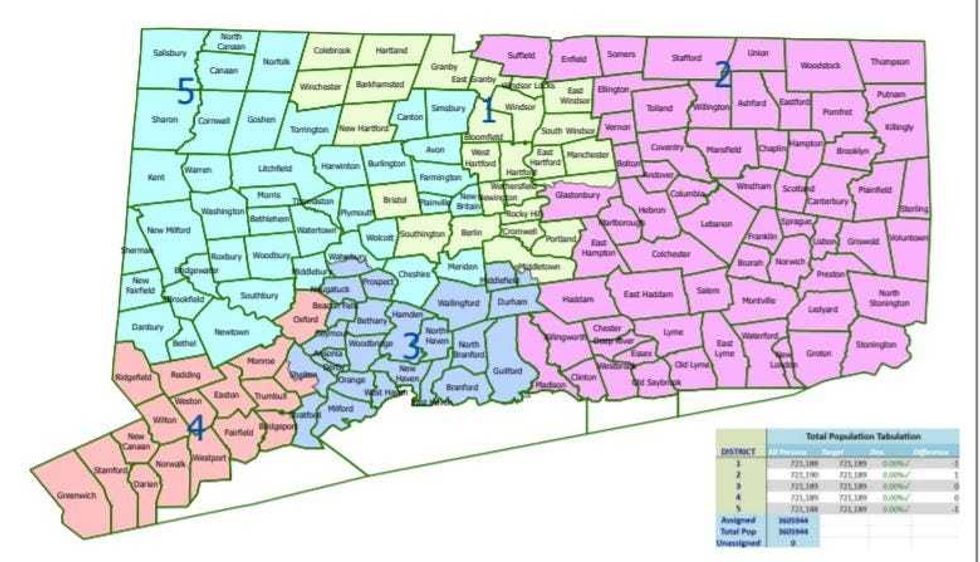 CT Republicans' proposed congressional mapLegal filing
"Torrington being sort of the urban center of the northwest corner of the state," says Candelora. "To have them divided up and sharing a district with Hartford and New Britain really doesn't make any sense."
Candelora calls the Democratic map a case of political gerrymandering. It largely maintains the districts from the 2001 state congressional map, drawn after the state lost a seat in the U.S. House. Those districts were widely maintained by the State Supreme Court in the last redistricting process, in 2011.
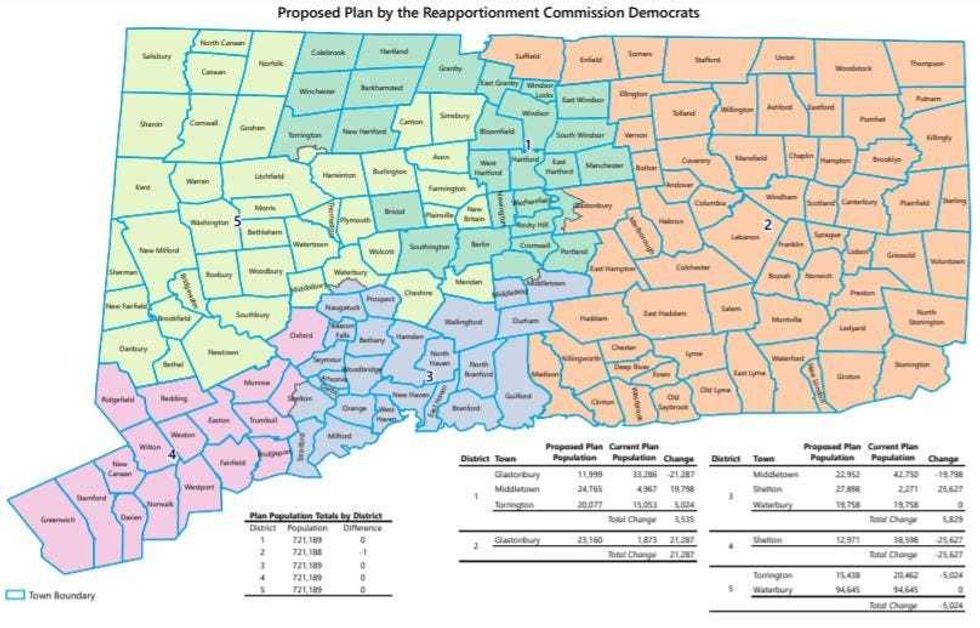 CT Democrats' proposed congressional mapLegal filing
Rojas explains that Republicans agreed to those boundaries in 2001: "They are now trying to revisit decisions that were made twenty years ago, and were acceptable ten years ago, the outcome of which were three Republicans who held congressional districts following the 2001 redistricting process, and now they want to change it because it meets their political needs of the moment."
Persily, who was hoping for some bipartisan guidance, will proceed to draw the final map, which is to be submitted to the State Supreme Court by Jan. 18.