


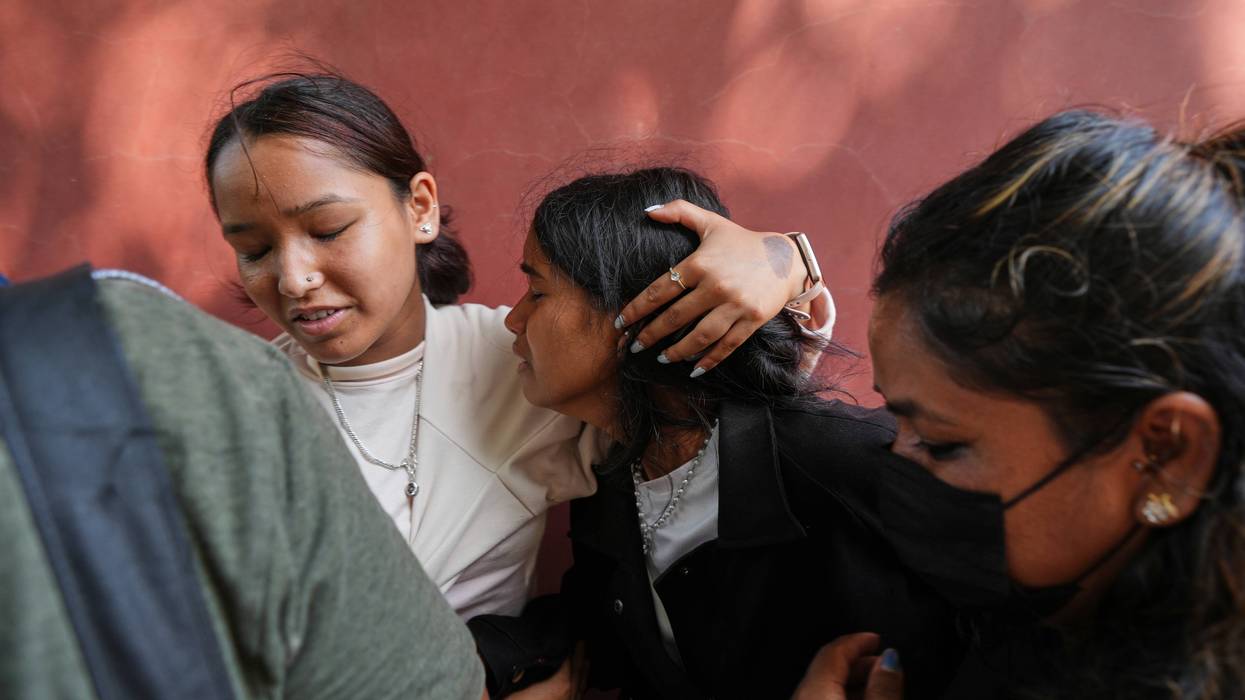

Rescue teams continued to work on Friday through mud and debris in areas devastated by a flash flood on the Himalayan border between Nepal and China.
Hundreds of people remain missing as the death toll climbed above 570 and Nepali and Chinese authorities warned of further risk of flooding from a new lake that has formed upstream following Wednesday’s disaster. Those still in the potentially affected areas at risk were warned to move to safer ground.
More than 3,700 people have been rescued in Nepal so far, but 1,924 people remain unaccounted for in the country. China’s state media previously said 558 people were missing on the Chinese side.
Nepal’s National Disaster Risk Reduction and Management Authority said the latest death toll had risen to 579.
China state broadcaster CCTV said five people had died in flooding along Tibet’s border with Nepal and 558 remained missing. Tibet is a region in China.
Here is the latest:
China sends rescue teams to disaster area
China has sent two rescue teams, comprising 21 people and a search dog, to the disaster site.
The deployment represents the first professional rescue teams to reach the disaster’s hardest-hit area, China’s Ministry of Emergency Management said on Friday.
Footage aired by China's state broadcaster CCTV showed a rescuer suspended from a drone being lowered onto the bank of the fast-flowing Gyirong River to help deploy an inflatable boat. A destroyed truck and a bridge pier could be seen nearby.
A separate team of 13 experts also later reached the area safely, according to the ministry.
Nepal raises death toll as number of missing doubles
Nepal’s disaster management authority said the death toll has risen to 579.
The agency said the number of people reported missing has doubled to 1,924, as more local residents were added to the tally.
The number of foreign nationals reported missing remains at 517.
Nepal does not need foreign search and rescue teams ‘for now’
Nepal said it does not require foreign search and rescue teams at this time.
Foreign Ministry spokesperson Lok Bahadur Poudel Chhetri said domestic personnel are managing the immediate crisis but remain open to targeted international technical support.
“Our security agencies are handling the rescue operations well, so for now, we do not need any rescue teams from other countries,” he said. “But it doesn’t mean that we don’t need any kind of support. We might need expertise and based on the specific requirements, we will take it.”
China says water level of barrier lake drops
The water level of a barrier lake that was formed in the wake of the floods has fallen, the state broadcaster China Central Television reported, citing data by China’s Ministry of Water Resources.
The water level has dropped 10 meters (32 feet) from the high point on Thursday morning, the state broadcaster said.
India says 320 citizens remain missing
Randhir Jaiswal, Indian External Affairs Ministry spokesman, told reporters that 320 Indian nationals remain uncontactable.
He said 96 Indians who were stranded on the Chinese side have crossed over to Nepal by land and efforts were being made to evacuate them.
India also will send another flight with relief supplies along with a tunnel rescue team, Jaiswal said.
One portable, prefabricated bridge has been sent to Nepal to help restore connectivity in the flood-affected areas, he said.
Japan's foreign minister says relief team starting operations
Japanese Foreign Minister Toshimitsu Motegi said Friday that two members of an emergency relief team were set to start their operations at the disaster site in Nepal.
Japan also has decided to provide emergency relief goods at the request of Nepal and will provide additional support as needed, Motegi said.
Nepal death toll rises above 500
Nepal’s National Disaster Risk Reduction and Management Authority says the death toll in flash floods has risen to 538.
Nepali police later put the number of deaths higher at 553.
The authority said in an update Friday that the number of missing people remained at 977 while 3,742 people have been rescued.
The authority said 14,829 security personnel have been mobilized for search and rescue operations.
Pakistan sending emergency relief assistance
Pakistan Prime Minister Shehbaz Sharif says his country is dispatching emergency relief assistance to support ongoing relief efforts following catastrophic flash floods.
Sharif gave the assurances while speaking to Nepalese Prime Minister Balen Shah on Friday.
Sharif’s office in Islamabad said he conveyed to Shah his “heartfelt condolences over the tragic loss of precious lives and widespread devastation caused by the recent flash floods and landslides.”
Sharif told Shah that Pakistan stood in complete solidarity with the government and people of Nepal during this difficult time.
“I assured Prime Minister Shah of our full support and conveyed that Pakistan is dispatching emergency relief assistance to contribute to the ongoing relief efforts,” Sharif said in the statement from his office.
Red Cross says at least 93,000 people ‘in great need’
The International Red Cross said it estimates at least 93,000 people “have been affected and are in great need.”
David Fisher, head of delegation in Nepal for the International Federation of Red Cross and Red Crescent Societies, told reporters in Geneva that some areas are still accessible only by helicopter and it hasn’t yet been possible to complete initial assessments.
UNICEF said at least 17,000 children are in urgent need of humanitarian assistance while 18 schools have been completely destroyed and another 20 damaged.
The World Health Organization said six health facilities have been damaged and eight health workers are missing.
Nepal's PM and cabinet to donate salaries to relief fund
Nepal Prime Minister Balen Shah and members of his cabinet will donate one month’s salary and remuneration to the Natural Disaster Relief Fund for flood victims, the government said Friday.
The decision was made during a cabinet meeting a day after Shah’s inspection of areas in Nuwakot hit by the flood.
Government spokesperson Sasmit Pokharel said the Finance Ministry also has been directed to prepare a relief and rehabilitation package for those affected.
The government is in contact with China through the Foreign Ministry over potential risks in the region, Pokharel said.
Rescuers arrive in hardest-hit zone on Chinese side of border
China’s state broadcaster CCTV reported Friday afternoon that 680 rescuers arrived at the hardest-hit zone in China’s Gyirong border area.
Video showed the rescuers arriving in an inflatable raft in rapids and flown in by a drone.
Footage shows that the road leading to the border was destroyed and flooded areas have become a river.
China says 5 people died in flooding
China state broadcaster CCTV says five people died in flooding along Tibet’s border with Nepal and 558 remain missing.
Tibet is a region in China.
China says glacier collapse in Nepal may have triggered disaster
China’s Foreign Ministry spokesperson said analysis showed the disaster may have been triggered by a high-altitude glacier collapse in Nepal.
Lin Jian told reporters Thursday that the assessments were made by experts and official institutions from China and Nepal.
Nepal police say water dam on the Tibet side has burst again
All security personnel, rescue workers and members of the public deployed in rescue and relief efforts were told to remain on high alert and immediately move to a safe location if necessary.
No further details were provided.
“It hasn’t stopped,” Nepal police spokesperson Abi Narayan Kafle told The Associated Press, noting that the rescue operation is continuing but with a high alert.
Floods highlight growing glacier risks in warming Himalayas
The flooding was likely caused by a huge chunk of a glacier that broke off and temporarily dammed a river, according to preliminary investigations by scientists. That may have led to the backed-up water surging downstream with enormous force a few hours later, they suggested.
Scientists are still piecing together information from satellite and ground-level data to figure out exactly what happened to cause the flood.
The U.S. Geological Survey on Wednesday reported a magnitude 5.2 glacier collapse that sent debris flowing downstream with catastrophic impact on communities. It said its determination was based on data from nearby seismic stations, long period seismic waves and satellite imagery.
Scientists said it is too early to draw a direct connection between global warming and Wednesday’s catastrophe.
However, they said that as Earth’s temperature rises because of human activities such as burning oil, gas and coal, the chances of such disasters increase, especially in the Himalayan mountains, which are warming considerably faster than many other parts of the world.