


President Donald Trump on Thursday said past U.S. presidents have mulled intervening in Cuba for decades, but “it looks like I’ll be the one that does it.” He’d suggested the opposite a day earlier, however, saying further escalation isn’t necessary after federal prosecutors announced criminal charges against former Cuban President Raúl Castro in the 1996 downing of civilian planes flown by Miami-based exiles.
Meanwhile, Senate Republicans are expected to abandon a proposal for $1 billion in security money for the White House complex and Trump’s ballroom on Thursday. And Trump's plan to build a triumphal arch in Washington is getting a second look from the U.S. Commission of Fine Arts, a federal agency that suggested changes before it approved the concept last month.
The Latest:
Trump, facing a Senate Republican mutiny, says, ‘I don’t need money for the ballroom’
Trump, facing a Senate Republican mutiny, says ‘I don’t need money for the ballroom’
Asked about Senate Republicans dropping a proposed $1 billion for White House security and his ballroom project, Trump said, “I’m making a gift of the ballroom.”
Trump says the ballroom will be paid for by himself and donors – though much about its financing remains mysterious.
Trump drew distinctions between the ballroom and proposed White House security improvements. He said the ballroom was being built “in conjunction” with the military and the Secret Service and that “a tremendous amount” of the project “is for national security.”
The president also said that the changes were “not for me because I’ll be gone,” even though he’s repeatedly mused about remaining in office after his term.
Trump says he hopes to finish his revamp of the Reflecting Pool by Independence Day
Trump says he hopes to finish his revamp of the Reflecting Pool by Independence Day
“The key is to have it done before July 4,” the president said. “We want to see if we can have it done before July 4.”
The president has spent weeks promising to improve the Reflecting Pool between the Washington Monument and the Lincoln Memorial. He says the project has been delayed by rain and other factors, but when completed, “It will be something special.”
In the meantime, a Washington-based nonprofit has sued, attempting to force the Trump administration to stop work on the Reflecting Pool and restore historic elements.
Trump returns to more definitive tone on controlling Iran’s uranium
Last week, Trump suggested that he might be OK with some 970 pounds of highly enriched uranium believed to be buried beneath Iranian nuclear facilities that were targeted by U.S. military strikes last year remaining entombed under those sites.
But speaking to reporters at the White House on Thursday, Trump reverted to a more definitive tone about the U.S. taking control of the uranium as part of any potential peace agreement with Iran.
“We will get it. We don’t need it. We don’t want it,” Trump said. “We’ll probably destroy it after we get it, but we’re not going to let them have it.”
Last week, Trump told Fox News’ Sean Hannity he’d “just feel better if I got” the uranium, but that “it’s more for public relations than it is for anything else.”
Trump says he didn’t like the AI executive order he was supposed to sign
President Donald Trump called off a Thursday signing ceremony for a new order on artificial intelligence because he worried it could dull America’s edge on AI technology.
Trump said he was postponing the signing because he didn’t like what he saw in the order’s text. He announced the change hours before the event was scheduled to take place in the Oval Office.
“We’re leading China, we’re leading everybody, and I don’t want to do anything that’s going to get in the way of that lead,” Trump told reporters at an unrelated Oval Office event.
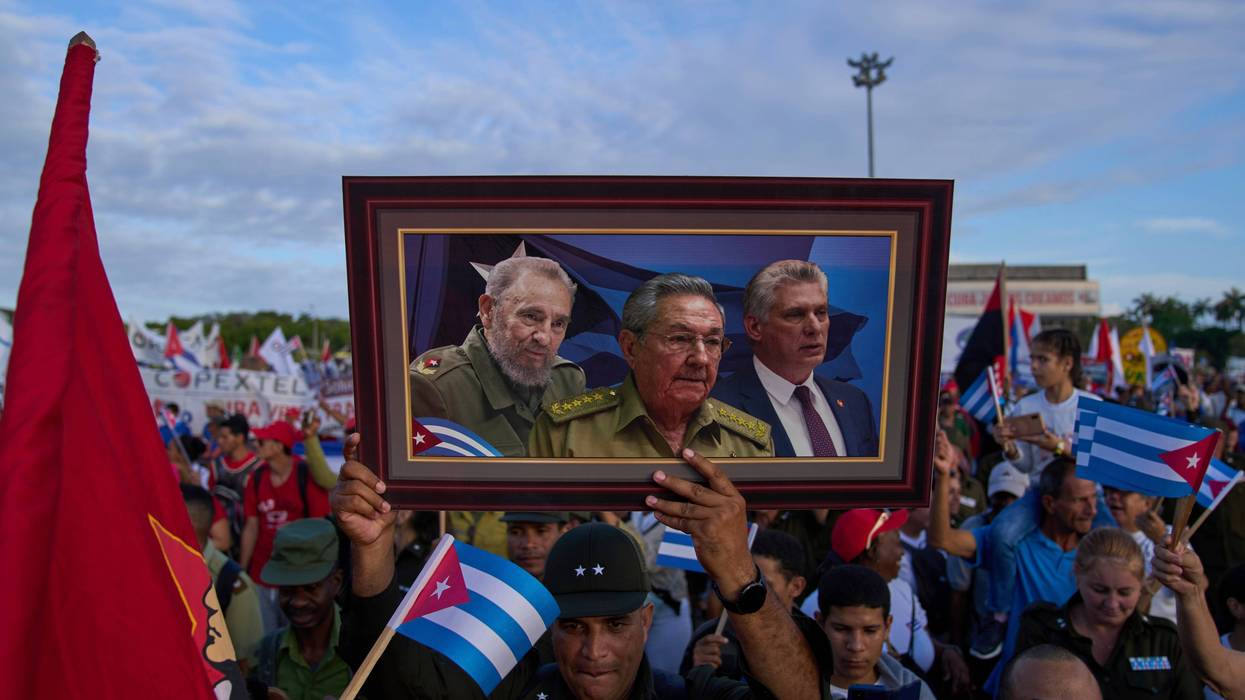
Trump suggests U.S. presidents have mulled intervening in Cuba for decades but ‘it looks like I’ll be the one that does it’
“Other presidents have looked at this for 50, 60 years, doing something,” Trump told reporters during an unrelated environmental event in the Oval Office, when asked Thursday about Cuba. “And, it looks like I’ll be the one that does it. So, I would be happy to do it.”
He added that the U.S. wants to open Cuba “up to Cuban Americans, where they can go back and help.”
Trump didn’t answer questions about the aircraft carrier Nimitz having reportedly entered the southern Caribbean on Wednesday. Nor did he clarify exactly what he meant.
Still, the president’s comments deviated from Wednesday, when the president was asked about a possible U.S. escalation in Cuba and suggested one wasn’t coming.
He called Cuba a failed country and said, “They don’t have electricity. They don’t have money. They don’t have really anything,” before adding, “We’re going to help them along.”
Trump falsely accuses Maryland of election fraud
Trump claimed that Maryland “got caught with 500,000 mail-in ballots that were corrupt,” an allegation he has repeated multiple times in recent days.
That’s not true. The Maryland State Board of Elections said some voters received a primary ballot for the wrong party ahead of the state’s 2026 gubernatorial primary due to a vendor error.
Voters who may have been affected will receive a replacement ballot and any original ballots already sent to election offices will be voided. Voters have been instructed to destroy their original ballots if they have not yet returned them. Safeguards such as unique identifiers on ballot envelopes ensure that each voter can only vote once.
Mark Lindeman, policy and strategy director at Verified Voting, a nonpartisan group focused on election technology, said the error isn’t expected to have much impact given how quickly it was discovered.
Trump begins Oval Office event as he loosens federal rules on grocery store cooling equipment
The president gathered leaders of grocery store chains and retail companies as he moved to loosen a federal rule requiring grocery stores and air-conditioning companies to reduce greenhouse gas emissions from cooling equipment.
Trump said terminating regulations from former President Joe Biden’s administration will “lower costs for consumers, protect hundreds of thousands of jobs, and save Americans well over $2 billion a year.”
Rubio says Trump’s preference is a diplomatic solution with Cuba, but US must preserve its interests
Secretary of State Marco Rubio says the Trump administration is keen to find a diplomatic solution to its differences with the Cuban government, but is not particularly optimistic that one can be achieved.
His comments leave open the option of military action against Cuba, particularly after the indictment this week of former President Raúl Castro on terrorism charges.
“The president’s preference is always a negotiated agreement that’s peaceful,” Rubio told reporters before leaving Miami for a trip to Sweden and India. “That’s always our preference. That remains our preference with Cuba. I’m just being honest with you. You know, the likelihood of that happening, given who we’re dealing with right now, is not high.”
He added that “our preference in Cuba and anywhere in the world is a negotiated diplomatic settlement.”
US Commission of Fine Arts approves Trump’s Washington arch design
The commissioners, all appointed by Trump, approved the triumphal arch design despite overwhelming opposition from the public.
It is one of several projects Trump is pursuing, along with a huge new White House ballroom, to leave his imprint on Washington. The arch itself would stand 250 feet tall (76 meters) from its base to a torch held aloft by a Lady Liberty-like figure on top, flanked by two eagles, all gilded. A proposal for gilded lions to guard the base was dropped.
The vast majority of people submitting public comment complained about the design. The arch would dwarf the nearby Lincoln Memorial.
UN council is urged ‘to use every means at its disposal’ to press Hamas to disarm
Nickolay Mladenov, who is overseeing the U.S.-brokered ceasefire in Gaza, warned the Security Council Thursday that every act of violence there risks “unraveling” the ceasefire. He said Hamas must accept the roadmap to peace and Israel must uphold its obligations.
The high representative for the Board of Peace said the choice before Hamas and Israel is “a deteriorating status quo” or a new beginning for two million Palestinians, now waiting “in desperate conditions.”
“There is no third option,” Mladenov stressed. “There never was, and the people of Gaza should not be made to wait while some pretend there is.”
He went through the 15 points in the roadmap, stressing that the board is not a substitute for Palestinian governance of Gaza.
Rubio says despite ‘good signs’ in Iran talks, ‘other options’ remain on the table
Being careful not to sound overtly optimistic, Rubio told reporters Thursday that while Pakistan and other regional allies are hard at work to bring a diplomatic resolution on Iran, with some officials traveling to Tehran today, Washington remains ready with alternative plans.
“The president’s preference is to do a good deal. That’s his preference. It’s always been his preference. If we can get a good deal done, that would be great,” he said. “But if we can’t get a good deal, the president’s been clear he has other options.”
Rubio says Iran’s plan to toll Strait of Hormuz would make deal ‘unfeasible’
Talking to reporters on the tarmac in Florida, Rubio once again blasted Tehran’s effort to financially benefit from its chokehold on the critical waterway.
“No one in the world is in favor of a tolling system. It can’t happen. It would be unacceptable,” he said. “It would make a diplomatic deal unfeasible if they were to continue to pursue that.”
But the secretary of state added that there were “good signs” in the ongoing negotiations between the U.S. and Iran despite weeks of back-and-forth on a sustainable end to the war between the longtime adversaries.
“I don’t want to get ahead of it ... I think we’ve made some progress,” Rubio said. “But obviously we’re dealing with a system that itself is a little fractured.”
GOP senators huddling with Blanche on Trump ‘anti-weaponization’ fund
Republican senators have some questions for acting Attorney General Todd Blanche as they finalize the text of a $70 billion bill to restore funding to U.S. Immigration and Customs Enforcement and the Border Patrol. The Trump administration wants it to include a $1.776 billion “anti-weaponization” fund as part of a settlement that also absolves Trump and his family from any potential tax law violations.
Senate Majority Leader John Thune said before their meeting with Blanche began Thursday that his fellow Republicans want to make sure the fund is “fenced in appropriately.”
Democrats have an opening because Republicans are trying to pass the bill through a complicated budget process that requires a long series of amendment votes. Among other things, Democrats want to ban any payments to Trump supporters who harmed law enforcement officers in the Jan. 6, 2021, attack on the Capitol.
Rubio says Cuba has ‘always’ been a national security threat
The U.S. secretary of state says Cuba has “always” been a national security threat to the United States.
“Cuba hosts a Russia and Chinese intelligence presence in their country,” Marco Rubio told reporters before leaving Miami for a trip to a NATO foreign ministers meeting in Sweden and then India.
Rubio would not discuss how the U.S. might move to implement the indictment against Castro, which has led many to believe that military action against the island is potentially imminent, after similar charges against former Venezuelan leader Nicolas Maduro were invoked to justify his ouster in a military operation in January.
Facing intense internal pressure, DNC releases post-election autopsy
Democratic National Committee Chair Ken Martin released a critical study of the party’s performance in the 2024 campaign on Thursday after frustrated party operatives publicly demanded the release of the post-election autopsy.
The 192-page report was concluded last December and authored by Democratic consultant Paul Rivera. It calls for “a renewed focus on the voters of Middle America and the South.”
“Millions of Americans are suffering from poor access to healthcare, manufacturing and job losses, and a failing infrastructure, yet continue to be persuaded to vote against their best interests because they do not see themselves reflected in the America of the Democratic Party,” the report says.
Martin is confronting a crisis of confidence among party officials amid increasing concerns about the health of their political machine. “Why not say this in 2024, or bring in more people to finish it, instead of turning this into the dumbest media cycle for 7-8 months?” Democratic strategist Steve Schale wrote in response.
Democrats rally at Capitol against GOP funding bill
House and Senate Democrats gathered on the Capitol steps in opposition to Republicans’ funding bill for immigration enforcement.
Democrats are trying to draw a sharp contrast with the upcoming votes by highlighting how the White House has proposed including $1 billion for security for the White House complex and President Donald Trump’s ballroom. Republicans are abandoning that proposal, but Democrats said Congress should be focused instead on making life affordable for everyday Americans.
“Ballroom Republicans are not working for you, they are busy fighting for Trump,” said Senate Democratic leader Chuck Schumer. “The American people are watching and in November, they will be watching.”
House Democratic leader Hakeem Jeffries, for his part, said “immigration enforcement in this country should be fair. It should be just, and it should be humane.”
Cuban government points to US airstrikes on boats in Latin American waters
Cuba is accusing the Trump administration of hypocrisy for indicting former President Raul Castro in the downing of civilian planes near its coast 30 years ago, noting that the U.S. president is responsible for many more killings of civilians in international waters this year.
“It is highly cynical that this accusation is made by the same government that has murdered nearly 200 people and destroyed 57 vessels in international waters of the Caribbean and the Pacific, far from the territory of the United States,” the Cuban government response said, adding that the killings “qualify as extrajudicial executions, in accordance with International Law, and murders, according to US laws.”
Trump has justified the attacks as necessary to stem the flow of drugs, while offering little evidence that “narcoterrorists” are in the boats.
The Pentagon inspector general announced a review of whether the attacks on alleged drug-smuggling boats followed an established targeting framework, but said it would not probe the legality of the strikes, which have drawn intense scrutiny.
Trump will ease refrigerant rule in effort to address surging grocery costs
The Trump administration is set to loosen a federal rule that requires grocery stores and air-conditioning companies to reduce greenhouse gases used in cooling equipment. The head of the Environmental Protection Agency, Lee Zeldin, said American families will see lower grocery prices as a result. Trump is scheduled to be joined by executives from Kroger, Piggly Wiggly and other grocery chains for Thursday’s announcement.
Just how much or how quickly loosening the refrigerant rule might ease grocery prices is unclear. The 2020 law reflected a broad bipartisan consensus on the need to quickly phase out domestic use of hydrofluorocarbons, or HFCs, that are thousands of times more potent than carbon dioxide and are considered a major driver of global warming.
Timeline of relations between the US and Cuba
Trump has been escalating talk about regime change in Cuba ever since he sent the U.S. military to capture Venezuelan President Nicolás Maduro in January. Now a federal indictment of former Cuban leader Raúl Castro is raising questions about whether Trump might try something similar in Havana.
Here’s a timeline of U.S. relations with the communist-run island, including repeated meetings with Raúl Guillermo Rodríguez Castro, the grandson of Castro known as “Raúlito.”
China opposes US sanctions and pressure on Cuba
“China always firmly opposes illegal unilateral sanctions that lack a basis in international law and have no authorization from the United Nations Security Council and the abuse of judicial measures, and we also oppose external forces exerting pressure on Cuba under any pretext,” Foreign Ministry spokesperson Guo Jiankun said Thursday.
The U.S. should “stop wielding the stick of sanctions and judicial measures” against the country, Guo added. “China firmly supports Cuba in safeguarding its national sovereignty and national dignity and opposes external interference.”
Trump’s proposed Washington arch gets another review
Trump’s plan to build a triumphal arch in Washington is getting a second look from a federal agency that suggested changes before it approved the concept last month.
The proposed 250-foot (76 meter) arch is one of several projects the Republican president is pursuing alongside a White House ballroom to leave his imprint on Washington. Critics of the project, including an overwhelming number of people who submitted public comment in April, said the arch would be taller than any other monument in the capital city and dominate the skyline.
He has said some of his other projects, such as adding a blue coating to the interior of the Lincoln Memorial Reflecting Pool, will beautify the city in time for July 4 celebrations of America’s 250th birthday.
The U.S. Commission of Fine Arts, whose members were appointed by Trump, approved the concept for the arch at its monthly meeting in April. Commissioners are set to consider and possibly vote on updated plans when they meet again on Thursday.
Young Republicans wrestle with their disappointment in Trump and their party
The more than a dozen young Republicans who gathered with beers and brightly colored cocktails at a bar called dEcORa in Kentucky this week were picking apart the presidential administration they welcomed with high hopes last year.
By now, their enthusiasm for Trump had curdled into frustration. What poured out at the bar was a sense that the Republican establishment — which they initially applauded Trump for disrupting, but which some now see him sustaining — had forsaken them.
That festering feeling has widened a generational gap between younger and older conservatives as the party slowly begins to consider a future without Trump in charge.
The Republican primary defeat of Rep. Thomas Massie — who had earned a younger and anti-establishment following while feuding with Trump — cost them one of their strongest allies in Congress.