


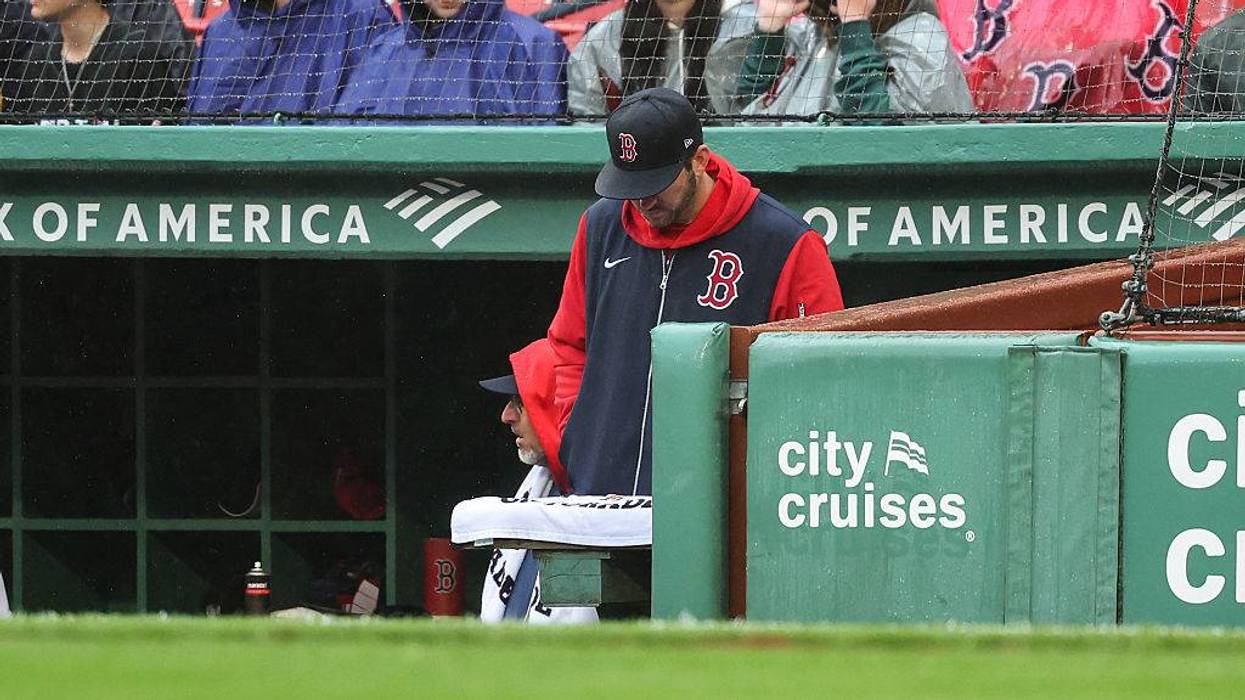

Home hasn’t felt much like home for the 2026 Red Sox.
After Tuesday night’s loss to the Orioles, Boston fell to a major league-worst 9-20 at Fenway Park. It marks the club’s worst record through 29 home games since 1932, when the Red Sox opened 7-22 at home during a 43-win season, the fewest wins in franchise history for a team that played at least 100 games.
Following the loss, which dropped the Red Sox to 4-12 at home since the start of May, veteran infielder Isiah Kiner-Falefa offered an interesting explanation for Boston’s struggles at Fenway this season.
“I just feel like on the road we’re a very close-knit team, we come home, and there’s just a lot of people. It’s different. It’s just a different vibe at home,” Kiner-Falefa said. “We’ve got to figure out a way to make it small like how it is on the road. I just feel like at home, we see a lot of people that we don’t know that are around this area. It’s just a close-knit group. And we were becoming a really close team. We’ve got to find a way to bring that back home.”
Kiner-Falefa has seen plenty of clubhouses during his career. The veteran is in his ninth major-league season and now with his fifth organization.
So what exactly is he talking about?
Red Sox interim manager Chad Tracy joined WEEI’s Rich and Ken with Ted Johnson on Wednesday to help clarify (full interview below)
“Broadly, I just think that there are a lot more people at Fenway,” he said. “It’s a big market, there are a lot of people. You go out for batting practice, there are fans on the field, there are tons of media, that’s part of it here. I do think, and I don’t want to speak for him – it’s not wrong. When you go on the road, you are all together; there is nowhere to go, and you aren’t necessarily rushing to get to your family because it’s just us. You are getting on the bus together to and from the ballpark, and there is a very small contingent of media that’s there; they are in there for 45 minutes. But when you come here, it’s different.”
Red Sox infielder Isiah Kiner-Falefa tried to explain why the team is playing so poorly at Fenway Park, and his response was confusing. Chad Tracy clarified those comments.@richkented @KenLairdWEEI @teddyjradio @heyrichhey @WEEI#RedSox, #MLB, #Baseball pic.twitter.com/kRhbd7lnkB
— WEEI (@WEEI) June 3, 2026
The contrast between the Red Sox at home and on the road has been striking.
Boston is 16-14 away from Fenway, the fourth-best road record in the American League behind the Guardians (18-13), Yankees (19-14), and Athletics (18-14). The Red Sox own a +19 run differential on the road.
At home, that figure drops to -26. Despite playing in one of baseball’s most hitter-friendly parks, Boston ranks last in the majors in both runs scored (92) and home runs (17) at Fenway while batting just .232.
Tracy admitted he didn’t have a definitive answer for why the discrepancy exists.
“As I watched him answer that, there was a long pause before he answered, and I had a similar pause when they asked. Sometimes, you are searching for that answer,” he said. “We all are. We know that we’re a good streak at home away from turning this around. But, sometimes, it’s like that feeling of you are searching for the answer, and you are playing out: what could it be? So we’re always looking at like, how can we do that? But I think broadly, he means it feels smaller on the road, because it is. It just is. When you go to Kansas City or Detroit, or wherever, it’s not Fenway Park, and there is just less going on. But at the same time, we’ve got to find a way to make it small and deal with that ourselves because it’s not going to change.”
So how do the Red Sox make Fenway feel smaller?
“You win some games. You win some games here, and it becomes less of a conversation,” said Tracy. “You come home, and you have a stretch where you win four or five in a row, and everybody stops talking about it. That’s a big part. But I don’t ignore what he says. And I think it’s just extra effort from all of our part to make it mostly about us, our group of 26 that is playing the game that night, and try your very best to eliminate all the other stuff.”
Whether Kiner-Falefa’s explanation is the answer remains to be seen.
What is clear is that the Red Sox are still searching for one.
Until they find it, Fenway Park will remain one of the biggest obstacles standing between the Red Sox and a turnaround.