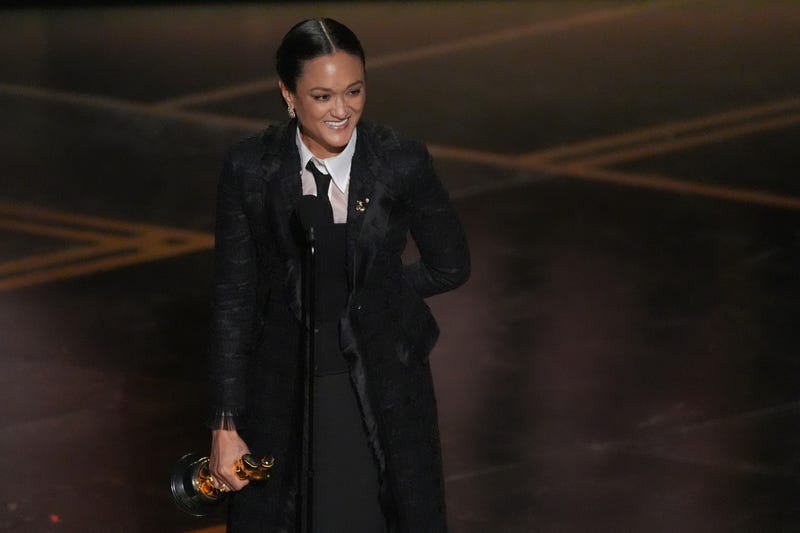
LOS ANGELES (AP) — Autumn Durald Arkapaw became the first woman to win the best cinematography Oscar Sunday. The 46-year-old American was recognized for her work on Ryan Coogler’s “Sinners.”
The profession has come a long way since Arkapaw, whose varied credits include “Black Panther: Wakanda Forever,” “The Last Showgirl” and a Rihanna music video, started exploring cinematography as a career path.
“I’m so honored to be here and I really want all the women in the room to stand up because I feel like I don’t get here without you guys,” Arkapaw told the audience.
Holding her Oscar, she said, “I have felt so much love from all the women on this whole campaign. I feel like moments like this happen because of people like you guys.”
It wasn’t too long ago that she said she struggled to find many women in the field besides Ellen Kuras (“Eternal Sunshine of the Spotless Mind”). Though there are more working today than there were 20 years ago, even Oscar nominations have been few and far between. Only three women before her had been nominated: Rachel Morrison (who worked with Coogler on “Fruitvale Station” and “Black Panther”) was the first for “Mudbound” in 2018, followed by Ari Wegner for “The Power of the Dog” and Mandy Walker for “Elvis.” Arkapaw was the first woman of color to be nominated.
Arkapaw greeted several of her “Sinners” colleagues as she made her way to the stage.
“Whenever I say thank you to Ryan, he replies and says, ‘No, thank you for believing in me and trusting me,’” she said. “He’s a very honorable person and he means it, he really truly means it.”
Arkapaw thanked her husband and parents. Her young son, Aidan, was carried down the aisle to get closer to the stage after she asked out loud where he was.
“This is an honor,” she said before departing.
“Sinners” is project that was already historic for women in cinematography. Before it, no woman had ever shot a movie on IMAX film before.
“I heard a phrase that said you need to see you to be you,” she told The Associated Press last year. “I think for us females in business, the more women are able to shoot on large format, it will inspire the younger girls who maybe don’t think that they can get there.”
A native of Northern California, she studied art history at Loyola Marymount University before attending graduate school at the American Film Institute where she used a background in photography to pursue cinematography.
Arkapaw had shot “Black Panther: Wakanda Forever” on IMAX digital, but film presented its own set of challenges. The cameras are big and loud and have a reputation for being limiting. Before beginning, she consulted with “Oppenheimer” cinematographer Hoyte van Hoytema, who told her not to worry about the size or weight of the equipment and to shoot the movie as she would with any other kind of camera.
“Hearing that straight off was inspiring and encouraging and we took that advice and just told our story,” Arkapaw said. “It was very freeing.”
In the end, they decided to employ a combination of IMAX film and Ultra Panavision 70, an even rarer format that Quentin Tarantino resurrected for “The Hateful Eight.”
One of Arkapaw’s favorite scenes in “Sinners” was one they weren’t even initially going to do on IMAX film because it was dialogue heavy and the cameras are notoriously noisy. But if her work on “Wakanda” taught her anything about Coogler, it’s that he’s always looking to push boundaries.
The scene is the introduction to Jack O’Connell’s Irish vampire Remmick and the Choctaw trying to hunt him down, which they shot like a Western as the sun sets in the distance.
“We had a lot of beautiful crane work in that and some intimate stuff. Ryan loves a hallway, so there’s a Steadicam shot inside. It’s very eerie,” she said. “I can’t see that scene in any other format now.”
___
Associated Press Writer Beth Harris contributed to this report.
___
For more coverage of the Oscars, visit https://apnews.com/hub/academy-awards.