

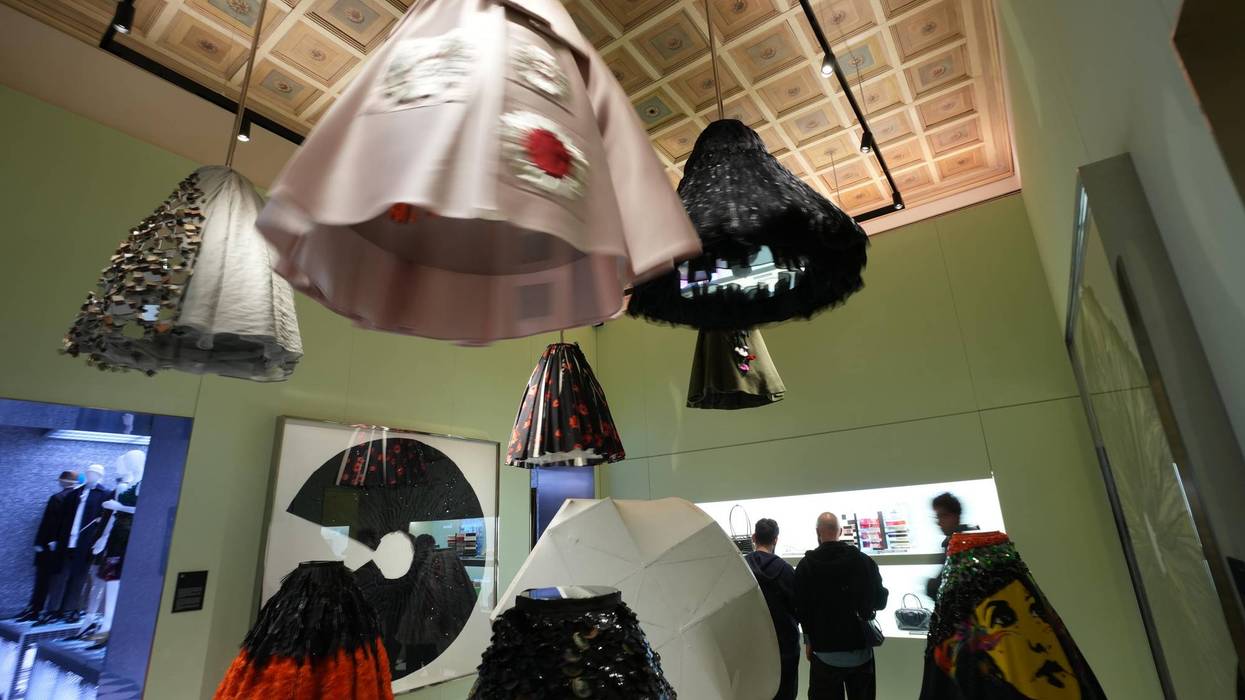

MILAN (AP) — Iconic A-line skirts twirl overhead, silver-covered handbags gleam in a secret underground passage and a spacesuit prototype brings more than a century of fashion history into the future at Prada’s new permanent exhibition in Milan, called “Pradasphere.”
The highly visual journey through the Italian luxury brand’s evolution is connecting Prada aficionados with the fashion house’s heritage in ways that go beyond nostalgia, and already is promising a commercial payoff.
“The exhibition is a multiplier,” said Lorenzo Bertelli, Prada Group's chief group marketing officer.
Prada projects that the Pradasphere exhibition anchoring the brand's expansion in the Galleria Vittorio Emanuele shopping arcade will add 100 million euros ($111 million) in annual revenues, and Bertelli said that target could be surpassed.
Pradasphere is fully booked into the new year and Bertelli said visitors have shown a tendency to spend more after immersing themselves in the brand’s history, sometimes going back to make an additional purchase after walking through the eight Pradasphere spaces.
“We see that the customers who go through the museum have a completely different perspective of the brand and also they browse the store with completely different minds,” said Bertelli, who has been identified as the future leader of the Prada Group. The 38-year-old, whose roles include executive chairman of Versace, is the son of creative director Miuccia Prada and Prada Group chairman Patrizio Bertelli.
Longtime Prada lovers will know that Mario and Martino Prada founded Fratelli Prada in 1913 in the historic Galleria. But they may never have seen in person the luxury bags and accessories, including a pleated evening bag with a devilish head-shaped clasp, its tongue sticking out, a detail that appeared on the Spring-Summer 2024 runway.
And it may be news that the brothers designed the brand’s signature inverted triangle logo.
Miuccia Prada’s third-generation entrance into the family business is announced with trademark nylon bags that she began designing in the 1970s, embodying the Prada high-low, industrial-luxury paradox, and a chocolate brown opera coat from her first runway collection presented in 1988.
The exhibition contains many runway hits, including the 2012 Flame heels and the Formica tile prints that gave birth to Prada’s “ugly chic” reputation, while also highlighting Miuccia Prada’s and the senior Bertelli’s reach into art, architecture, film and sport.
“Curiosity and having fun is what drives my parents,” the younger Bertelli said, adding that experimentation doesn't always bring immediate financial success, “but for sure it drives the enrichment of our story, and our culture and our knowledge.”
He cited as an example investments in sports and engineering made with the formation of the Luna Rossa America’s Cup sailing team in the 1990s, which helped develop the kind of materials expertise that led Prada to collaborate with Axiom Space on a space suit, a prototype of which is displayed at the end of the exhibition.
Prada helped design the suit’s outer layer, which is engineered to withstand extreme thermal conditions, as well as the high-performance inner layer, with a focus on thermal regulation and comfort. It is intended for astronauts walking on the moon on NASA’s Artemis IV mission, targeted for 2028.
Just 20 visitors are admitted to Pradasphere by appointment each hour to explore the compact eight rooms of the exhibition, which Bertelli promises will be in constant evolution.
Prada’s presence in the Galleria now spans eight floors, encompassing the existing Marchesi 1824 pastry shop and Osservatorio Fondazione Prada contemporary art space, alongside the new exhibition, private salon and apartment.
Most visitors end their journey in a secret underground passage connecting the menswear and womenswear boutiques, the latter occupying the original Fratelli Prada premises.
The passage contains “lesser-known” chapters from the brand’s history, including a chandelier dress created for Baz Luhrmann’s “The Great Gatsby.”
“It was a great experience,” said Luca Missio, an architect from the northeastern Italian city of Udine. “I recognized the stores I’ve visited around the world, in Tokyo and New York, in the models and displays. That was lovely.”