TOKYO (AP) — Asian shares were trading mixed Wednesday after Wall Street pulled back from its recent records and as political uncertainty brewed in various regions, including in Iran.
Australia's S&P/ASX 200 slipped 0.1% to 8,798.80 in early trading. Japan's benchmark Nikkei 225 surged 1.6% to 54,413.92 amid speculation that Prime Minister Sanae Takaichi may call general elections soon.
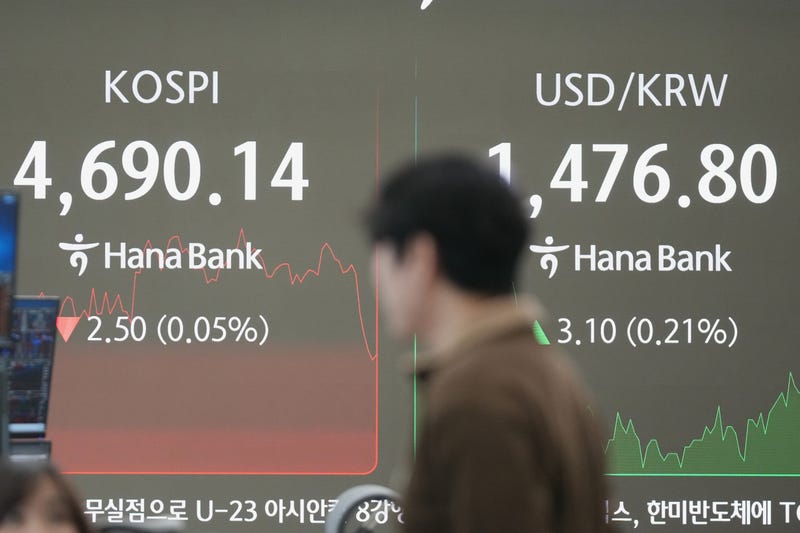
Takaichi met Tuesday with her South Korean counterpart, President Lee Jae Myung, and they committed to working together on economic and security issues. South Korea's Kospi fell 0.1% to 4,687.32 in Wednesday trading.
Hong Kong's Hang Seng added nearly 0.8% to 27,055.14, while the Shanghai Composite jumped 1.2% to 4,187.14.
President Donald Trump announced he would impose a 25% tax on imports to the United States from countries that do business with Iran. The death toll from the latest protests in Iran surpassed 2,500 as of Wednesday, according to activists.
On Wall Street, the S&P 500 fell 0.2% from its all-time high set the day before, following mixed earnings reports from some U.S. companies. The Dow Jones Industrial Average dropped 398 points, or 0.8%, from its own record, while the Nasdaq composite slipped 0.1%.
U.S. companies are under pressure to deliver strong growth in profits to justify the runs to records their stock prices have made. Analysts expect companies in the S&P 500 index will deliver earnings per share for the final three months of 2025 that are 8.3% higher than a year earlier, according to FactSet.
JPMorgan Chase helped kick off the latest reporting season by delivering weaker profit and revenue than analysts expected. Its stock fell 4.2% and was one of the heaviest weights on the market.
The shortfall may have been because some analysts hadn’t updated their estimates to account for an earnings hit resulting from the bank’s purchase of the Apple Card credit card portfolio. CEO Jamie Dimon sounded relatively optimistic about the U.S. economy, saying “consumers continue to spend, and businesses generally remain healthy.”
Delta Air Lines lost 2.4% despite reporting a stronger profit than analysts expected. Its revenue came up short of Wall Street’s expectations, as did the midpoint of its forecasted range for profit in 2026.
On the winning side of Wall Street were several health care companies that raised their financial forecasts at an industry conference with analysts.
Moderna jumped 17.1% for the biggest gain in the S&P 500 after saying it expects to report revenue for 2025 that’s above the midpoint of the range it had forecast in November. It also offered updates on several products, including a seasonal flu vaccine that could see potential approvals beginning later this year.
All told, the S&P 500 fell 13.53 points to 6,963.74. The Dow Jones Industrial Average dropped 398.21 to 49,191.99, and the Nasdaq composite sank 24.03 to 23,709.87.
In the bond market, Treasury yields eased after a highly anticipated update on inflation came in close to economists’ expectations. The data strengthened expectations that the Federal Reserve will cut its main interest rate at least twice in 2026 to shore up the job market.
Lower interest rates could make borrowing cheaper for U.S. households and boost prices for investments, but they could also worsen inflation at the same time. Tuesday’s report showed that U.S. consumers paid prices last month for gasoline, food and other costs of living that were 2.7% higher overall than a year earlier. That’s a touch worse than economists expected and above the Fed’s 2% target for inflation.
The data helped the 10-year Treasury ease to 4.17% from 4.19% late Monday. The two-year Treasury yield, which more closely tracks expectations for what the Fed will do, inched down to 3.52% from 3.54%.
A day earlier, Treasury yields swung amid worries about the Federal Reserve’s worsening feud with Trump. The concern is that the president’s attacks on the Fed could result in a central bank that’s more subservient to the White House. Experts say that in turn could lead to higher inflation over the long term.
In energy trading, benchmark U.S. crude dipped 18 cents to $60.97 a barrel. Brent crude, the international standard, lost 15 cents to $65.32 a barrel.
In currency trading, the U.S. dollar inched up to 159.16 yen from 159.13 yen. The euro cost $1.1645, little changed from $1.1647.
___
AP Business Writer Stan Choe contributed.