

SOUTHFIELD (WWJ) - One local university is giving the public a chance to learn about solar eclipses as well as observe the one in April for free.
Lawrence Technological University will host a free program at 7 p.m. on March 28 called "Eclipse 2024—And Before And After," according to a statement from the University.
Associate Professor of Physics Scott Schneider will be the presenter. "Schneider is well-known on the LTU campus for his astronomy efforts, frequently setting up telescopes on the LTU quadrangle during various celestial events," the statement said.
Southfield won't have a total eclipse, but Schneider said the area will be at 98 or 99% totality.
"There will still be a crescent of the sun that peeks out. We're not sure just how dark that will make things get," Schneider said.
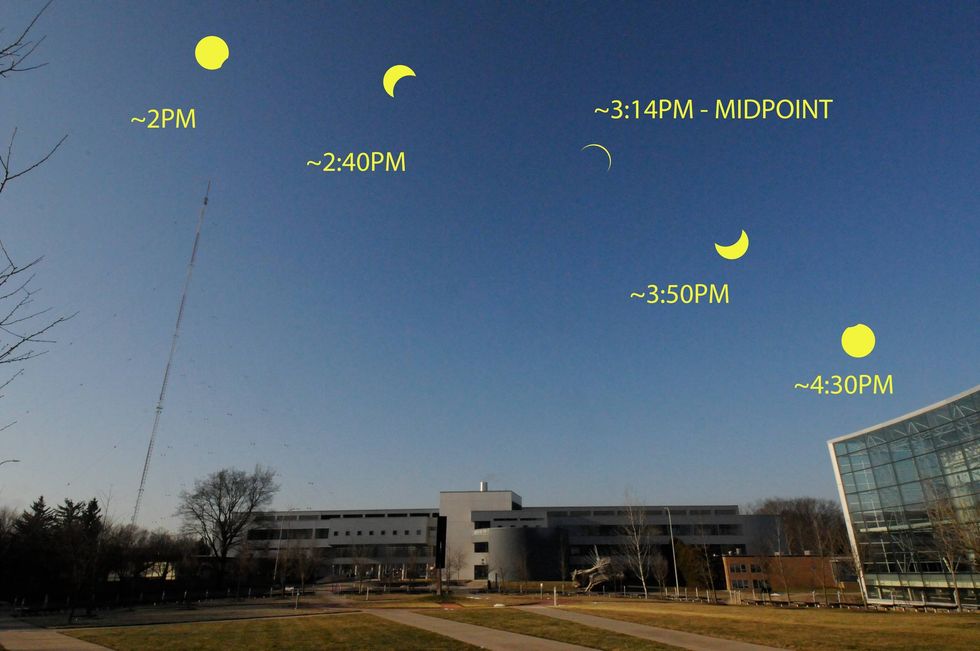 Trajectory of solar eclipseLawrence Technological University
Schneider will be joined by physics professors Bhubanjyoti Bhattacharya, George Moschelli, Valentina Tobos and Changgong Zhou, as well as physics students from LTU, on the afternoon of April 8. Four large telescopes will be set up on the LTU quadrangle for the public eclipse viewing. There will also be several "pinhole camera devices" available for use.
The eclipse will begin at approximately 2 p.m. on April 8 and go until about 4:30 p.m. Peak sun coverage will be at 3:14 p.m.
Schneider said that if it's cloudy, there will be a video feed from locations that have clear skies available in Room S100 in LTU's Science Building.
The LTU physics staff offered a tongue-in-cheek comment to the public to check out eclipses while they can.
"So enjoy the eclipse, while you can," the press release said. "After all, tidal forces are pushing the moon away from Earth by 1.5 inches a year—so in a few hundred million years, the moon will be so much smaller in the sky that we won't get total eclipses at all."
"Eclipse 2024—And Before And After" is March 28 at 7 p.m. It will be in the Marburger Auditorium, Room S100 in LTU's Science Building. It is Building 7 at www.ltu.edu/map. There is a lot of free parking available in Parking Lots D and E. The program and eclipse viewing are both free to the public.
The March 28 program can be livestreamed on LTU's YouTube channel.