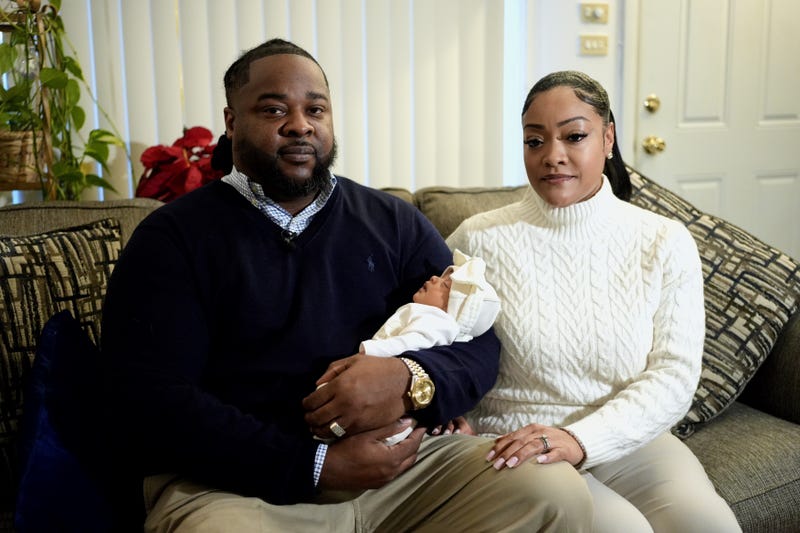
Two pregnant Black women nearly 1,000 miles apart were ready to do what many do every day: welcome new bundles of joy, and just before the start of the holiday season. Instead, the health of both women and their babies was put at risk after hospital staff did not immediately provide the needed care.
One woman was discharged and delivered her baby on the side of an Indiana highway, while the other nearly gave birth in a Texas hospital's emergency waiting room. Both women survived, but are still reeling from ordeals that have drawn national attention — in part, because they were captured on video and shared on social media.
Each instance highlights the long-standing and rising disparities in health outcomes for Black women, who die at a rate nearly 3.5 times higher than white women around the time of childbirth, according to a 2023 Centers for Disease Control and Prevention report.
While maternal mortality rates for white, Hispanic and Asian women fell in 2023, according to the CDC report, the rate for Black women barely budged.
Now, the women’s families, health organizations and civil rights advocates are urging the medical profession to address systemic racism that they say perpetuates Black women's experiences.
‘I felt dismissed’
Mercedes Wells’ water had already broken when a nurse at Indiana's Franciscan Health Crown Point hospital checked on her in triage, a room typically designated for women in earlier trimesters of pregnancy.
Wells, already a mother of three, knew the baby could come at any minute. The nurse did not believe she was going into labor, Wells recalled.
“She still suggested that I be discharged and I begged, ‘No, I can’t be discharged. Please don’t discharge me because I am about to have this baby,’” Wells, 38, told The Associated Press from her Chicago area home in Dolton, Illinois.
“I began to wail because I was in so much pain, and my feelings were hurt because that was happening to me. So I let out a cry, you know? The nurses showed no compassion, none of them,” said Wells, whose experience was captured in a now-viral video of her crying in pain as nurses pushed her toward the exit.
But she was out of time. Wells felt the baby coming.
Her husband, Leon, loaded her into their car and sped away hoping to reach another hospital. Thereafter, in the early morning hours of Nov. 16, he pulled over on a Lake County highway and delivered their daughter.
Wells said the nurses she saw were all white, and all assured her that concerns were relayed to the attending physician.
“I felt dismissed. I felt ignored, disregarded as a whole,” she said. “I’m dealing with this pain, and they’re all watching me from the nurse’s station as if it’s normal to send someone out in that much pain.”
Franciscan Health Crown Point said in a statement that both the nurse and physician involved in Wells’ ordeal were fired and that the hospital has mandated cultural competency training for all labor and delivery staff.
“We must fix what failed in our hospital so that no one experiences what happened to Mercedes Wells,” said Raymond Grady, the hospital’s president and CEO.
Several days before Wells’ ordeal, Kiara Jones and her mother received similar treatment at a Texas hospital.
On Nov. 10, Jones, in active labor at Dallas Regional Medical Center in Mesquite, was visibly distressed and screaming in pain, a now-viral video shared online by her mother shows. Instead of immediately admitting her to labor and delivery, Jones’ family says, staff left her in a triage area for more than 30 minutes.
“Y’all treat all your patients like this or just the Black ones?” Jones' mother asks in the video.
Jones gave birth minutes after she was finally moved to a labor and delivery room.
“Ms. Kiara Jones’ experience during admission, labor, and delivery raises profound and disturbing concerns about Dallas Regional’s policies, practices, staff training, and culture with respect to obstetric care — particularly for women of color,” reads a letter to the hospital from Jones's attorneys, the national civil rights firm Romanucci & Blandin and the Dunk Law Firm.
The incident is under review by the hospital, which also said in a statement to AP that “the safety, dignity, and well-being of our patients are always our highest priorities.”
Texas state Rep. Rhetta Bowers, who is Black, said the hospital provided limited information after she asked for “full answers and real corrective action.”
“The outrage we’re seeing is not just about one horrifying incident; it reflects long-standing inequities in healthcare that Black families have endured for generations,” Bowers said in a statement released last week.
Postdelivery complications
Postpartum care is also an area Black women face challenges in.
Excessive bleeding, blood vessel blockages and infections are leading causes of postpartum maternal deaths. For Black women, not being believed when reporting postpartum discomfort or pain is often also a matter of life or death, advocates say.
Wells, the Illinois mother, was admitted to a different hospital a week after giving birth, after experiencing shortness of breath. Doctors there told her she was experiencing additional pain caused by sitting upright in the car during delivery.
“It was just, I guess, a setback. I was bent over. I couldn’t even walk,” Wells told the AP. “The pain was so bad. I’ve never experienced anything like that, so we had to call the ambulance and they had to get me out of bed.”
Although Wells was discharged 24 hours later, her husband told the AP he remains vigilant about the ongoing impact of her experience at the first hospital.
For Jones, in Texas, several medical tests were required for her and her newborn, according to local press accounts. In one account, her baby was stressed and had an in utero bowel movement, which her family has said was caused by the delay in care.
SisterSong, a southern U.S.-based national reproductive justice collective, found that regardless of income, education level, or how they presented themselves, Black women reported being treated differently from others at their doctors’ offices.
“We’ve seen the wealthiest of people to the most everyday Black woman just trying to live in this country, and unfortunately, their stories are the same,” said Monica Simpson, the organization’s executive director. “They are not trusted or listened to.”
‘There needs to be a big change’
Following her experience, Wells says she distrusts the health care system. Both she and her husband say they now plan to do more research when going to a hospital to ensure “nothing like this or remotely close to this” happens again.
“And we’re going to document everything,” Leon Wells said. “We’re going to come in with expectations that we might be getting treated wrong, because we’re scared from it.”
Some of that fear reflects research showing that implicit bias, false assumptions about pain tolerance and structural racism contribute to slower triage, delayed analgesia and inadequate emergency response for Black patients overall, according to the National Black Nurses Association.
“The situations we see across the country are not accidents, they are symptoms of systemic failures in maternal care. Respectful, timely, lifesaving maternity care is non-negotiable. Hospitals must not only investigate these incidents; they must change,” said Dr. Sheldon D. Fields, the association’s president.
For the Wellses, it comes down to something even more fundamental.
“There needs to be a big change as far as people needing to show empathy,” said Leon Wells. “If you're in this field of caring for others when they need you, care.”