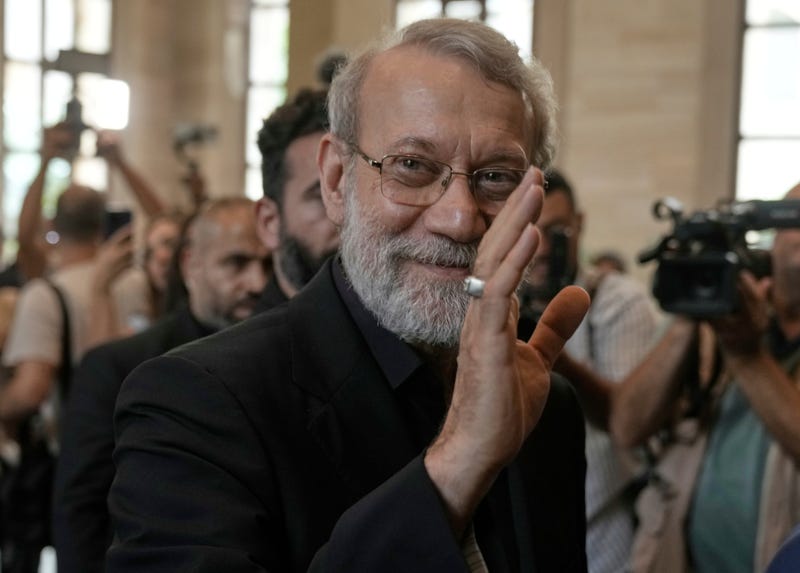
DUBAI, United Arab Emirates (AP) — Ali Larijani, a top Iranian security official, was widely believed to be running the country as it reeled from the killing of its supreme leader and a widening war. Israel said Tuesday that it killed Larijani in an overnight strike.
Israel's military also said it killed Iranian Gen. Gholam Reza Soleimani, who led a powerful internal security force that has crushed waves of mass protests against the Shiite theocracy.
Iran has not yet confirmed or denied their deaths. Supreme Leader Ayatollah Ali Khamenei and other top security officials were killed in the surprise U.S. and Israeli strikes that started the war. Khamenei's son, Mojtaba, who was appointed to replace him, has not been seen in public, and Israel suspects he was wounded.
The killing of top leaders has so far had little impact on the war itself, as Iran's Revolutionary Guard continues to fire missiles at Israel and Arab Gulf countries. Iran has also effectively closed the Strait of Hormuz, through which a fifth of the world's traded oil passes, sending prices up and rattling the world economy.
Israeli Prime Minister Benjamin Netanyahu said the strikes were aimed at weakening Iran's government “to give the Iranian people the opportunity to remove it.” There have been no signs of anti-government protests since the war began, as many Iranians are sheltering from the American and Israeli strikes.
A political veteran with the supreme leader's ear
Larijani hails from one of Iran’s most famous political families, which many media outlets have compared to the Kennedys in the United States. One brother, Sadeq, served as the head of Iran’s judiciary, while another, Mohammad Javad, was a senior diplomat who closely advised the late Khamenei on foreign affairs.
Larijani has been a conservative force within Iran’s theocracy, issuing increasingly hard-line threats throughout the years. In the 1990s, he served as Iran’s culture minister, tightening censorship. He served as parliament speaker from 2008 to 2020, and most recently as head of the Supreme National Security Council.
Larijani has also written at least six philosophy books, including three exploring the works of German philosopher Immanuel Kant.
He was appointed to advise Khamenei on strategy in nuclear talks with the Trump administration and traveled to Oman to meet with mediators just two weeks before the war began. Like other top Iranian leaders, he was under heavy U.S. sanctions and implicated in the violent repression of mass protests in January.
He was ineligible to become supreme leader because he is not a Shiite cleric. But he was widely expected to serve as a top adviser, and many believed he was running the country as U.S. and Israeli strikes have driven Iran's leadership underground.
A week ago, after U.S. President Donald Trump threatened to attack Iran “TWENTY TIMES HARDER” if Tehran stopped oil flowing through the Strait of Hormuz, Larijani responded to him on X.
“The sacrificial nation of Iran doesn’t fear your empty threats. Even those bigger than you couldn’t eliminate Iran,” he wrote. “Be careful not to get eliminated yourself.”
Shadowy leader of the ayatollahs' shock troops
Less is known about Soleimani, who led Iran’s paramilitary Basij, an all-volunteer force fiercely loyal to the Islamic Republic. He is not related to Gen. Qassem Soleimani, Iran's top general who was killed in a U.S. strike in 2020.
An Israeli military official, speaking on condition of anonymity in line with regulations, said Soleimani was killed in a combat tent alongside other Basij commanders, who were using it as makeshift headquarters as Israel has targeted several of their bases.
Gen. Gholam Reza Soleimani was born in the mid-1960s in the western Iranian city of Farsan. He first joined the Basij as a volunteer in 1984 during the Iran-Iraq war, when it was notorious for launching human wave attacks at fortified Iraqi positions. He became the commander of the Basij in 2019.
The Basij numbers in the hundreds of thousands, and includes military-style brigades, anti-riot police and a vast network of informers who spy on Iranian society. During protests, plainclothes members can often be seen attacking, beating and hauling away demonstrators.
Soleimani has been under U.S. and international sanctions since 2021 connected to his involvement in crushing protests going back to the disputed presidential election of 2009. The U.S. Treasury said the Basij killed “hundreds of Iranian men, women and children” when it cracked down on protests in 2019.
Thousands were killed and tens of thousands detained in January when Iranians again rose up. It was the bloodiest such crackdown since the 1979 Islamic Revolution and caught the attention of Trump, who threatened to intervene on the protesters' behalf before shifting his attention to Iran's nuclear program.
___
Lidman reported from Tel Aviv, Israel and Spike from Budapest, Hungary.