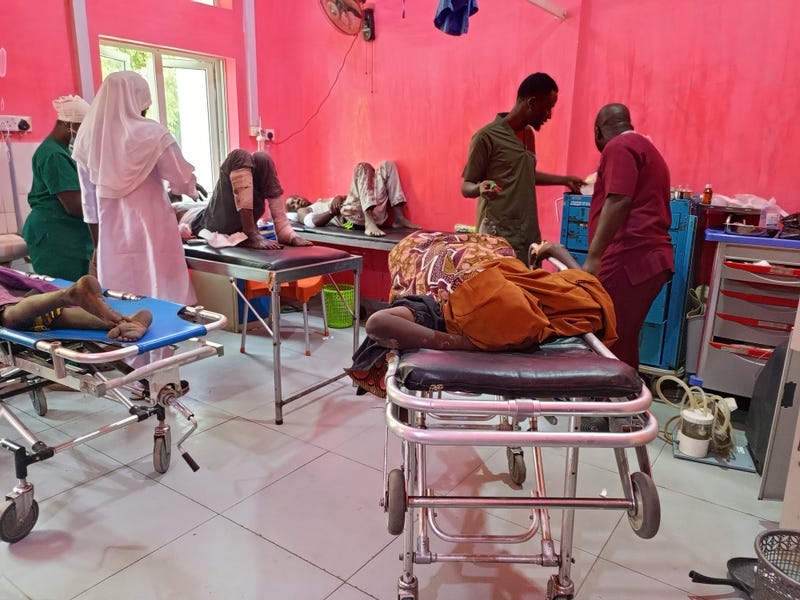
MAIDUGURI, Nigeria (AP) — Three suspected suicide bombings have killed at least 23 people and wounded 108 others in northeastern Nigeria, police said Tuesday. It was one of the deadliest attacks targeting the city of Maiduguri in recent history.
Residents and emergency services earlier told The Associated Press that the explosions were reported on Monday night in crowded places in Maiduguri, the capital of Borno state, including at a major market and the entrance of the University of Maiduguri Teaching Hospital.
The wounded "sustained varying degrees of injuries,” Borno police spokesperson Nahum Kenneth Daso said in a statement, which blamed the attacks on suspected suicide bombers.
President Bola Tinubu, who left the country on Tuesday for a two-day state visit to the United Kingdom, expressed his condolences for the victims and directed security chiefs to “take charge of the situation" in Maiduguri.
“The Monday attacks were desperate acts of the evil-minded terrorist groups," Tinubu said. "Our gallant military and civilian task forces will curtail and put them down.”
No group has claimed responsibility for the attacks, but suspicion quickly fell on the Boko Haram jihadi group, which in 2009 launched an insurgency in northeastern Nigeria to enforce their radical interpretation of Shariah, or Islamic law.
Boko Haram has since become stronger, with thousands of fighters and different factions, including the Islamic State West Africa Province, which is backed by the Islamic State group.
Near simultaneous blasts
The first explosion was recorded at about 7:30 p.m. at the entrance of the teaching hospital, while the second and third blasts followed a few minutes later at the popular Monday Market and nearby Post Office business hub, both located about 4 kilometers (2½ miles) from the hospital.
Witnesses recounted the chaos that followed at the scenes and at hospitals, as security forces and emergency services quickly intervened.
Caleb Jonah, a survivor of the explosion at the hospital entrance, told the AP that he sustained injuries to his legs and hands.
“I was coming to the hospital to check (in on) a patient when I saw two men struggling with the security men at the gate,” Jonah said. “Before I could process what was going on I heard the deafening blast and I passed out."
Another resident, Mamman Usman, 52, said that his younger brother who worked at the Monday Market was about to close his stall when the blast occurred.
“He was badly injured and rushed to the hospital unconscious,” Usman said.
Mohammed Hassan, a member of a volunteer group assisting security forces in fighting extremists said the attack was one of the deadliest in Maiduguri in years and that hospitals were “in dire need of blood” to treat victims.
Heavy security deployed
Maiduguri has been at the heart of deadly violence in Nigeria in the past, but has experienced relative peace in recent years, even as the countryside is often battered by extremists.
The attack took place less than 24 hours after the Nigerian military repelled attacks by militants on the outskirts of Maiduguri, in what some residents say could have been planned as a distraction.
By Tuesday morning, there was a heavy security deployment in the affected locations and along major roads in the city. Many public places remained closed amid heightened fear.
“Investigations are ongoing to further ascertain the circumstances surrounding the incidents and to bring perpetrators to justice,” the Borno police command said.
Jihadi attacks intensifying
Extremists have intensified their attacks against Nigerian military bases in recent weeks, killing several senior officers and soldiers, and stripping the bases of stocks of weaponry and ammunition.
The multiple attacks could be seen as a major victory for the jihadis in a city seen as impregnable, despite attackers often targeting troops and villages on the outskirts of the city.
Last year, an apparent suicide attack killed five at a mosque on Christmas Eve in the city last year.
“Maiduguri being attacked is like an insult for the security forces ... and for the (jihadi) groups, it is symbolic because it shows nowhere is out of their reach,” said Malik Samuel, a Nigerian security researcher with Good Governance Africa.