

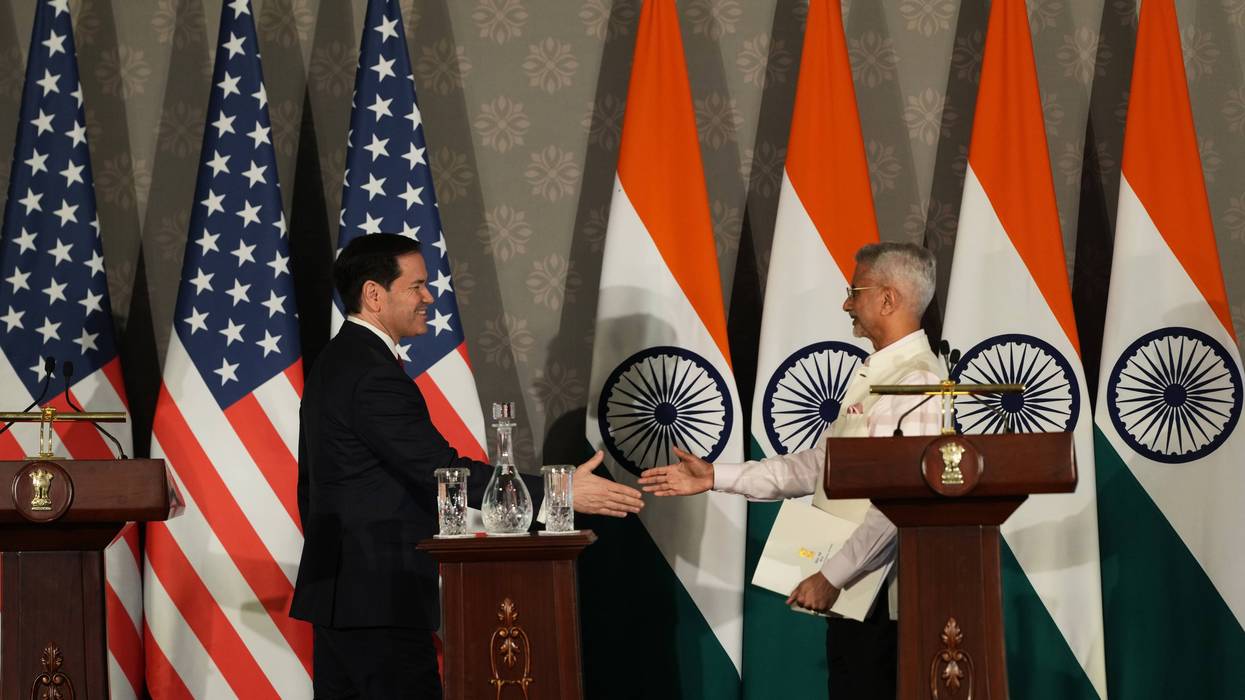

NEW DELHI (AP) — U.S. Secretary of State Marco Rubio held bilateral talks with his Indian counterpart Subrahmanyam Jaishankar on Sunday as the two countries look to steady ties that have fallen to their lowest point in over two decades.
Rubio's first official visit to the South Asian country came amid an economic and diplomatic downturn between the United States and India, largely strained by U.S. President Donald Trump’s tariff policies, which raised duties on several Indian exports.
Rubio is set to meet in New Delhi on Tuesday his counterparts from India, Australia and Japan, members of the Indo-Pacific strategic alliance known as the Quad.
India is a US strategic partner, Rubio says
Rubio and Jaishankar held a joint press briefing after Sunday’s initial round of talks. They reiterated their aim to deepen the U.S.-India strategic partnership while pursuing their respective national interests.
The U.S. top diplomat said that India is one of the most important strategic partners of the United States and expressed optimism about finalizing a bilateral trade deal soon. “I don’t view our relation with any country in the world as coming at the expense of our strategic alliance with India,” he said, adding that he hoped that India-U.S. relations would come out much stronger in the coming years.
Rubio stressed that the Trump administration’s trade decisions were of a global perspective to serve the U.S. economy, rather than targeted at New Delhi. “There virtually is no country in the world that I could travel to that isn’t going to raise the issue of trade because we did this from a global perspective.”
Jaishankar said the U.S.-India strategic partnership exists because of a “convergence of national interests" in multiple areas.
“Trump administration has been very forthright in putting forward its foreign policy outlook as America first. ... We have a view of India first. So both of us are obviously driven by our respective national interests,” he said.
The Indian foreign minister also said his country sought dependable, multiple and cheap energy sources for its 1.4 billion people.
“The United States fits the bill in many respects. So do some other countries. So, we will continue to diversify and maintain multiple sources of supply at the most reasonable cost,” Jaishankar said.
India has recently made a notable shift by wrapping up a series of trade deals: three in 2025 with Oman, New Zealand, and the UK. This was followed by an agreement with the European Union in January, which represents a third of global trade.
On tensions in the Strait of Hormuz, following the U.S.-Israel attacks on Iran that sparked a war in the region, spiking oil prices and disrupting supply chains, Jaishankar said India and the U.S. are keen on keeping global maritime trade safe and uninterrupted, while ensuring fuel remains affordable and widely available.
He said India's approach is to diversify its energy sources so that energy markets stay open and unconstrained, with prices kept low to support global economic growth.
Rubio's four-day visit includes a multicity tour and a gala reception in New Delhi marking the 250th anniversary of U.S. independence.
India and US have different priorities but shared concerns
“In the past one year, statements and rhetoric coming from Washington on some of India’s most sensitive security concerns and trade matters have not been helpful and have created a trust deficit,” said Ashok Malik, a former policy adviser in India’s Foreign Ministry.
“Certain misgivings will remain,” Malik added, noting Rubio’s visit will be considered an achievement if the talks somewhat stabilize the relationship and check further deterioration.
Experts say friction exists between U.S. global strategic ambitions and India’s priorities as an emerging middle power. Historically close to Russia, New Delhi has long expressed unease as it moves closer to the U.S., reflecting India's lingering distrust of American intentions rooted in cultural differences and Cold War-era instincts.
Still, India-U.S. ties steadily deepened over two decades into a broad, robust strategic partnership, increasingly shaped in recent years by shared concerns about China’s growing assertiveness in the Indo-Pacific and articulated diplomatically through the Quad forum.
The Quad has repeatedly accused China of flexing its military muscles in the South China Sea and aggressively pushing its maritime territorial claims. Beijing maintains that its military is purely defensive to protect what it says are China's sovereign rights and calls the Quad an attempt to contain its economic growth and influence.
After the U.S. presidential inauguration in January 2025, Rubio’s first formal international engagement was meeting with the foreign ministers of the Quad countries jointly and in separate sessions.
Tensions build up over conflict with Pakistan and Russian oil purchases
Despite close ties and often being perceived as ideological allies, Indian Prime Minister Narendra Modi downplayed Trump’s role in brokering a ceasefire after a brief India-Pakistan military conflict triggered by the April 2025 massacre of mostly Hindu tourists in Indian-controlled Kashmir. But Pakistan openly courted Trump and even advocated for him to receive the Nobel Peace Prize.
Economic tensions followed, with the Trump administration imposing tariffs on India over its discounted purchases of Russian oil, further straining ties between the two countries.
“In India, there is some skepticism about U.S. policy and predictability,” said Malik, who heads the India chapter of The Asia Group advisory firm in the U.S. He said what has happened in the past year between India and the U.S. “can’t be forgotten or erased easily.”
When the Iran war broke out in February, the U.S. stepped up engagement with Pakistan, which positioned itself as a mediator between Washington and Tehran, deepening unease in New Delhi. Trump’s recent, high-profile visit to China has only added to India’s discomfort.
India-U.S. relations are challenging “due to a few structural tensions and Trump only brought them to the fore,” said Praveen Donthi, a senior analyst with the International Crisis Group.
“New Delhi’s foreign policy, increasingly colored by its domestic politics, has become more black-and-white in the last decade, as evidenced by its deep discomfort with the U.S.’s ties with Pakistan and its moves toward detente with China,” Donthi said.
Experts say these shifts reflect the growing complexity of India-U.S. relations, rooted in shared strategic interests, yet increasingly shaped by competing priorities and a shifting geopolitical landscape.
“New Delhi is likely to exercise strategic patience and wait for Trump to leave office,” Donthi said. “India would hope that the bipartisan consensus on India in the U.S. survives his term and that it can start building on that again.”
___
Hussain reported from Srinagar, India.