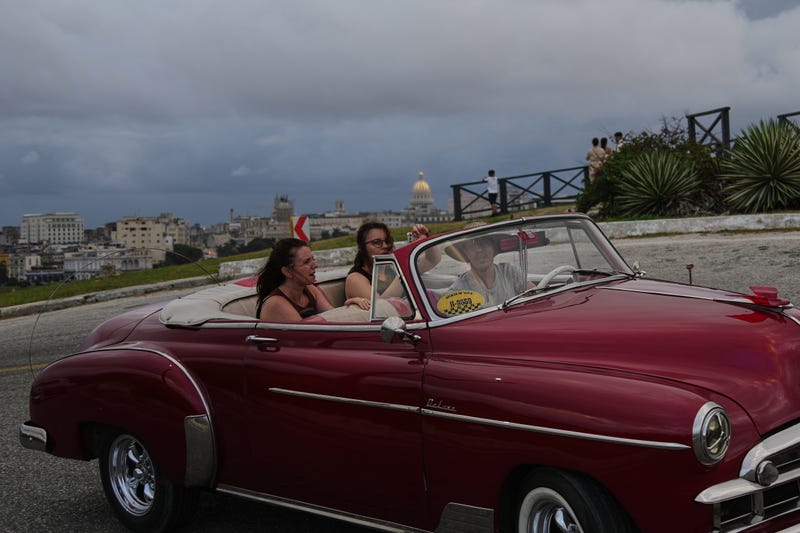
HAVANA (AP) — It’s almost noon in Havana when a handful of tourists tumble out of a small yellow bus and rush toward a row of shiny classic cars, cameras in hand.
Nearby, under the shade of a beach almond tree, a group of drivers jump to their feet, some hoping for their first customer of the day.
But the tourists take a couple of quick selfies in front of brightly colored cars ranging from a 1950 Pontiac to a 1960 Buick and walk away.
“This is grim,” said Reymundo Aldama, who drives a bubblegum pink 1957 convertible Ford Fairlane. “We’re waiting for them to come, we’re waiting for work.”
Tourism in Cuba is plummeting at a time when the island desperately needs that revenue, with the number of visitors dropping by more than half since 2018. For almost two decades, a steady stream of visitors sparked a boom in tourism, only for the COVID-19 pandemic and severe blackouts to hit, coupled with increased U.S. sanctions.
Now, Cubans whose livelihood depends on tourism are among those suffering the most as the island braces for what experts warn could be a catastrophic economic crisis following a disruption in oil shipments from Venezuela after the U.S. attacked the South American country and arrested its president.
The situation is already acute for Rosbel Figueredo Ricardo, 30, who sells a popular Cuban street food known as “chivirico,” fried flour chips sprinkled with sugar.
He used to load 150 bags of chips every morning onto a plastic tray he balances on his shoulder and sell out by late afternoon. Nowadays, he only loads 50 bags a day, works from dawn until nighttime and sometimes doesn’t sell a single bag.
“I’m a mid-level industrial mechanical technician, and look at me here,” he said.
Figueredo has a partner and three children, with a fourth one on the way, so he frets.
“This is our day-to-day, so we can eat,” he said.
On a recent afternoon, unable to find any tourists near Havana’s famed seawall, he walked toward the Spanish embassy, hoping that some of the dozens of Cubans who line up daily seeking a visa to leave the island will buy from him.
‘A brutal drop’
For decades, tourism generated up to $3 billion a year for Cuba.
Visitors would pack into restaurants, crowd along Havana’s seawall and gather at imposing monuments and state buildings. The constant flow of passengers boosted employment and led to the opening of hundreds of small businesses including hostels and restaurants.
Nowadays, the seawall is dotted mostly with Cuban couples or fishermen hoping to catch their next meal.
Nearby, tablecloths at empty seaside restaurants flutter in the wind while employees clutch menus and scan the horizon for customers that never arrive.
Some 2.3 million tourists visited Cuba from January to November 2025, significantly lower than the 4.8 million in 2018 and the 4.2 million in 2019, before the pandemic hit.
Some Cubans worry that growing tensions between the U.S. and Cuba, cuts in water and power supply and large piles of garbage in popular tourist areas have spooked visitors.
The dramatic drop in tourists hits especially hard because U.S. sanctions stripped Cuba of nearly $8 billion in revenue from March 2024 to February 2025, a loss that is nearly 50% higher compared with the previous period, according to government statistics.
On a recent afternoon, only three people boarded a double-decker tourism bus driven by Gaspar Biart.
He’s been driving for 16 years and recalled with a small smile how crowded buses would get.
“There’s been a huge change,” he said, noting that sanctions imposed by U.S. President Donald Trump have closed Cuba’s doors. “We can’t even breathe.”
When tourism was booming and petroleum was flowing, eight double-decker sightseeing buses would make three trips a day across Havana. Now, there are only four, and most are largely empty when they take off, Biart said
“What we’re missing are customers,” he said. “That’s what all Cubans want…Tourism is a driving force for a country’s economy.”
Long lines used to form near the rows of classic cars awaiting passengers. There was so much demand that sometimes tourists would have to take whatever car was available, not the make and model they preferred.
Aldama, who drives a classic car, recalled how he would sometimes work until 9 p.m. Nowadays, he’s lucky if he takes one or two tourists for a spin in a day.
He blames Trump, who in June 2019 banned cruise ships from visiting Cuba, one of the most popular forms of travel to the island.
That led to what Aldama described as “a brutal drop” in tourists that he says has worsened in the past six months.
He used to charge $50 for a drive around the capital. Now, given the lack of demand, he has lowered his price to $25 and even $20 if a tourist insists on bartering.
“The day that we run out of fuel, we’ll stop driving and look for another job,” Aldama said. “There’s no other choice.”
‘Political craziness’
On a recent sunny afternoon, Vincent Seigi of Russia relaxed on a wooden bench and faced the deep blue sea and Cuba’s imposing Morro Castle built during the colonial era.
He scraped the white fleshy meat off several coconuts along with two friends.
He had only been in Cuba for two days.
“I expected it to be a little bit chaotic, not so maybe tourist friendly because of the complicated economic situation,” he said. “It’s kind of like time is a bit stopped here.”
Seigi said he wasn’t worried about the chronic blackouts and garbage galore but said it was strange not having a mobile connection.
He worried that what he was observing in Cuba could soon happen in Russia.
“Politics is not great, to say it lightly,” he said. “We have many sanctions already because of political craziness.”
With Venezuela, Cuba’s strongest political and economic ally vanished for now, some wonder whether China or Russia would step in.
“I think our country now is only able to provide rhetorical help,” he said, like making statements that the U.S. is bad for Cuba. He added that he doesn’t believe Russia has any resources to offer and that it’s struggling already to win the war against Ukraine.
Seigi said it felt like some Cubans were desperate to make money off tourists, with some selling expensive cigars claiming they came from a festival sponsored by former President Raúl Castro. “So many poor people, sadly,” he said
Meanwhile, Brazilian tourist Gloraci Passos de Carvalho, a teacher, said she had long been curious about Cuba’s political and educational system and was not spooked by the island’s deepening crisis or the ongoing tensions with the U.S.
She said she was struck by Cuba’s welcoming atmosphere, architecture, but above all, its resilience.
“It’s a lesson for people, to survive with less,” she said. “In Brazil we call it making lemonade out of lemons…So I see it in that sense, I see it in a positive light.”
___
Follow AP’s coverage of Latin America and the Caribbean at https://apnews.com/hub/latin-america