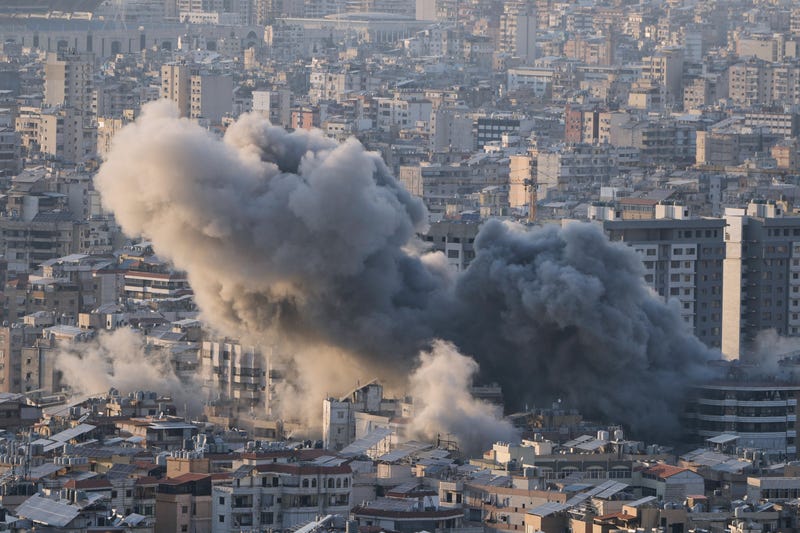
DUBAI, United Arab Emirates (AP) — Iran’s attacks on oil infrastructure and pledges to choke off a vital waterway left markets on edge Tuesday as the United States promised blistering new strikes. The war entered its 11th day with no end in sight as its effects were felt across the Middle East and beyond.
Both sides sharpened their rhetoric as they dug in, with U.S. Defense Secretary Pete Hegseth again promising the most intense strikes yet, while Iran's leaders ruled out talks and threatened U.S. President Donald Trump.
Iran launched new attacks against Israel and Gulf Arab countries, while Israel carried out waves of airstrikes on Iran and Lebanon, where it is battling Hezbollah militants.
Residents of Tehran said they had experienced some of the heaviest strikes of the war, leading to electricity cuts in many neighborhoods of the capital. One resident said his area shook for a half hour from strikes overnight and into Tuesday.
A 27-year-old mother of a toddler said she witnessed a residential building get hit. She and others reached by The Associated Press spoke on condition of anonymity to prevent reprisals. Tens of thousands of Iranians have sought shelter in the countryside.
Death toll rises in the Gulf
The United Arab Emirates reported two more deaths as nine drones struck the country, while nearly three dozen other drones and missiles were intercepted. Firefighters battled a blaze in the industrial city of Ruwais — home to petrochemical plants — after an Iranian drone strike, officials said. No injuries were reported there.
Iranian attacks on the wealthy Gulf country — home to the business and travel hub of Dubai — have killed six people and wounded 122 others since the U.S. and Israel launched a surprise bombardment of Iran on Feb. 28.
In Bahrain, authorities said an Iranian attack hit a residential building in the capital, Manama, killing a 29-year-old woman and wounding eight people. Bahrain's Defense Ministry says it has intercepted over 100 ballistic missiles and 175 drones since the war began.
Sirens also sounded in Jerusalem, and sounds of explosions could be heard in Tel Aviv as Israel’s air defenses worked to intercept barrages from Iran. Hezbollah, which began firing on Israel after the start of the war, launched missiles into Israel.
US and Iranian leaders trade threats
At the Pentagon, Hegseth warned that Tuesday “will be yet again our most intense day of strikes inside Iran: The most fighters, the most bombers, the most strikes, intelligence more refined and better than ever.” He added that the last 24 hours had seen the fewest Iranian missiles fired since the start of the war.
Gen. Dan Caine, chairman of the Joint Chiefs of Staff, said U.S. forces hit more than 5,000 targets.
The Pentagon separately said Tuesday that about 140 U.S. service members have been wounded since the start of the war. It said the “vast majority” of the injuries were minor, with 108 service members having already returned to duty. Eight U.S. service members have been “severely injured,” and seven have been killed.
Iran's leaders have remained defiant after days of heavy strikes targeting the country's leadership, military, ballistic missiles and disputed nuclear program. Iran's parliament speaker, Mohammad Bagher Qalibaf, said on X that Iran was “definitely not looking for a ceasefire.”
“We believe that the aggressor should be punched in the mouth so that he learns a lesson so that he will never think of attacking our beloved Iran again,” he said.
A top Iranian security official, Ali Larijani, appeared to threaten Trump himself, writing on X that “Iran doesn’t fear your empty threats. Even those bigger than you couldn’t eliminate Iran. Be careful not to get eliminated yourself.” Iran has been accused of plotting attempts to kill Trump in the past.
Attacks on oil aimed at pressuring the US
Iran has repeatedly targeted energy infrastructure with attacks that appear aimed at generating enough global economic pain to pressure the U.S. and Israel to end their strikes. It has also fired on Israel and U.S. military bases in the region.
Brent crude, the international standard, spiked to nearly $120 on Monday before falling back but was still at around $90 a barrel on Tuesday, nearly 24% higher than when the war started on Feb. 28. The Dow Jones Industrial Average drifted lower initially on Tuesday, but turned positive as oil prices sank and hopes rose that wealthy industrialized countries could tap into strategic reserves.
Iran has effectively stopped tankers from using the Strait of Hormuz, through which 20% of the world’s oil is carried. Attacks on merchant ships near the strait have killed at least seven sailors, according to the International Maritime Organization.
Iran’s paramilitary Revolutionary Guard said it “will not allow the export of even a single liter of oil from the region to the hostile side and its partners until further notice.”
Trump warned on social media that “If Iran does anything that stops the flow of Oil within the Strait of Hormuz, they will be hit by the United States of America TWENTY TIMES HARDER than they have been hit thus far.”
A bulk carrier likely came under attack on Tuesday off the coast of the United Arab Emirates, with the captain reporting a splash and a loud bang nearby, according to a monitoring center run by the British military.
Amin Nasser, the president and CEO of Saudi Arabia’s oil giant Aramco, said tankers were being rerouted to avoid the strait, and that its East-West pipeline would reach its full capacity of 7 million barrels a day being brought to the Red Sea port of the Yanbu this week.
“The situation at the Strait of Hormuz is blocking sizable volumes of oil from the whole region,” he said. “If this takes a long time, that will have serious impact on the global economy.”
Hundreds of thousands displaced by fighting
The U.N. refugee agency said Tuesday that more than 667,000 people in Lebanon had registered as displaced — an increase of over 100,000 since a day earlier — and more than 85,000 people from Lebanon, mostly Syrians, had entered neighboring Syria.
The British government said the number of commercial flights from the UAE to the U.K. is returning to normal levels, with 32 flights operated from Dubai to Britain on Monday and another 36 scheduled Tuesday.
However, British Airways said it has suspended flights to and from Jordan, Bahrain, Qatar, Dubai and Tel Aviv until later this month.
Many foreign nationals have been getting out of the Persian Gulf region: Over 45,000 U.K. citizens have returned from the area since the conflict began, the British Foreign Office said, and some 40,000 people returned to the United States, according to the State Department.
Since the war began, at least 1,230 people have been killed in Iran, at least 397 in Lebanon and 12 in Israel, according to officials. Seven U.S. service members have been killed.
___
Magdy reported from Cairo, and Keaten reported from Geneva. Associated Press writers Qassim Abdul-Zahra in Baghdad, David Rising in Bangkok, Melanie Lidman in Tel Aviv, Israel, and Toqa Ezzidin and Fatma Khaled in Cairo contributed to this story.