

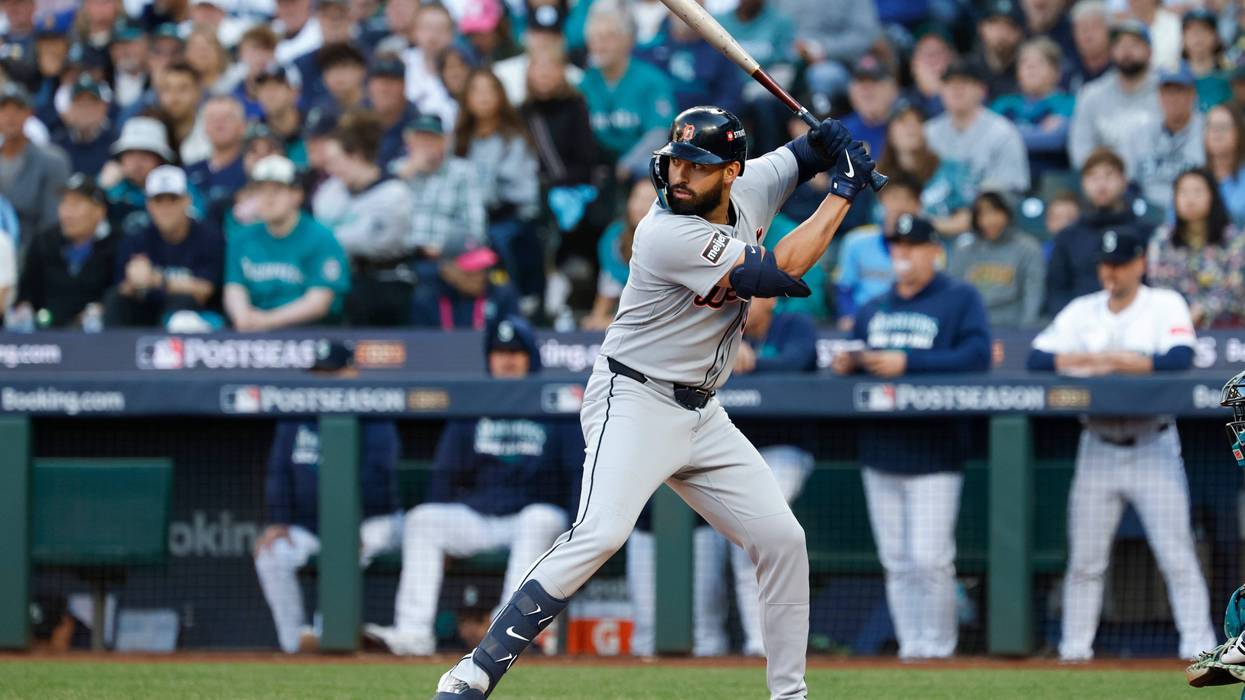

On one hand, Riley Greene is coming off the best offensive season of his career. He piled up 36 homers and 111 RBI last year, both career highs and top-five marks in the American League.
On the other, he set the Tigers' single-season franchise record with 201 strikeouts, most in the American League. While it might have been the most prolific season of Greene's young career, it wasn't his most valuable.
"The good things were good," Greene said Saturday in Lakeland. "Obviously the strikeouts were the big thing, and the walks were down."
Greene is sticking with his swing, aside from a few mechanical tweaks that he said will be too small to even notice. It's his approach that he plans to adjust. He started that process this offseason by having more "competitive" sessions in the hitting cage, instead of the "feel-good days," as Greene likes to call them, where "we just take some BP right down the middle and hit a bunch of homers."
Greene and his personal hitting coach cranked up the velocity on the pitching machine, mixed in more curveballs and changed the location of the pitches up and down in the zone to force him to be more selective. At times last season, especially in the second half, Greene's eyes got too big at the plate. He believed he could hammer everything, especially when he was feeling good. His strikeout rate spiked to 30.7 percent, and his walk rate plummeted to 7.0 percent.
"And it looked like it," he said. "I was swinging at everything trying to hit a homer. So we worked on that, just the mental side of things, picking and choosing your spots: 'Hey, if you have two strikes with a runner on second, maybe try not to hit a homer 5,000 feet.' It was just mental stuff like that, taking a step back, letting the game slow down and recognizing the situations. Obviously there's points where you can take your shot, and there's points where, 'Hey, let's maybe choke up, let's do some work in the box.'"
Greene's issues were concentrated in the second half. He arrived at his second straight All-Star Game hitting .284 with an .879 OPS. He hit .218 with a .694 OPS the rest of the way, and was worse in the playoffs as the Tigers lost in Game 5 of the ALDS for the second season in a row.
The strikeouts are an inevitable tradeoff for Greene's power. But it doesn't have to be so extreme. When he made his first All-Star Game in 2024, Greene had a chase rate of 23.1 percent -- one of the better marks in the bigs -- and finished the season with 27 homers, an OPS of .827 and a strikeout rate of 26.7 percent.
His chase rate last year jumped to 31.2 percent, one of the worst in the bigs. The homers and whiffs jumped, too, and Greene's OPS dropped to .806 -- still very good, but not elite.
The idea isn't to be more passive at the plate, but more disciplined. If Greene gets into good hitting counts, he'll get good pitches to hit. His talent should take care of the rest.
"Obviously it showed last season that I was trying to hit a homer every single time, and it happens," said Greene. "You feel so good and you feel like you can do anything, but you gotta slow the game down and change it up a little bit."