

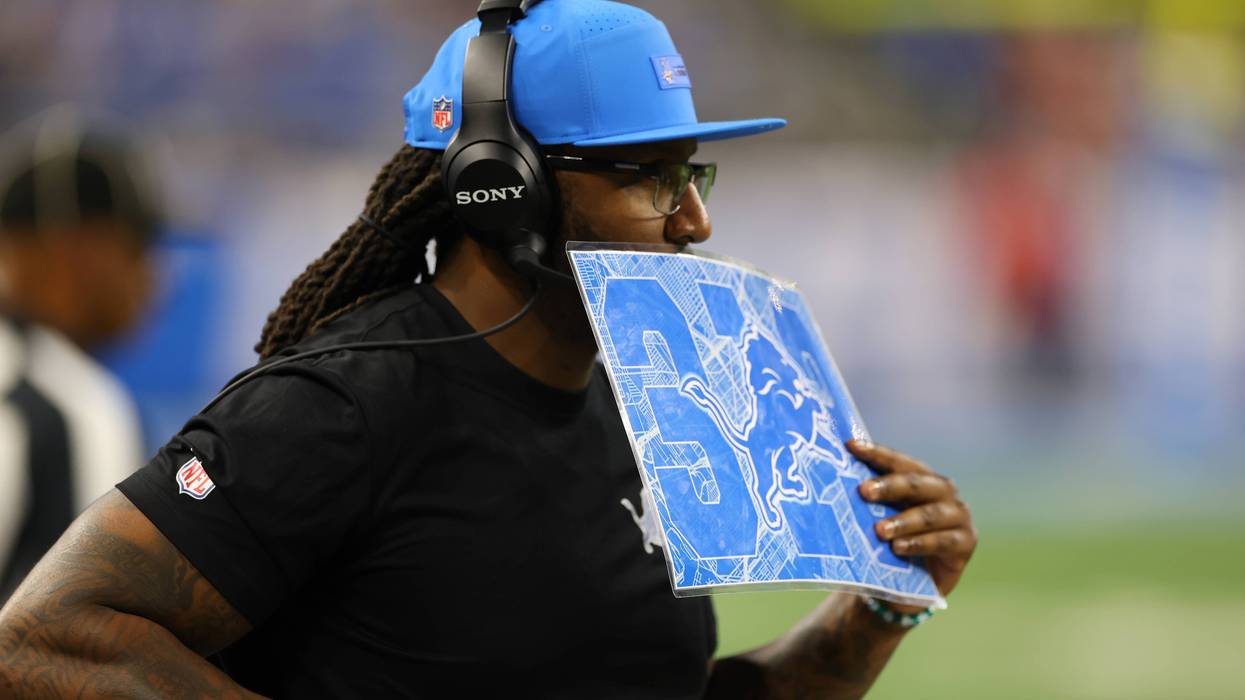

If nothing else, Kelvin Sheppard said a few days before the Lions' season opener, "the explosive plays will be limited this year."
"No explosive plays by way of mental error or missed tackles," he said, "because that's on us."
Well, if nothing else, give Sheppard credit for this: He's owning it. The Lions have been gashed on the ground and gouged through the air, and Sheppard, unlike last year, isn't dismissing it.
"That was the big talk of this offseason, the explosives that were generated primarily in the back half of last year. And we've failed in that category up to this point," Sheppard said Thursday. "And that starts with me."
Is it on Kelvin Sheppard's game plan or the personnel? pic.twitter.com/P5t8kZC8F2
— 97.1 The Ticket: (@971theticketxyt) September 24, 2026
Whenever Detroit's defense stumbled last season, Sheppard often explained it away a few days later by pointing to a few bad plays. Remove those, he'd say, and the defense played pretty darn well. In hindsight, Sheppard seems to understand how foolish that sounded. NFL games often hinge on a few plays.
"I know before, I stood up here and said, 'Alright, we played three quarters good, but in the fourth quarter if you take that play out' -- well, we're no longer doing that this year, because taking those plays out are the exact plays that's been a demise to our defense," Sheppard said.
In Week 1, per Sheppard, the Lions allowed three explosive runs, eight explosive passes. In Week 2, eight explosive runs, four explosive passes. Last year, he might have chalked up the Bills' 200-plus rushing yards to a few poor run fits and a couple instances where the defense lost contain on the quarterback.
This year, "no, no, no," Sheppard said. "That is the single-hand demise to this defense right now that's trickling to the team's overall success."
So, now what? After the Lions' 41-31 loss to the Bills last Thursday -- a look-in-the-mirror moment for the whole team -- Sheppard and the defensive staff spent the long weekend doing the sort of self-scout they'd typically do during the bye week. The aim was to identify why the explosive plays keep happening and how the defense can stop them. It wasn't about "finger-pointing," said Sheppard.
"No, that's for losers. Let's find solutions, and let's and make sure we have answers for these players Monday when they come back in this building," he said.
Upon reviewing the film, Sheppard said that 75 percent of the 23 explosive plays allowed by the defense in the first two games were "self-induced." Misfits in the run game have been costly, despite a veteran group of linebackers. Miscommunications in the secondary have been deadly, despite an experienced group of corners and safeties. Mistakes by the defensive line haven't helped.
Who do you blame more for the defense: Brad Holmes or Kelvin Sheppard? pic.twitter.com/bbbNMaXq7o
— 97.1 The Ticket: (@971theticketxyt) September 24, 2026
On Monday, instead of fixing their eyes on their Week 3 matchup with the Jets, Sheppard and the defense turned on the tape and went down the list of those 23 plays in a "transparent" film session where the players on the field explained their thought process on each breakdown. The directive from Sheppard was this: "Tell me what you're doing. Tell me what you're supposed to be doing. Coaches, don't say a word. Let's let them talk."
"Because right now, there's a clear gap from meetings and practice, what's taking place at 222 Republic Drive, and then game day," said Sheppard. "And how can we close the gap? There was a lot of honesty said out loud in that meeting, player to player, player to coach, coach to player. And we hashed out some things."
At the center of this is Jack Campbell. The All-Pro linebacker and the captain of Detroit's defense has not had a good start to the season. He was so disappointed in his own performance last Thursday that he got choked up in the locker room and shouldered all of the blame for the loss. He hasn't looked like himself so far, especially against the run.
Campbell said Monday's meeting was productive, and that everyone spoke up.
"The thing that came out of it was trying to get on the same page, and what's everyone seeing? That was the main reason for this: why are people doing what they're doing? And if it's wrong, how do we correct it?" he said. "Every person on the field was trying to have constant communication through the whole thing, so everyone did a good job. Now it's just correcting it. We'll move forward, but it was very helpful to just get back on the same page and just make sure people are seeing things the right way."
Every defensive play is dictated by each player's rules within the scheme. For example, it looked like Aidan Hutchinson was complicit on one of Josh Allen's early scrambles last Thursday when Hutchinson rushed inside and abandoned the edge. Turns out that Hutchinson's rules within Detroit's defense allow him to do that, and that it was up to defensive tackle Skyler Gill-Howard to read Hutchinson's rush and loop behind him to shut down Allen's escape lane.
Trouble was, Gill-Howard got dropped to the ground by the guard as soon as Hutchinson rushed inside, and Allen had nothing but green grass in front of him around the right edge. This same sequence happened on another Allen scramble where D.J. Wonnum rushed inside and Alim McNeill couldn't replace him after he got dumped by the guard.
While those are failures by the players, they can be traced back to the scheme. It's asking a lot of a defensive tackle, especially a rookie like Gill-Howard, to react to a spur-of-the-moment stunt by getting off a block in the trenches and racing to the edge. In games against highly mobile quarterbacks like Allen, it might behoove Sheppard to adjust the defensive rules and simply have his edge defenders set edges. The Lions' primary aim entering last Thursday was to keep Allen in the pocket, but they deployed rushes that it more likely for him to escape. The risk wasn't worth the reward.
Kelvin Sheppard spoke about the Lions defensive performance through 2 weeks pic.twitter.com/tHPdJ62QBn
— 97.1 The Ticket: (@971theticketxyt) September 24, 2026
Meanwhile, Campbell looked like the culprit on two long runs by James Cook on back to back plays in the second quarter. And Campbell, to be sure, could have done a better job of reading each play and meeting Cook at the line. The first looked like a failure across the board. On the second, a 35-yard scamper into the red zone, it might have been corner D.J. Reed who misread the play, overran it and let Cook run untouched into the second level of the defense.
Dan Campbell noted this week that almost 100 of the Bills' rushing yards came on plays "where we had a couple of guys misfit on the perimeter, and everybody else was doing their job."
It's jarring to see Jack Campbell look so out of place on one big run, let alone two. The Lions are much lighter on the interior of the defensive line this year, which might change the way Campbell moves behind them. Asked if his rules are different this season when it comes to filling gaps in the run game, Campbell wouldn't say.
He did say: "Those couple runs that you're alluding to, it shouldn't have gotten to the point where it got to. But it's on me. That's all I'm going to say."
The busts in coverage are an entirely different story. Those owe mostly to miscommunications in a secondary that's suddenly playing a lot of zone. Zone requires chemistry, and a shared understanding of each player's responsibilities. Sheppard and the Lions shifted to that scheme believing that all the experience in the backend of their defense would allow for clean execution.
That was a miscalculation on the part of Sheppard, whose safeties, corners and nickels are not functioning as one. It doesn't take a breakdown of the film to see that. Joshua Palmer wound up wide open in the end zone for a 43-yard touchdown last week on a play where he was essentially running a decoy route.
The Lions have rotated a lot of defensive backs into a variety of packages over the first two games, in an attempt to confuse the quarterback. They're playing much more nickel this year, which was needed, and blitzing a lot. It was working for the first half of the Saints game, against Tyler Shough.
It has begun to backfire. Reed suggested after last week's loss that the volume of players and coverages in the secondary might be a reason for the communication issues. Sheppard on Thursday shot that down.
"No, I don't think there's a lot going on," he said. "There's not much. As far as coverage variation, especially the first two weeks, it's been about four or five things going into it. It's just the execution portion of it ... And again, it's been done. It's not like it's something we're asking them to do that hasn't already been done.
"So, now it's up to me. OK, do you pull back? But then you pull back so much, you're a sitting duck. That's where we've been, I feel like, at times in the past. Trying to have variety, trying to change the picture for the quarterback, is very important in this league. And trying to have guys understand how important that is, but not to the detriment that we're letting off 23 explosives in the first two weeks. That's the fine balance. That's why I sit in the seat that I sit in with the guys to my right and left, because it's our job to find that answer and I believe we have."
We'll see on Sunday.