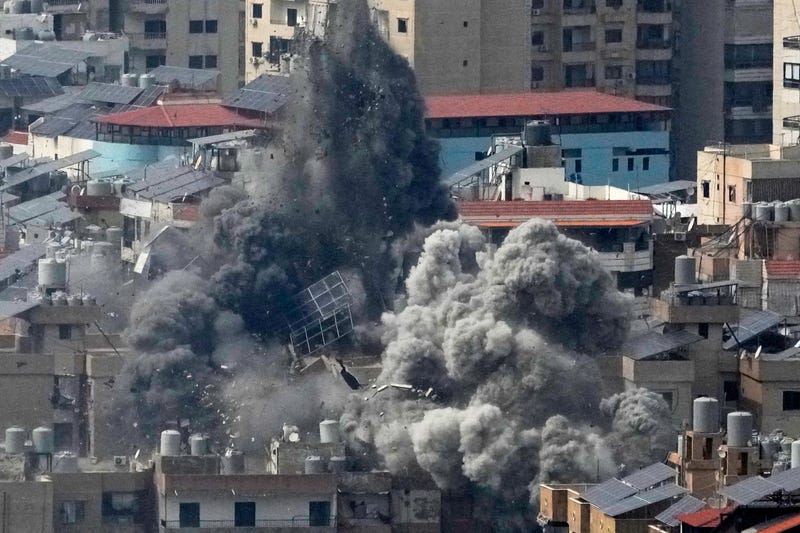
DUBAI, United Arab Emirates (AP) — U.S. President Donald Trump on Friday appeared to rule out talks with Iran absent its “unconditional surrender.” Israeli warplanes bombed Beirut and Tehran as Iran launched more retaliatory strikes against Israel and Gulf countries on the seventh day of the war.
The strikes in Lebanon were the heaviest since a 2024 ceasefire ended the last war between Israel and the Iran-backed Hezbollah, who fired rockets at Israel in the opening days of the war now underway. More than 95,000 people have fled Beirut’s suburbs and southern Lebanon after sweeping Israeli evacuation warnings.
The U.S. and Israel have battered Iran with strikes, targeting its military capabilities, leadership and nuclear program. The stated goals and timelines for the war have repeatedly shifted, as the U.S. has at times suggested it seeks to topple Iran’s government or elevate new leadership from within.
Russia has meanwhile provided Iran with information that could help Tehran strike the U.S. military, according to two officials familiar with U.S. intelligence on the matter.
Qatar’s energy minister Saad al-Kaabi warned in an interview with the Financial Times that the war could “bring down the economies of the world,” predicting a widespread shutdown of Gulf energy exports that could send oil to $150 a barrel.
The price for a barrel of benchmark U.S. crude rose above $90 for the first time in more than two years Friday, with gas prices rising 34 cents in just one week to a national average of $3.32 per gallon, according to motor club AAA.
Trump says US will help rebuild Iran once it has ‘ACCEPTABLE’ leaders
In a social media post on Friday, Trump said that after Iran’s surrender, “and the selection of a GREAT & ACCEPTABLE Leader(s),” that the U.S. and its allies would help rebuild Iran, making it “economically bigger, better, and stronger than ever before.”
Those comments were likely to raise further questions about the endgame of the war launched a week ago by the United States and Israel. The war has killed at least 1,230 people in Iran, more than 200 in Lebanon and around a dozen in Israel, according to officials in those countries. Six U.S. troops have been killed.
Iran’s President Masoud Pezeshkian wrote on social media that “some countries” had begun mediation efforts in the conflict, without elaborating.
On Thursday, Trump urged the Iranian people to “help take back your country,” promising the U.S. would grant them “immunity,” without elaborating.
Trump also told media outlets that he should be involved in choosing a replacement for Supreme Leader Ayatollah Ali Khamenei, who was killed in the opening strikes of the war. Trump spoke dismissively of Khamenei’s son, Mojtaba Khamenei — a front-runner to replace his father — calling him “a lightweight.”
Iranian state television reported Friday that a leadership council had started discussing how to convene the country’s Assembly of Experts, which will select the new supreme leader.
Buildings associated with the 88-member clerical panel, have been attacked during the Israeli-American air campaign. Israel has said it would target the next supreme leader if he poses a threat.
Russia providing information to Iran, officials say
Russia has provided Iran with information that could help Tehran strike American warships, aircraft and other assets in the region, according to two officials familiar with U.S. intelligence on the matter.
The people, who were not authorized to comment publicly on the sensitive matter and spoke on the condition of anonymity, cautioned that the U.S. intelligence has not uncovered that Russia is directing Iran on what to do with the information.
Still, it’s the first indication that Moscow has sought to get involved in the war that the U.S. and Israel launched on Iran a week ago.
Heavy strikes on Iran and retaliatory attacks
Israel’s military said Friday it had launched “a broad-scale wave of strikes” on Tehran, Iran’s capital, and that over the past week it has heavily bombed an extensive underground bunker that Iran’s leaders had planned to use during the hostilities.
Witnesses described Israeli airstrikes as particularly intense, shaking homes in the area and sending columns of smoke rising. Others reported explosions around the Iranian city of Kermanshah, an area that is home to multiple missile bases. They spoke anonymously for fear of retribution.
Countries across the Gulf said they intercepted Iranian missiles and drones on Friday, including attacks aimed at U.S. bases. Strikes have killed at least 15 civilians, including in Oman, Kuwait, Bahrain and the United Arab Emirates.
Qatar and Saudi Arabia said Friday they intercepted projectiles headed toward U.S. bases. Air raid sirens sounded in Bahrain, where the Interior Ministry said Iranian strikes hit two hotels and a residential building, though no casualties were reported.
The United Arab Emirates and Kuwait — where six U.S. soldiers were killed Sunday — also reported missiles and drones breaching their airspace.
In Israel, the sound of explosions could be heard in Tel Aviv throughout Friday after warnings about missiles incoming from Iran, as air defense systems worked to intercept the barrage. Five soldiers have been wounded in the fighting with Hezbollah, Israel’s military said.
Israel bombards Lebanon as death toll rises
Israel has carried out waves of airstrikes on the southern suburbs of Beirut, where Hezbollah has a large presence but which is also home to hundreds of thousands of civilians.
Lebanon's Health Ministry said 217 people had been killed by Israeli strikes since Monday and 798 wounded.
Roads in the Lebanese capital were choked with evacuating traffic as smoke rose over the city’s southern districts. Two hospitals evacuated patients and staff.
“What can we do? We prayed here under the tree. During the night we slept in the car because there is no place to stay,” Jihan Shehadeh, one of the tens of thousands of displaced, said.
One Israeli strike hit near the Iranian embassy in Beirut, according to Lebanon's state-run National News Agency. Israel's military did not immediately respond to questions about the report.
Hezbollah’s military command on Friday urged its fighters not to relent and to “defend the nation,” casting the escalating war in religious terms and calling on them to “kill them wherever you find them.”
Lebanon’s Prime Minister Nawaf Salam slammed both Israel and Hezbollah, saying the Lebanese state and people “did not choose this war.”
___
Metz reported from Ramallah, West Bank, Rising from Bangkok and Abou AlJoud from Beirut. Seung Min Kim and Aamer Madhani in Washington; Geir Moulson in Berlin, and Malak Harb, Abby Sewell and Bassem Mroue in Beirut contributed.