UNITED NATIONS (AP) — After weeks of escalating tension, U.S. and Iranian officials faced each other Thursday at the U.N. Security Council, where America's envoy renewed threats against the Islamic Republic despite President Donald Trump's efforts to lower the temperature between the two adversaries.
The U.S. was joined by Iranian dissidents in rebuking the government’s bloody crackdown on nationwide protests that activists say have killed at least 2,677 people.
“Colleagues, let me be clear: President Trump is a man of action, not endless talk like we see at the United Nations,” Mike Waltz, U.S. ambassador to the U.N., told the council. “He has made it clear that all options are on the table to stop the slaughter. And no one should know that better than the leadership of the Iranian regime.”
Waltz's remarks came as the prospect of U.S. retaliation for the protesters’ deaths still hung over the region, though Trump signaled a possible de-escalation, saying the killing appeared to be ending. By Thursday, the protests challenging Iran’s theocracy appeared increasingly smothered, but the state-ordered internet and communication blackout remained.
One diplomat told The Associated Press that top officials from Egypt, Oman, Saudi Arabia and Qatar spent the last 48 hours raising concerns with Trump that a U.S. military intervention would shake the global economy and destabilize an already volatile region.
During the meeting, Hossein Darzi, the deputy Iranian ambassador to the U.N., blasted the U.S. for what he claimed was America's “direct involvement in steering unrest in Iran to violence.”
“Under the hollow pretext of concern for the Iranian people and claims of support for human rights, the United States is attempting to portray itself as a friend of the Iranian people, while simultaneously laying the groundwork for political destabilization and military intervention under a so-called ′humanitarian′ narrative,” Darzi said.
The U.S. requested the emergency Security Council meeting and invited two Iranian dissidents, Masih Alinejad and Ahmad Batebi, to describe their experience as targets of the Islamic Republic.
In a stunning moment, Alinejad addressed the Iranian representative directly.
“You have tried to kill me three times. I have seen my would-be assassin with my own eyes in front of my garden, in my home in Brooklyn,” she said while the Iranian official looked directly ahead, without acknowledging her.
In October, two purported Russian mobsters were each sentenced to 25 years behind bars for hiring a hit man to kill Alinejad at her New York home three years ago on behalf of the Iranian government.
Batebi described the deep cuts the prison guards in Iran would inflict on him before pouring salt on his wounds. “If you do not believe me, I can show you my body right now,” he told the council.
Both dissidents called on the world body and the council to do more to hold Iran accountable for its human rights abuses. Batebi pleaded with Trump not to “leave” the Iranian people alone.
“You encouraged people to go into the streets. That was a good thing. But don’t leave them alone,” he said.
Russia was the only member of the council that defended Iran's actions while calling for the U.S. to stop intervening.
Protests appear smothered as death toll rises
Videos of demonstrations have stopped coming out of Iran, likely signaling the slowdown of their pace under the heavy security force presence in major cities.
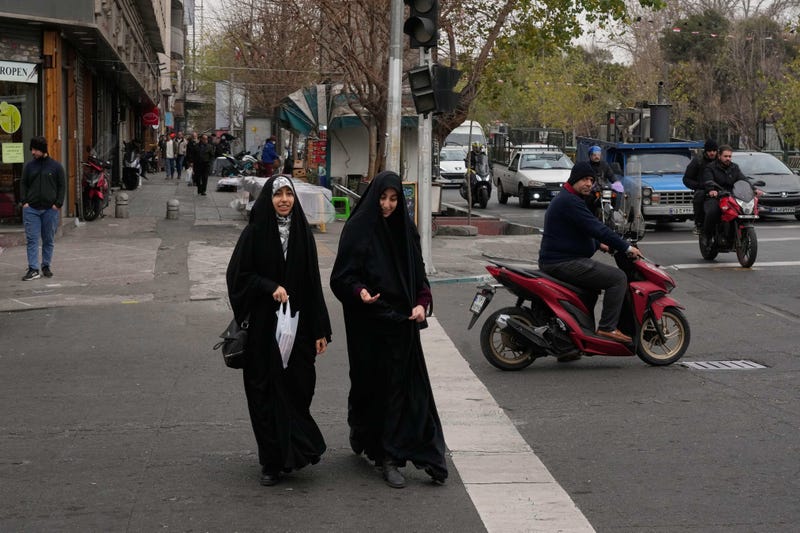
In Iran’s capital, Tehran, witnesses said recent mornings showed no new signs of bonfires lit the night before or debris in the streets. The sound of gunfire, which had been intense for several nights, has also faded.
The clampdown on the demonstrations has killed at least 2,677 people, according to the U.S.-based Human Rights Activists News Agency. The figure reported Thursday is an increase of 106 from a day earlier, and the organization says the number will likely continue to climb. The death toll exceeds that of any other round of protest or unrest in Iran in decades and recalls the chaos surrounding the country’s 1979 Islamic Revolution.
The U.S.-based agency, founded 20 years ago, has been accurate throughout multiple years of demonstrations, relying on a network of activists inside Iran that confirms all reported fatalities.
With communications greatly limited in Iran, the AP has been unable to independently confirm the group’s toll. The Iranian government has not provided casualty figures.
New sanctions on senior Iranians
In other developments Thursday, the U.S. announced new sanctions on Iranian officials accused of suppressing the protests, which began late last month over the country’s faltering economy and the collapse of its currency. The Group of Seven industrialized democracies and the European Union also said they too were looking at new sanctions to ratchet up the pressure on Iran’s theocratic government.
Among those hit with U.S. sanctions was the secretary of Iran’s Supreme Council for National Security, whom the Treasury Department accuses of being one of the first officials to call for violence against protesters. The Group of Seven, of which the U.S. is a member, also warned they could impose more sanctions if Iran’s crackdown continues.
European Union chief Ursula von der Leyen said the 27-nation bloc was looking at strengthening sanctions “to push forward that this regime comes to an end and that there is change.
___
Associated Press writers Aamer Madhani and Matthew Lee in Washington and Jon Gambrell in Dubai, United Arab Emirates, contributed to this report.