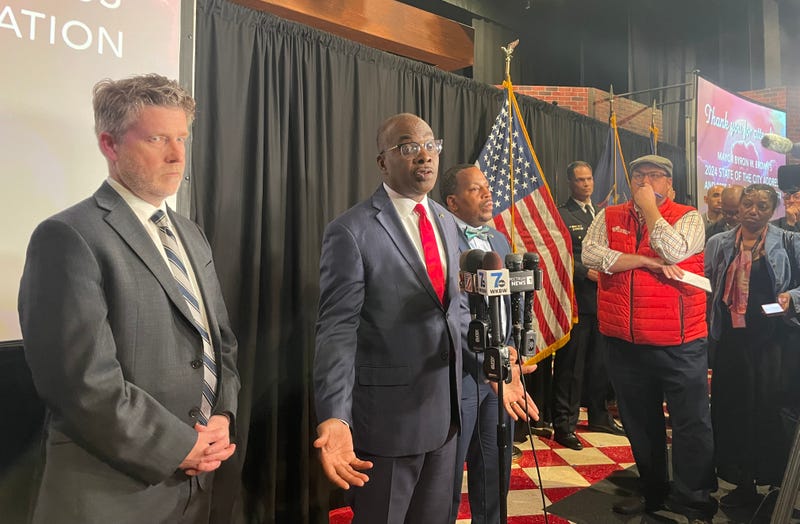

Buffalo, N.Y. (WBEN) - Raising taxes in the City of Buffalo is a decision that Mayor Byron Brown does not like to often make, especially when it's a 9% proposed hike as part of the 2024-25 budget.
However, Mayor Brown feels that this proposed hike is a difficult decision that's required to enable city government to continue providing high quality services for residents, and protect the progress the community has made overall.
"We will see more affordable housing. We will see more infrastructure projects - streets, sidewalks, curbs. We will see more responsive snow removal. We will see a more responsive sanitation delivery of service. There will be a number of new services that people will see. The 3-1-1 Call and Resolution Center, people will be able to have more hours that they can use that line for information. But most importantly, this protects and preserves the services that we already provide," said Mayor Brown on Wednesday following his annual State of the City address at Shea's 710 Theatre in Downtown Buffalo. "If we did not provide these increases, cuts to get to balancing the budget would be painful, they would be dramatic, and they would be very harmful to the residents of this community. We didn't want to do that."
In his more than 18 years in office as mayor, Brown says for the most part, taxes have been lowered or have held the line. And as of right now, the tax rate in the City of Buffalo, based on fiscal policy, is lower than it was when he first came into office in 2006.
"We have been very strategic in how we have handled taxes in the city. If you look at tax increases that we could have done that we didn't do, we save taxpayers and businesses in the city over $360 million that we actually kept in people's pockets," Mayor Brown noted.
The proposed budget will see a $.78-cent increase in the homestead property tax rate per $1,000 of assessed value, and a $2.32 increase in the non-homestead property tax rate per $1,000 of assessed value, which is expected to generate approximately $14 million in additional revenue for the city.
When compared to other cities in New York State, there are those that have more poverty than Buffalo does, and others with larger budgets than Buffalo that have residents paying higher taxes. Mayor Brown feels it's important to continue to invest in the city and its resources, not cut at this time.
"We thought this was critical to protect the services that we provide to our residents to continue to build for the future," he said. "As we looked at this very lean budget, there is no fat in this budget. We can't cut our way to prosperity. If we try to cut things, as opposed to continuing the investment, our city would go in the wrong direction."
Related
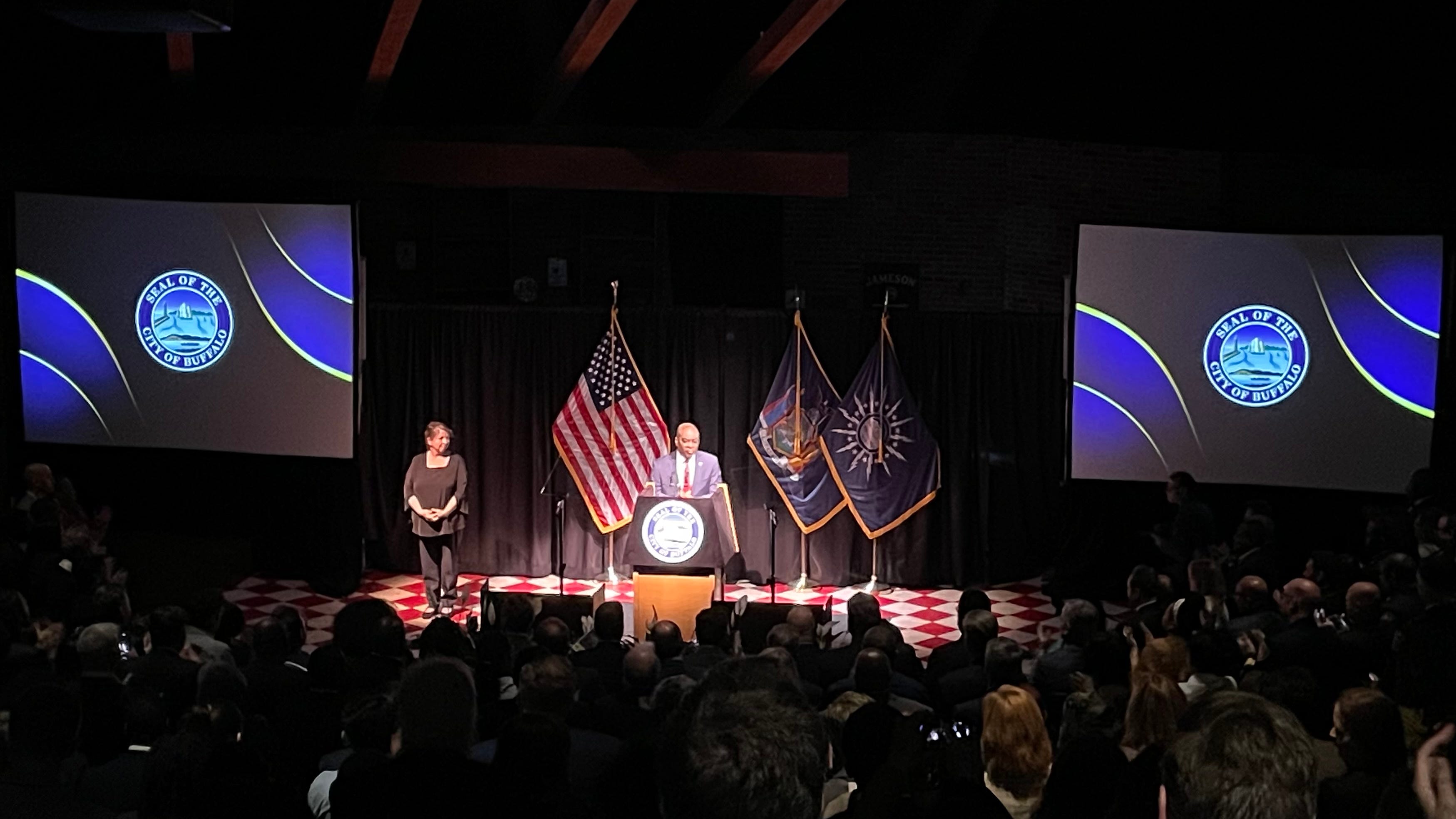
As for city lawmakers, they hadn't gotten the chance to look at the recommended budget detail book ahead of Mayor Brown's State of the City address. North District Councilman Joe Golombek knows the devil will be in the details with the increased budget numbers.
"I'm sympathetic to the mayor. I do think that prices have gone up, costs have gone up," said Golombek following Wednesday's State of the City in an interview with WBEN. "The situation with the storms that we had last year, the city did a much better job with snow removal, and there is a price tag that goes along with that. But I want to see the budget book. I want to see where there were cuts that were made, I want to see where there were additions that were made."
Golombek represents a district in Buffalo that has a lot of poverty and a lot of rental units in it. His concern is the tax increase is going to fall on the backs of the poorest and most vulnerable residents of his district.
"I know some of my colleagues, I would assume all of my colleagues, want to go through everything with a fine tooth and see where there are additions, where there are subtractions, where are there jobs that are filled financially, but not necessarily with live bodies? And if there's any place that we can make cuts to relieve the tax burden on the residents of the City of Buffalo. That's what we're going to be doing for the next three weeks," Golombek said.
Buffalo Common Council President Chris Scanlon feels the first thing many residents across the city are going to see and be thinking and talking about is that proposed 9% tax increase.
"Listen, no one likes to pay more in taxes. I can tell you as a legislator, no one likes to increase anyone's taxes. But at the end of the day, we do have to pay for city services, so that's the balancing act ahead of us in the next few weeks," said Scanlon following the mayor's State of the City address. "Making sure that we're not just maintaining services, but what I don't like to see or ever want to see in the City of Buffalo is us doing anything second rate. I want to make sure we're providing the absolute best services that we can and the best services around."
Another concerning factor with the proposed budget from the mayor's address on Wednesday was the 7.1% increase in the city's operating budget, totaling $618 million.
"Whenever you see a jump of that size, it sets you back on your feet a little bit," Scanlon said. "We'll dive into the budget a little more, see exactly what's driving those costs. And again, if it's something that we can negotiate and we can talk to the administration about - myself, the leadership, the other council members - have conversations with them about it and see exactly what's driving that costs, and hopefully we can make it more manageable for the people of Buffalo."
One issue that saw members of the Common Council not happy with the Mayor's Office on is the lack of timing when it came to overriding the state's 2% tax cap when dealing with the proposed tax increase. Mayor Brown explains his administration was looking at the state budget to see what the gap would be.
"Certainly, as I've indicated, we were hoping for more money coming from Albany, particularly in AIM (state aid). The state didn't follow the normal AIM formula, they imposed a cap on the AIM increase that they provided this year. If there had been no cap, we would have gotten $6.2 million more than we actually received. So we were waiting to see what we got from the state. We made it very clear to the state what we needed, and we did not get the amount that we needed," Brown noted.
That lack of timing with the discussion over the state tax cap eventually led to a bit of a heated back-and-forth between Council President Scanlon and University District Councilman Rasheed Wyatt.
Scanlon understands that disputes such as this over concerns with items like the budget do happen from time-to-time. However, it can't be something that prohibits from city lawmakers from doing their jobs under the City Charter.
"You have nine different personalities on a legislative body, and there's going to be disagreements, quite frankly," Scanlon said. "Over my time in the Council, I think there really hasn't been those many disputes, as you maybe have seen in the past on the Council. You're gonna see them, but it's not a matter of wanting for it to happen, we have to. It's our chartered responsibility to get together in the room, start talking about the budget, and see what we can do to, again, make sure that we're providing the best services to the residents of the City of Buffalo in the most appropriate and reasonable manner."
The Common Council will host budget hearings, budget workshops, and a budget public hearing at Buffalo City Hall in the coming few weeks before a vote on the budget must come by May 22.