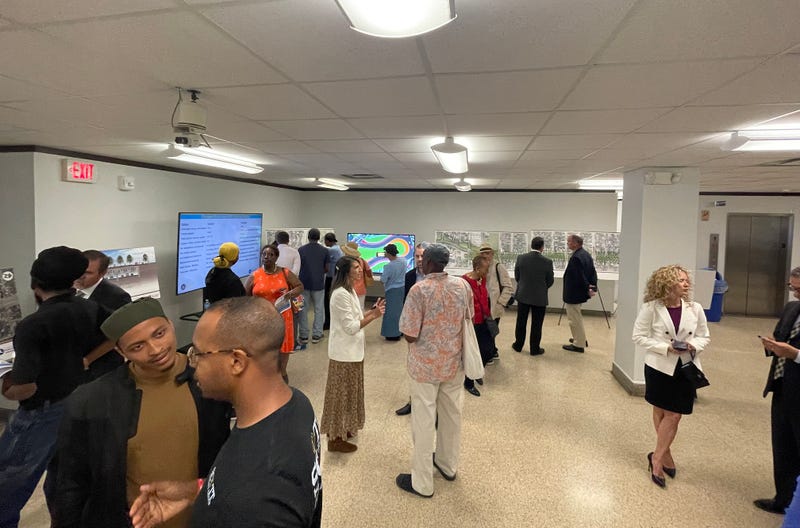

Buffalo, N.Y. (WBEN) - Tuesday presented another opportunity for residents of East Buffalo to provide public input and feedback regarding the proposed $1 billion project to cap the Kensington Expressway and re-connect neighborhoods in the community.
This was all made possible with the New York State Department of Transportation (NYSDOT) hosting a pair of public meetings with residents at the Buffalo Museum of Science, detailing what the project entails, plans for construction, and much more.
Residents were given the chance to not just look at a number of visual presentations for the project provided by the NYSDOT, but they were also able to ask questions of experts and professionals on-hand for the event.
Among the constituents that were in attendance for Tuesday's public meeting, the reactions towards the project were a mixed bag.
LISTEN LIVE TO WBEN:
For East Buffalo resident Ras Jomo Akono, he sees this proposal as a crossroads of the past and the future for the community.
"Trying to fix everybody in the middle to satisfy all of the strong desires for some, disappointments for others, expectations, long-term desires for those who've been living before the expressway was actually created," said Akono on Tuesday. "You have a lot of different age groups and people who've entered at different eras of Buffalo's history. I think that is one of the major goals of this project is how do you acquiesce all of those ideas?"
While East Buffalo resident Michael Mingo was generally in favor of some of what the project entails for the neighborhoods, he says it was important for him to ask some questions and provide his input on what's to come for residents in the coming years.
"I looked at some of the projects and talked to some of the guys who's actually running the projects. I kind of gave my input by being an ex-Navy person and working for different parts of the city and state. The system they have in place is pretty good," said Mingo during the meeting. "I don't know if, for what is worth, they take my advice. There can be some improvement, there's always bugs to be worked out, and I kind of pointed out some of the things that I observed. They didn't much agree with me, but whether it goes forth and they use it, that's another story."
As for brothers Edward and Michael Hughes of East Buffalo, they both grew up in the neighborhood when the Kensington Expressway was being implemented as kids.
"We grew up here when it was green space. It wasn't this massive, but it brings back memories from when we used to walk to Bible School, Bible Study up Humboldt down [to Ferry]," said Edward during Tuesday's event. "Then when they started the demolition for the expressway, we had just moved there right when the expressway opened up. We lived there a couple of years, and then they started the other part. When they started the explosions, the demolition, the vibrations and that affected our house, affected all these houses here, because there's old houses, old plumbings and whatnot."
"We've watched the change in this neighborhood. It went from a green space to a desert," added Michael. "We watched the weathering of all our houses because there was no green, and all the dust and the noise and all that stuff."
Both brothers said their 94-year-old mother is opposed to the project, and said they felt they needed to find out how it's going to affect our property. While both brothers feel the project looks like it brings new life for the community, they also believe the money can go to better use elsewhere.
"They could fix the existing structure, especially around the 198 [Scajaquada Expressway] where it goes up and over. They haven't fixed those lights around Delaware Park at all. They were more concerned about reducing the speed limit because there was one accident there that took the life of a little boy. That's something that should have been planned a long time ago. They should have taken care of that instead of being worried about reducing [the speed]," Edward said. "There's other things in the city that needs to be taken care of. They don't take care of what they have already, so who's going to take care of this?"
"I'm tired to watching us throw good money after bad money," Michael added.
"It could be used to improve lot of other infrastructure ideals that are needed. I know it'd be nice to reunite, but this is going to screw things up for a while. Like everything else that has been a project, it screws things up, and it makes the change. Then by the time they finish, it's obsolete. So my concern I'd like to see them use it for more infrastructure-type things like improve some of the other streets. 33, yeah, I think we need to improvement, because the walls are falling down."
The NYSDOT announced on Monday as part of the $1 billion proposed project coming for East Buffalo and the Kensington Expressway, it would include nine miles worth of improvements to local streets and roadways in-and-around the site. It also calls for sidewalks, ramps and driveway aprons to be replaced and upgraded as needed to meet the requirements of the Americans with Disabilities Act and enhance mobility and safety for pedestrians. In addition, street lighting and traffic signals will also be upgraded as needed, and new green spaces and trees may also be included.
Related
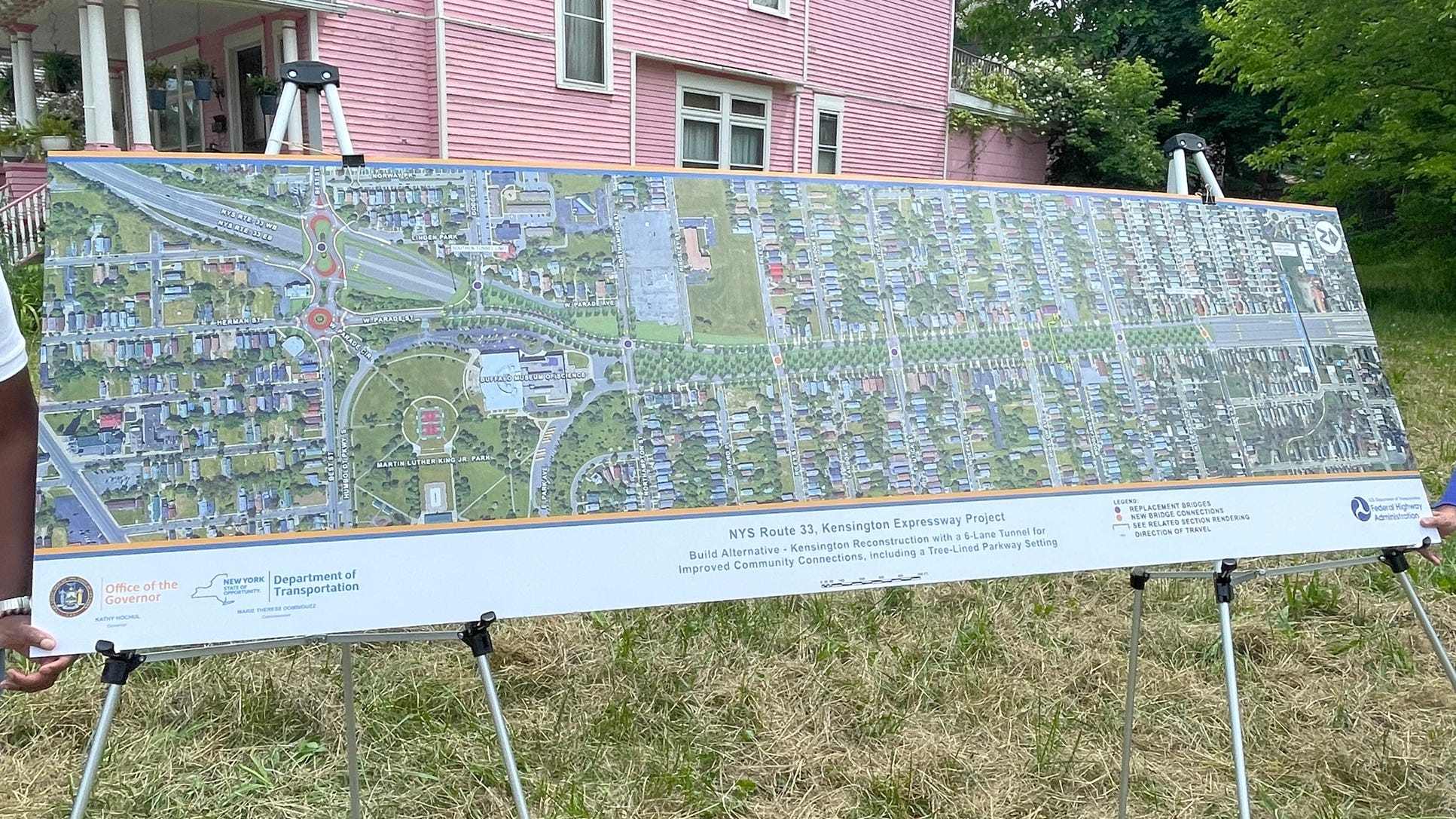
Residents like Akono are very pleased to hear that a project this vast will include a number of enhancements to improve the quality of life for residents of East Buffalo.
"Giving everybody a good quality of life in an area that can afford to give everyone a good quality of life," he said. "I think one of the main realities is that the community that has been there are actually allowed to stay there to enjoy the benefits that they have not enjoyed for the multi generations waiting for better to come.
"These are residents, these are taxpayers, these are people that have endured it when it was good, when it was bad. And as the new era comes, do we protect the rights and the desires of those who have borne the brunt of not having substantial quality."
As for the Hughes brothers, they, once again, point to using the $1 billion dedicated to this project to other uses, including going beyond the nine miles of roadways that will benefit from this specific proposal.
"A lot of people who are for this and want this probably may not live in this area. They might live maybe 5-10 miles away, but this doesn't affect them. It affects the people who live along this area, because everything's gonna be disrupted for them for a while," Edward said.