


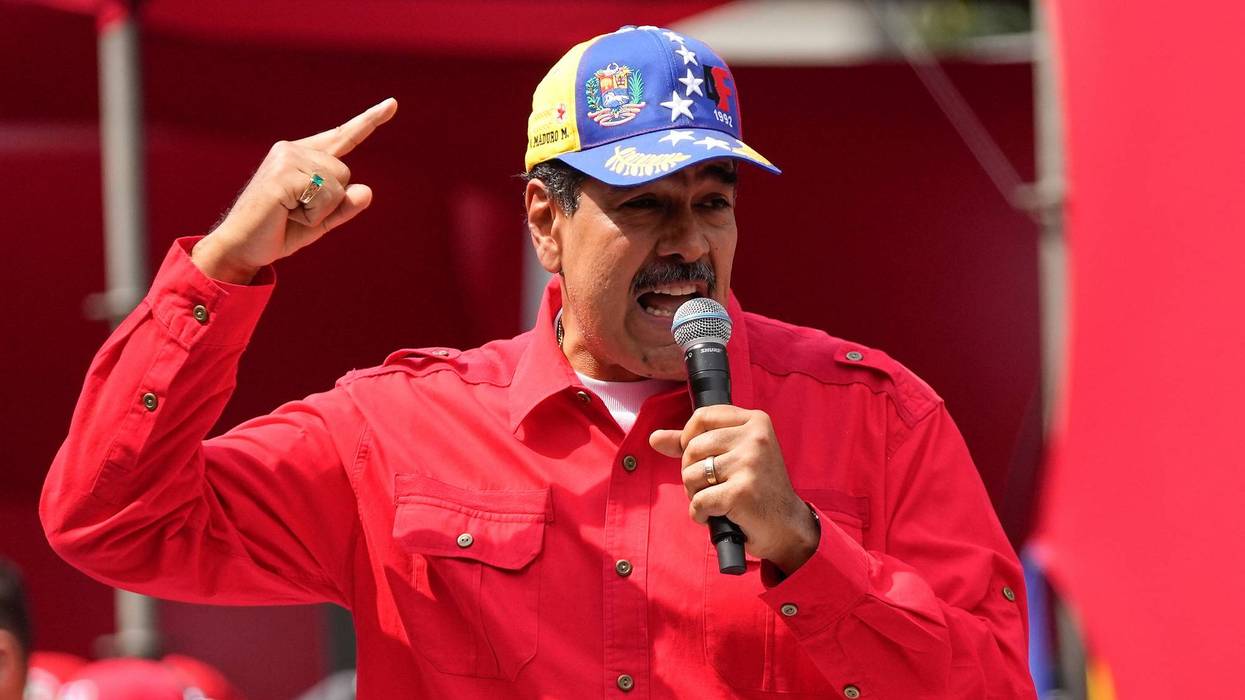

NEW YORK (AP) — Former Venezuelan President Nicolás Maduro and his wife were back in a New York courtroom Thursday as they seek to have their drug trafficking indictments thrown out over a geopolitical dispute over legal fees.
The defense and prosecution argued over whether Maduro should be allowed to use Venezuelan government funds to pay for his defense. His lawyers have insisted the U.S. is violating the deposed leader’s constitutional rights by blocking government money from being used for his legal costs.
Judge Alvin Hellerstein questioned why the prosecution's argument to block the funds still stands, now that U.S. and Venezuelan relations have warmed somewhat. He did not immediately rule on the issue Thursday and did not give a timeline for the decision. A date for the next hearing was not set.
As supporters and opponents rallied outside, Maduro and his wife, Cilia Flores, made their first court appearance since a January arraignment at which he protested their capture by U.S. military forces and declared: “I am not guilty. I am a decent man, the constitutional president of my country.” Flores has also pleaded not guilty.
The couple sat at the defense table between their lawyers, wearing jail uniforms and headphones to listen to the translation.
In addition to drug trafficking, they are accused of ordering kidnappings, beatings and murders of those who owed them drug money or undermined their trafficking operation. That included the killing of a drug boss in Caracas, the indictment said. If convicted, they face life in prison.
Both are being jailed at a Brooklyn detention center, and neither has asked to be released on bail. Hellerstein has yet to set a trial date.
Demonstrators gathered outside the courthouse to rally both in favor of and against Maduro. In a noisy scene, protesters and supporters chanted, blew horns and beat drums and cowbells. Among the anti-Maduro contingent, one person waved a sign reading “Maduro rot in prison.” On the other side of a metal barrier, people held signs reading “Free President Maduro.”
In Caracas Thursday morning, a couple hundred people gathered at a public plaza including ruling party supporters, state employees and civilian militia members. One attendee, retiree Eduardo Cubillan, said he was there to pray for Maduro and Flores and condemn the violation of Venezuela’s sovereignty during the Jan. 3 operation.
“We hope that in the United States, if justice truly exists, a trial will be held that will lead to President Maduro’s freedom, because this kidnapping violated international legal principles, and we want justice to be served,” Cubillan, 80, said.
Maduro, 63, and Flores, 69, continue to enjoy some support in Venezuela, with murals and billboards across the capital, Caracas, demanding their return. While Maduro's ruling party remains in power, he has slowly been erased from the government of Delcy Rodríguez, Venezuela's acting president.
Rodríguez has replaced senior officials including Maduro’s faithful defense minister and attorney general, reorganized agencies, appointed ambassadors and eliminated tenets of the self-proclaimed socialist movement that has ruled Venezuela for more than two decades.
Venezuela has since reestablished diplomatic relations with the U.S., which in 2019 cut ties with Maduro's government and recognized the then-head of the National Assembly, a member of the opposition, as the country's legitimate leader. The U.S. has eased economic sanctions on Venezuela’s crucial oil industry and also dispatched a chargé d’affaires to Caracas.
Prosecutor Kyle Wirshba argued Thursday that if the reason for U.S. sanctions on Venezuela was because Maduro and his wife were plundering their country's wealth, “it would undermine the sanctions to allow them to access the same funds now to pay for their defense.” Maduro has said he doesn't have personal funds to pay his lawyers.
Hellerstein questioned that argument, saying Maduro and Flores’ right to defend themselves “is paramount” over the government’s national security and foreign policy interests.
“I see no abiding interest of national security on the right to defend themselves,” the judge said.
Among his arguments, Maduro lawyer Barry Pollack contended that if Maduro got public defenders, investigating and preparing his case would sap legal resources meant for people who can’t afford their own attorneys, and that doesn’t make sense in “a case where you have someone other than the U.S. taxpayer standing ready, willing and able to fund that defense.”
Hellerstein also ruled out Pollack's suggestion to dismiss the case at this juncture. The judge said Pollack could revisit the request if the Treasury Department doesn’t relent on its decision to bar Venezuela from paying Maduro's legal fees. The judge acknowledged that the “government has the right to block the funds,” but suggested that the license allowing such payments may have been “arbitrarily withheld.”
In a court filing last month, Pollack said the Treasury Department’s Office of Foreign Assets Control, which administers sanctions, flip-flopped on a decision to let Venezuela pay for his legal fees. The office approved the arrangement Jan. 9, Pollack said, but then rescinded it without explanation less than three hours later.
In a written declaration filed with the court, Maduro argued that he is “entitled to have the government of Venezuela pay for my legal defense.
During a Cabinet meeting Thursday, President Donald Trump accused Maduro of being a “major purveyor of drugs coming into our country.”
Trump said Maduro would be given “a fair trial. But I would imagine there are other trials coming.” He didn’t provide details, but suggested the current charges Maduro is facing might be “a fraction of the kind of things that he’s done.”
Maduro and Flores were seized Jan. 3 in a middle-of-the-night raid on their Caracas home.
A 25-page indictment accused him and others of working with drug cartels and members of the military to facilitate the shipment of thousands of tons of cocaine into the U.S.
Post-Maduro, everyday life for most Venezuelans remains the same.
Many public sector employees earn just about $160 per month, while the average private sector worker makes about $237. Last year the annual inflation rate soared to 475%, according to Venezuela’s central bank, putting the cost of food and other essentials beyond the reach of many.
___
Garcia Cano reported from Caracas. Associated Press writer Dave Collins in Hartford, Connecticut, contributed to this report.


