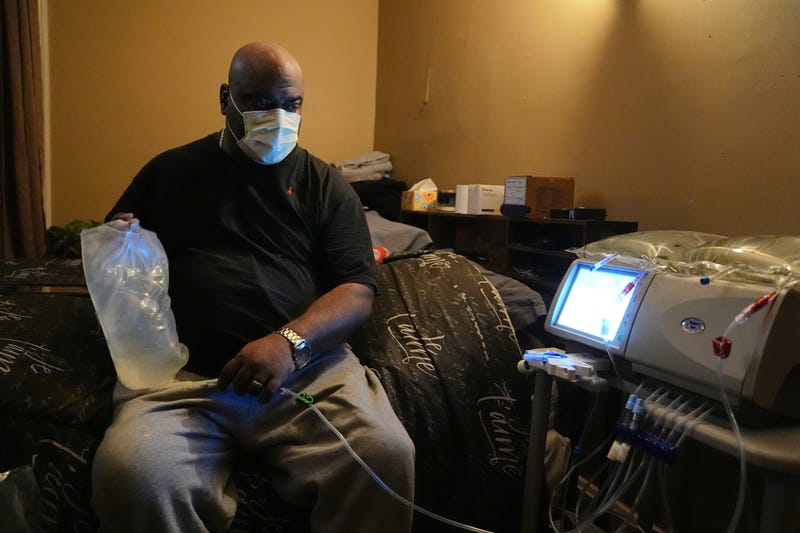
HARRISBURG, Pa. (AP) — Fernando Moreno has been on dialysis for about two years, enduring an “unbearable” wait for a new kidney to save his life. His limited world of social contacts has meant that his hopes have hinged on inching up the national waiting list for a transplant.
That was until earlier this year, when the Philadelphia hospital where he receives treatment connected him with a promising pilot project that has paired him with “angel advocates” — Good Samaritan strangers scattered around the country who leverage their own social media contacts to share his story.
So far, the Great Social Experiment, as it was named by its founder, Los Angeles filmmaker David Krissman, hasn't found the Vineland, New Jersey, truck driver a living kidney donor. But there are encouraging early signs the angel advocate approach is working, and there's no question it has given Moreno new optimism.
“This process is great,” said Moreno, 50, whose own father died of kidney failure at 65. “I'm just hoping there will be somebody out there that’s willing to take a chance.”
Moreno is part of a pilot program with 15 patients that began in May at three Pennsylvania hospitals. It's testing whether motivated, volunteer strangers can help improve the chances of finding a life-saving match for a new kidney — particularly for people with limited social networks.
“We know how this has always been done, and we're trying to put that on steroids and really get them the help that they need,” Krissman said. “Most patients are too sick to do this on their own — many don't have the skills to do it on their own.”
Seeking a blueprint for the future
The Gift of Life Donor Program, which serves as the organ procurement network for eastern Pennsylvania, southern New Jersey and Delaware, is supporting the pilot program with a grant of more than $100,000 from its foundation.
So far, two of the five patients in the program through Temple University Hospital have found kidney donors, and one is preparing for surgery, according to Ryan Ihlenfeldt, the hospital’s director of clinical transplant services. One of the five patients at the University of Pittsburgh Medical Center in Harrisburg has also undergone a transplant.
The approach Krissman has developed is something new, said Richard Hasz Jr., Gift of Life's chief executive, and may help identify the types of messages that attract and motivate potential live kidney donors.
“This is the first of its kind that I’m aware of,” Hasz said. “That’s why, I think, the foundation was so interested in doing it -- studying it and hopefully publishing it — so we can create that blueprint, if you will, for the future.”
Gift of Life agreed to fund a broader test and helped Krissman identify five patients each at Temple, UPMC-Harrisburg and Jefferson University Hospital in Philadelphia.
Hasz said the pilot program's approach combines social media outreach with Krissman’s storytelling talents and aggressive efforts to mobilize the patients’ own connections.
“We know that patients who are waiting don’t always have the energy or the resources to do this themselves,” Hasz said.
There have been other ways for patients to set up “ microsites ” where they can tell their stories and seek a donor match. But the pilot program currently underway in Pennsylvania aims to connect patients with a wide universe of potential donors and produce videos and other ways to spread their message.
Potential to ‘snowball’
Krissman's bout with an illness about two decades ago inspired him to tackle the sticky challenge of increasing live kidney donations. He was debilitated for more than a year before medication helped him recover, explaining, “It gave me my life back. And I never forgot what it's like to be chronically sick.”
After producing a podcast on kidney transplantation, Krissman recruited four patients through Facebook who were waiting for kidneys. He was able to help two of them. A second effort, a pilot program with three patients in North Carolina that ended last year, helped match all three with living donors.
Becca Brown, director of transplant services at UPMC-Harrisburg, thinks it might be a game changer.
“There’s potential for this to really snowball,” Brown said. “I’m anxious to see what happens and if we can roll it out to other patients.”
Some 90,000 people in the United States are on a list for a kidney transplant, and most of the roughly 28,000 kidneys that were transplanted last year came from deceased donors. Living kidney donations are hard to come by — about 6,400 were transplanted last year. Thousands die each year waiting for an organ transplant in the United States.
Living kidney donations can be a better match, reducing the risk of organ rejection. They allow for surgery to be planned for a time that is optimal for the donor, the recipient and the transplant team. And, the foundation says, living donor kidneys, on average, last longer than kidneys from deceased donors.
The National Kidney Foundation says living donors must be at least 18 years old, although some transplant centers set the minimum age at 21. Potential donors get screened for health problems and can be ruled out if they have uncontrolled high blood pressure, diabetes or cancer, or if they are smokers.
Many living donors make “directed donations” to specify who will get their kidney. Nondirected donations are made anonymously to a patient.
A way to make a difference
Francis Beaumier, a 38-year-old information technology worker from Green Bay, Wisconsin, came into contact with the angel advocate program after being a double living donor — a kidney and part of his liver.
He sees the program as “a great little way for everyone to make a small difference.”
Another angel advocate, Holly Armstrong, was also a living donor. She hopes her efforts will plant a seed.
“Some people might just keep scrolling,” said Armstrong, who lives in Lake Wiley, South Carolina. “But there might be someone like me, where they stop scrolling and say, ‘This boy needs a kidney.’”
A study released last year found that people who volunteer to donate a kidney are at a lower risk of death from the operation than doctors had previously thought. Tracking 30 years of living kidney donations, researchers found fewer than 1 in every 10,000 donors died within three months of the surgery. Newer and safer surgical techniques were credited for dropping the risk from 3 deaths per 10,000 living donors.
Temple serves a large cohort of poorer patients who can have difficulty understanding health issues and who suffer from uncontrolled hypertension and diabetes, Ihlenfeldt, who works there, said.
“What David’s trying to do is coalesce a network of support around these patients who are sharing the story for them,” Ihlenfeldt said.
Rallying for Ahmad
At a kickoff event in a Harrisburg meeting room for kidney patient Ahmad Collins, a couple dozen friends and family listened with rapt attention as Krissman went over the game plan, answering questions and describing the transplant process.
Collins, a 50-year-old city government worker and former Penn State linebacker, has needed 10 hours a night of dialysis since a medical procedure left him with damaged kidneys late last year.
His mind was on the strangers who might decide to pitch in.
“They can be a superhero, so to speak,” Collins said. “They can have the opportunity to save somebody's life, and not too many times in life do you have that opportunity.”