

NEW YORK (1010 WINS) – The U.S. Federal Highway Administration has approved the revamped congestion pricing plan, the MTA said Friday—the final green light the transit agency needed to begin rolling out tolls in January.
While the plan has passed its last bureaucratic hurdle, it could still be derailed by several lawsuits. A federal judge in Manhattan is expected to rule next month on whether to pause the plan based on opponents' legal challenges.
We are pleased to have received formal approval from the Federal Highway Administration," said Catherine Sheridan, president of MTA Bridges and Tunnels, in a statement.
MTA chair Janno Lieber said from Grand Central on Friday that "today is the moment we have been waiting for."
"I hope New Yorkers, whatever their opinion, can recognize that this is a significant moment when we are saying we can do things to address the big challenges that we as a city and we as a region face," Lieber said.
The program would charge most motorists $9 a day to enter Manhattan below 60th Street. There are discounts and exemptions for some drivers; the full tolling structure can be found here.
The $9 amount is less than the originally planned toll of $15. Gov. Kathy Hochul paused the initial rollout in June before reviving it earlier this month at the lower rate. The MTA board approved the scaled-back plan on Monday.
Under the new program, congestion pricing starts at $9 on Jan. 5, 2025, then increases to $12 in 2028 and $15 in 2031.
The governor said the billions of dollars raised will be used to fund various transit projects and upgrade the subway system, which needs billions of dollars in upgrades and repairs.
Congestion pricing has proved highly controversial, especially with suburban commuters. There are at least nine ongoing lawsuits against the tolling plan, including from trucks and teachers unions and the state of New Jersey.
Meanwhile, New Jersey Gov. Phil Murphy told Bloomberg Television on Friday that he'll "try like heck" to stop the plan, saying "it's an enormous burden financially on our commuters, and none of the money comes back on our side of the Hudson."
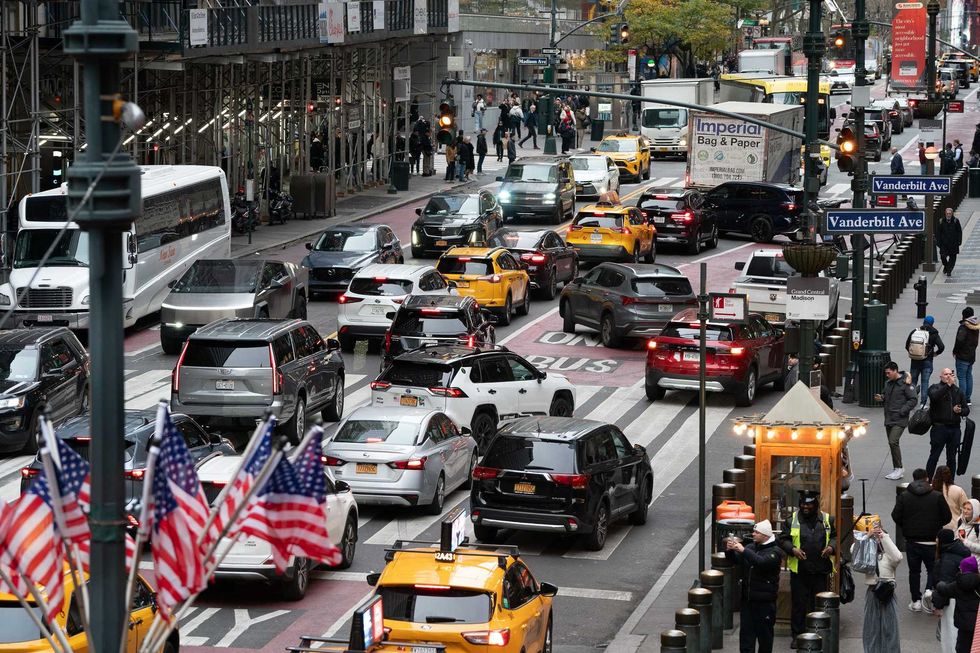 Proponents say the program will cut down on traffic and pollution while providing badly needed funds for mass transit.Barry Williams/New York Daily News/Tribune News Service via Getty Images
The Town of Hempstead on Long Island said Friday it would sue the MTA over "the rushed and covert process by which the controversial New York City congestion pricing plan was approved." Rockland County also announced it was resuming its lawsuit, calling the plan "unfair to Rocklanders."
"We think the crux of our lawsuit stems on what the New York Administrative Procedure Act requires, which is requiring a 45-day period to allow the public to comment on these changes," Hempstead Town Supervisor Don Clavin told 1010 WINS, calling it "a clear violation."
Clavin said residents across New Jersey, Long Island, Westchester and the Hudson Valley have formed "a unified voice" in opposition to "this money grab by the governor."
"We're comfortable that we followed all the rules," Lieber said in response to the suits. "But obviously there's other litigations, and we're confident, but they'll have to run their course as well."
Trump's win in the presidential race this month added new urgency to revive the plan. The president-elect has said he opposes the toll, and he could take executive action to stop it for good.
Public transit and environmental advocates, who had ripped Hochul in June for halting the plan over economic concerns, have hailed its return, saying it's better to have it with a lower price tag than not have it at all.
The Riders Alliance, a group that has backed congestion pricing for years, said in a statement, "Public transit riders are one big step closer to more reliable trains, accessible stations and faster buses. After years of campaigning and holding our leaders accountable, relief cannot come soon enough."
New York City Comptroller Brad Lander also hailed a legal settlement between Hochul and transit advocates who'd sued her over her earlier pause, saying, "Today we are two big steps closer to modernized subway signals, new station elevators, expanded subways, faster bus service, less traffic, and cleaner air."


