


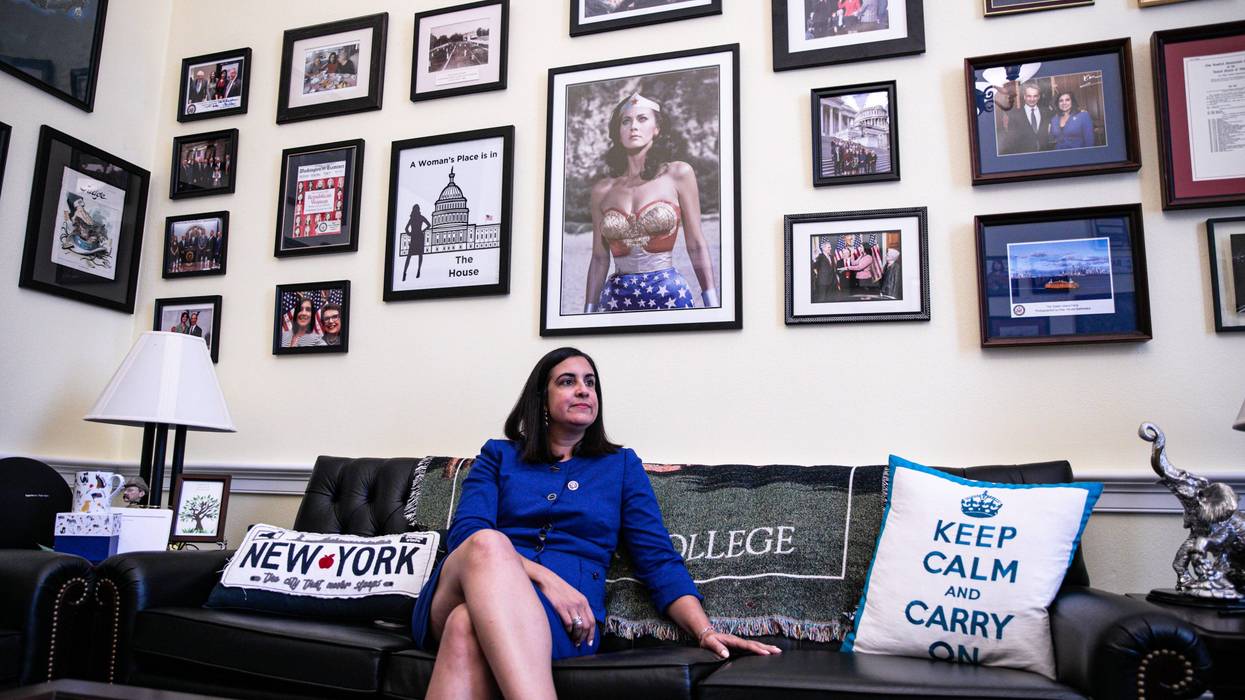

NEW YORK (BLOOMBERG) — Staten Island stands apart from the rest of New York City in more ways than one. But its status as a Republican redoubt in a Democratic stronghold is under threat.
In January, a state court judge ruled that New York's 11th Congressional District, which encompasses Staten Island and a wedge of southwestern Brooklyn, violates the voting rights of minorities who live within it, and must be redrawn.
The judge had given a state panel, the Independent Redistricting Commission, until Feb. 6 to come up with a new map. But the process was paused after Representative Nicole Malliotakis, a Republican who's held the seat since 2021, launched an effort to overturn the judge's order. A new deadline of Feb. 23 has been set for the judge to finalize the lines.
"If the people of this district don't want me to represent them, they can vote me out in the election," Malliotakis said in an interview with Bloomberg News. She blamed the effort to revise her district's borders on political operatives in Washington.
"In no way will we allow a Washington law firm to come along and dictate how this community is going to be represented," she said.
The battle on Staten Island is playing out amid a nationwide campaign to redraw political borders and gain a leg up in the 2026 midterm elections. So far, the parties have largely dueled to a draw. With Congress narrowly divided, control of the House could turn on a small number of skirmishes over district lines.
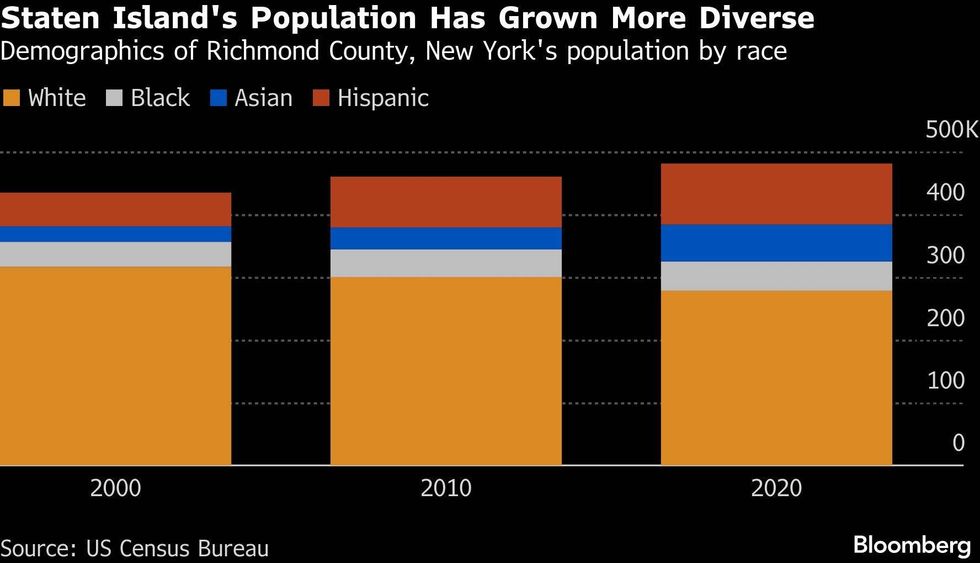
Some Staten Islanders say the fight reflects deeper anxiety about how the borough is changing. Over the past 25 years, an influx of Latino and Asian residents have moved to the northern section of the island, drawn by the prospect of cheaper housing and a more suburban lifestyle. Meanwhile, its South Shore, with its more spacious homes and strong schools, has remained a Republican bastion.
Paul Alexander Shali-Ogli, an activist and campaign consultant who resides on the island, said the shifting demographics have unsettled parts of its electorate. "There are a lot of people who are hopeful for the future," said Shali-Ogli. "But then there seem to be a minority who can't accept that the island has changed since the '70s, '80s and '90s."
Yet Joseph Pidoriano, a local entrepreneur, said reshaping the district would betray Staten Island's conservative character.
"They're going to redraw the lines and make this district a destination where our values aren't represented," said Pidoriano. "Our values are faith, family, freedom, leadership, and the ability to be successful."
Malliotakis's district has been New York City's most durable Republican perch since the early 1980s, when the Staten Island-anchored seat, then numbered differently and once extending into Lower Manhattan, was redrawn to include a conservative-leaning sliver of Brooklyn. Only two Democrats — Michael McMahon in 2008 and Max Rose in 2018 — have won there since. Neither served more than one term.
Malliotakis, whose mother left Cuba following the rise of Fidel Castro, said that hers is "the only competitive seat" in New York City, and serves as a counterweight to Democratic dominance of local politics. Many Staten Island Republicans reject the idea that the district's Black and Latino voters have been disenfranchised.
"It's absurd that a district that elects a Latina would somehow empower minorities by removing the more diverse portion of NY-11 in Brooklyn and replacing it with a lily white district in Lower Manhattan," said Joe Borelli, a former Republican city and state lawmaker for Staten Island who testified in the January court hearing.
Conservative Culture
On the Staten Island Ferry, during the free, nearly 30-minute ride across New York Harbor, the Manhattan skyline recedes gradually. At the St. George Ferry Terminal, passengers step off the boat into a borough where most trips continue by car rather than subway, and where the pace and scale feel far removed from the rest of New York City.
Staten Island's landscape looks less like Midtown than New Jersey, to which it is linked by three bridges. The island's quiet streets are lined by single-family homes in car-dependent, hilly neighborhoods, where a plethora of American flags snapped in gusting wind on a frigid February morning.
Much of the borough's commercial activity runs along Hylan Boulevard, a stretch of set-back strip malls and residential areas running from Tottenville at the island's southern tip toward Fort Wadsworth, just across the water from Brooklyn on the island's northeast.
For many commuters, getting to the city's major employment hubs means a drive on the Staten Island Expressway and over the towering Verrazzano-Narrows Bridge, through traffic that island residents routinely rank among the worst in the city. Others rely on express buses that charge $7.25 each way.
Staten Island's physical isolation from the rest of New York City and its status as a haven for blue-collar workers and city employees including police officers and firefighters has long defined its proudly conservative political culture.
Democrats argue that their party would better represent the island's changing makeup. Assemblymember Charles Fall, chair of Staten Island Democrats, sees it as a question of how effectively the district's interests are represented in Congress.
"If we had a Democrat in this seat, I think we would see a representative that was much more reflective of what hardworking people need in this area," Fall said.
With half a million residents, Staten Island is the least populous New York City borough. Its median annual household income of nearly $100,000 is around $20,000 higher than the citywide average. It is majority White, according to the US Census, but its Asian American and Hispanic populations have surged in the past 25 years.
 Bloomberg
Many of those new residents have clustered on the island's North Shore, where denser housing, lower incomes and higher shares of Black, Latino and immigrant residents contrast with the predominantly white South Shore. The island is bisected by the Staten Island Expressway, a six-lane artery that residents and planners have long described as a social and economic boundary.
Staten Island Republicans fear that if Democrats prevail in their redistricting push, they would be losing representation, and that has renewed talk of seceding from the city to get out from under Democratic domination.
"It's a serious conversation, and I feel it's percolating again," Staten Island Borough President Vito Fossella said.
Secession efforts have surfaced before at times when borough leaders felt Staten Island's needs weren't being addressed. In 1993, nearly two-thirds of voters approved a referendum to secede from the city, but the movement stalled in the New York State Assembly.
National Redistricting Push
The legal dispute over the district's shape will likely turn on the question of whether it is being redrawn to benefit one party or another.
New York passed an amendment to its state constitution in 2014 that prohibits the redrawing of congressional districts to favor candidates or parties.
"Political gerrymandering sets up a system where it's more like an incumbent protection program," Malliotakis said. "You eliminate competitive seats like mine, and you make them lopsided where only one party can win, and therefore the voters can't hold that individual accountable."
On a national level, the pressure to revise electoral boundaries is likely to persist. The unusual middecade scramble to design new districts — previously, most states only altered their maps after the decennial US census — could become a new norm amid increased polarization and closely divided government. But some onlookers have recoiled at leaving much of the process in the hands of courts.
"You don't want to see lines drawn by judicial decree," said Richard Flanagan, a political science professor at the College of Staten Island. "You'd rather have a good state legislative process draw the lines."
GOP officials have signaled their willingness to take their case to the US Supreme Court, if necessary. In the meantime, Republicans on Staten Island fear that they could lose one their few remaining avenues for exerting national influence.
"One of the few ways in which Republican voters can have a voice, at least on the national stage, is through this seat," Fossella said. "And to silence it in this way, in this form, just reaffirms people's cynicism."
More stories available on bloomberg.com.