


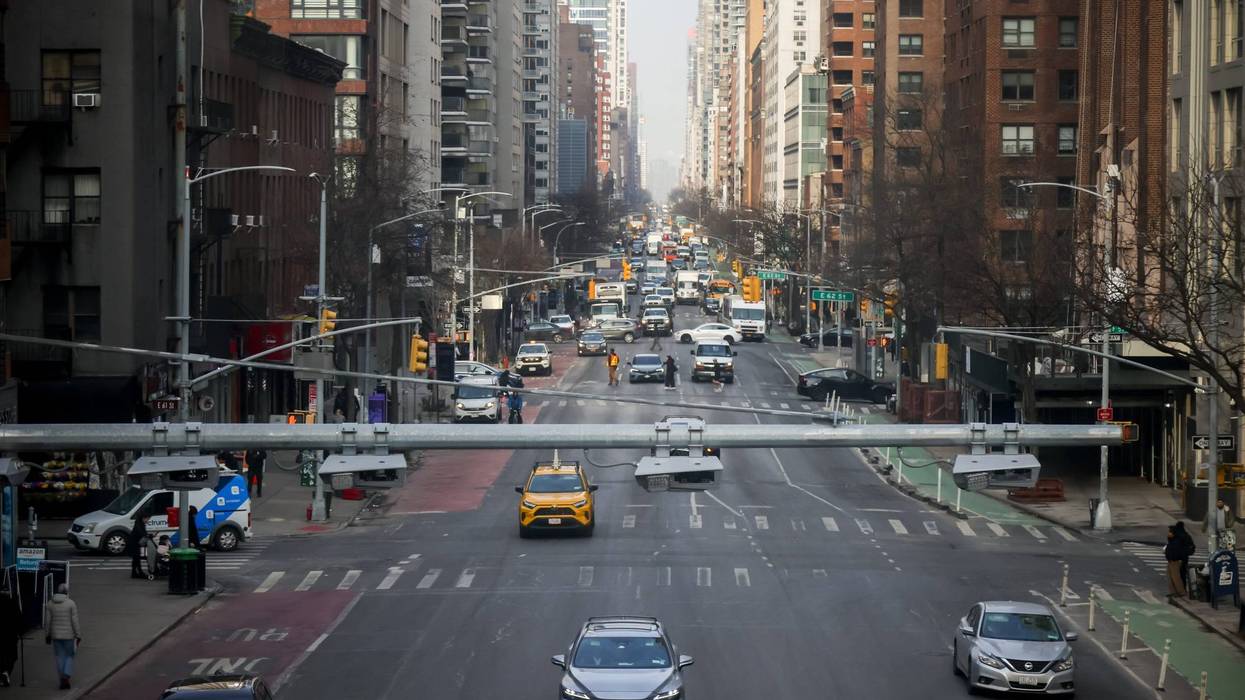

NEW YORK (BLOOMBERG) -- A federal judge appeared skeptical Wednesday of the Trump administration's attempt to cancel a congestion pricing program New York City began a year ago that charges most motorists $9 to enter parts of Manhattan during peak hours.
Last year, US Transportation Secretary Sean Duffy rescinded approvals for the program that were granted during the Biden administration, following up on a campaign pledge by President Donald Trump. The state-run Metropolitan Transportation Authority then sued to prevent the federal government from revoking approval for the toll for driving into Manhattan south of 60th Street.
US District Judge Lewis Liman, who last year ruled the US can't withhold funds or block new MTA projects while the case proceeds, on Wednesday heard oral arguments in the case from the state agency and the US Department of Transportation, both of whom are asking the judge to rule in their favor without a trial.
The case "raises fundamental questions of whether the Secretary of Transportation can enter into a contract for repair of roads and have a counterparty get ready to execute that contract and then say we've changed our minds, we don't like this now, oops sorry," Liman said.
The judge didn't make an immediate decision and is waiting for more written arguments before issuing a ruling.
Roberta Kaplan, a lawyer for the MTA, urged Liman to reject the attempt to end congestion pricing, saying the plan has seen "undeniable" success. She cited data showing that fewer vehicles entered the tolled area last year compared with historical averages, while vehicle speeds have increased and pollution has dropped.
Kaplan said the administration is trying to "assert a radical new theory of presidential power to cancel any contract," and that "only kings like Henry VIII could cancel a contract whenever they see fit." That was an apparent reference to Trump's post from February 2025 declaring that "congestion pricing is dead" and "long live the king!."
"President Trump is President Trump, not King Donald," Kaplan said.
Eric Hamilton, a lawyer for the Department of Transportation, said the dispute arises out of an agreement entered into by the Biden administration just a few weeks after a new president was elected on a promise to make the country more affordable, which included cancelling congestion pricing.
But Liman pressed Hamilton, asking if he was saying that a president couldn't place an order for equipment — such as a plane — that wouldn't be binding on the next administration.
Hamilton called congestion pricing a pilot program that was never intended to continue indefinitely. While the department hasn't made a final decision to end the plan, it has the authority to terminate such projects, he said.
"Congress could insert something in there that the pilot program should continue in perpetuity," Hamilton said.
The new toll, the first of its kind in the US, began Jan. 5 last year and brought in about $562 million in 2025, according to MTA's financial documents. So far, the levy is helping the agency to meet its goal of reducing traffic, improving air quality and raising new revenue to help modernize a more than 100-year-old transit system.
That's helped traffic move faster, with vehicles traveling through the Holland Tunnel to Manhattan during weekday mornings driving an average 16.2 miles per hour, up 51% compared to 2024, according to MTA data. Pollution in parts of Manhattan dropped by 22% in the first six months of the program, according to a Cornell University study.
Governor Kathy Hochul said at a press briefing with New York City Mayor Zohran Mamdani earlier this month celebrating the one-year anniversary of the program that the state continues to stand behind congestion pricing.
"Later this month, guess where we'll be," Hochul said. "We'll be back in court, defending our program once again. But we'll just keep on winning."
Last year, Duffy said the Federal Highway Administration was withdrawing from a Biden-era agreement that allowed the congestion pricing program to proceed. He also has cited subway system crime in threatening to withhold transportation funds for the state.
While the administration questions the legality of the toll, Trump has focused on how the fee could affect the city's business activity. Earlier this month, he said in a Truth Social post that the toll was "a disaster for New York."
But the fee hasn't created the economic decline that some had predicted. Foot traffic last year in the area south of 60th Street in Manhattan increased by 3.1%, higher than the 1.5% growth for all of Manhattan, according to Placer.ai data.
The case is Metropolitan Transportation Authority v. Duffy, 25-cv-1413, US District Court, Southern District of New York (Manhattan).
More stories like this are available on bloomberg.com.


