


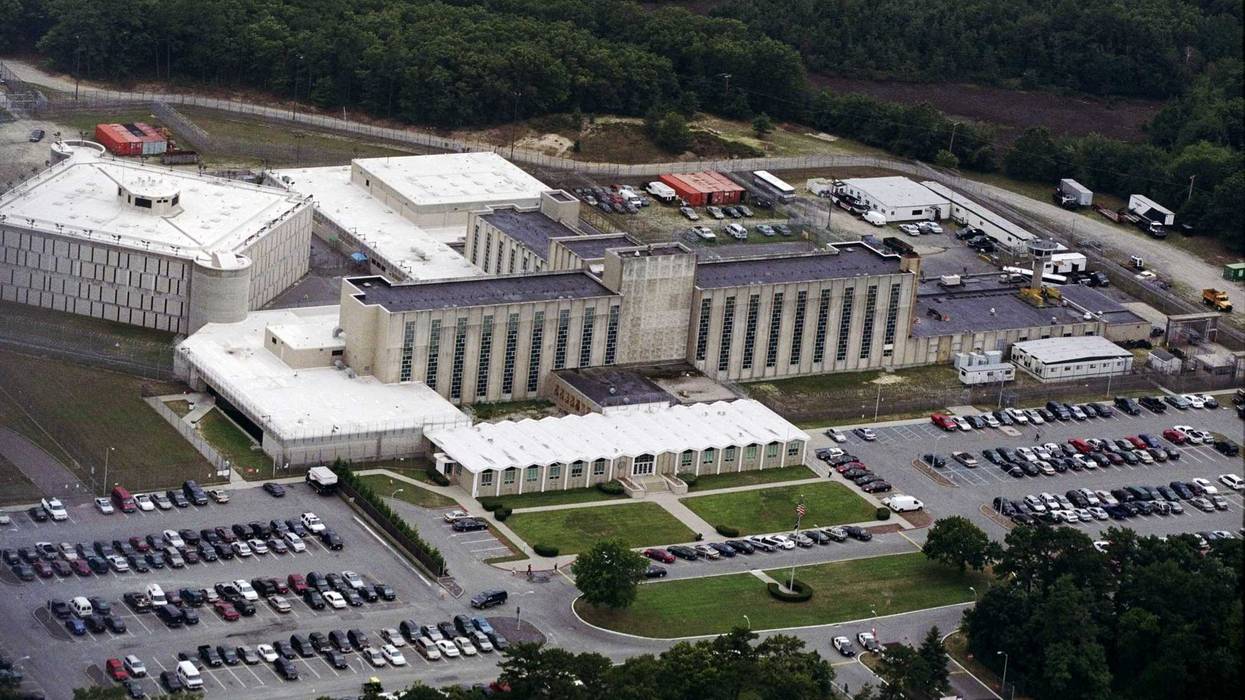

NEW YORK (BLOOMBERG) -- Suffolk County, home to the ultra-wealthy Hamptons and the bucolic North Fork, must pay $112 million in damages to immigrants after a court ruled that their detention in local jails violated their rights.
The Long Island county disclosed the verdict, which it is appealing, to bondholders in a filing this week. A jury granted the award in November following a trial over a lawsuit filed in 2017 in federal court. The suit, which dropped during the first Trump administration, alleged hundreds of foreigners were held past their release dates.
Representatives for Suffolk County said they cannot comment on pending litigation.
The case is part of a strategy that "shows that cities, municipalities, counties, correctional facilities, can be liable for large sums of money if they cooperate with ICE," said Andrew Case, an attorney at LatinoJustice PRLDEF, which filed the case on behalf of more than 600 plaintiffs.
The verdict comes as local officials consider when or how to cooperate with US Immigration and Customs Enforcement under the Trump administration. In his second term, President Donald Trump has continued to push for partnerships between local jurisdictions and federal law enforcement to support his plan to ramp up the deportations of undocumented immigrants.
Local Agreements
To reach its goal of more than 1 million arrests and removals a year, the administration has been working to rapidly expand 287(g) agreements that let some local officers perform limited immigration functions. Suffolk County has no such arrangement. Instead, the case centers on a different but related practice: ICE's so-called detainer requests asking local jails to hold immigrants longer than their scheduled release so federal agents can take custody.
Administration officials have repeatedly criticized local authorities for not honoring detainer requests for suspected criminals. Most recently, the agency has urged New York Attorney General Letitia James, a target of the Justice Department in a criminal investigation, to honor the immigration arrest requests.
Not honoring detainers has also brought the threat of federal crackdowns. On Wednesday morning federal authorities, led by the US Border Patrol, launched an arrest blitz in New Orleans in response to what the administration described as "sanctuary policies that force local officials to ignore US Immigration and Customs Enforcement arrest detainers." The Department of Homeland Security made similar statements about the agency's recent enforcement focus in Charlotte.
States and law enforcement across the country remain divided on providing support for federal enforcement efforts. On Wednesday, the Wisconsin Supreme Court agreed to take up a challenge to state law enforcement's authority to arrest individuals subject to federal immigration retainers.
In July, Trump earmarked $165 billion for immigration enforcement, including fully funding ICE's 287(g) program and offering reimbursement for salaries, benefits and overtime for participating agencies. The bill also includes $12 billion to reimburse states, like Texas, that fought against then-President "Biden's open border policy."
The Suffolk verdict could spur future lawsuits. Suffolk County retained a surety bond, a routine step in the appeals process that provides proof of an ability to pay damages while a case continues, according to the securities filing.
Wealthy County
The easternmost county in New York is home to some of the wealthiest enclaves in the US, including the Hamptons and Fire Island — popular summer vacation destinations. The region also contains high populations of undocumented migrants who have clustered in towns such as Riverhead and Huntington, and have faced heightened ICE activity this year.
Nearly half of the 66,000-some undocumented immigrants in Suffolk County are from El Salvador and Honduras, according to 2023 data from the Migration Policy Institute (MPI), a nonpartisan immigration policy think tank.
The county's general-obligation bonds carry an AA- grade, the fourth-highest level of investment grade, from S&P Global Ratings, which highlighted its large and diverse economy and above-average incomes, in an October report. Suffolk, home to 1.5 million residents, has a median household income of about $127,000, according to US Census data.
Howard Cure, director of municipal bond research at Evercore Wealth Management, said places like Suffolk - and New York City, which has its own $92 million ICE-related settlement on the books - are unlikely to be burdened by any additional debt spurred by settlements. But if the pattern continues, smaller entities could experience a squeeze in more acute ways.
"If you have a small community in violation of this sort of due process issue, the potential liability on a per prisoner basis is the same, but disproportionate to the size of their budget," said Cure.
Lawyers, including LatinoJustice's Case, say they have been approached by other would-be plaintiffs for additional suits in other jurisdictions. In June, lawyers from the New York Civil Liberties Union joined LatinoJustice and other civil rights groups to file a case against neighboring Nassau County in response to its efforts to cooperate with ICE enforcement.
Both the sheriff's office and police department in Nassau County have 287(g) agreements on the books, but neither agency participate in jail enforcement model agreements. ICE has entered into roughly 1,200 total agreements across 40 states.
"Now other people are on notice that this is what happens if you engage in this conduct," said Case.
The case is Orellana Castaneda, et al. v. County of Suffolk and Suffolk County Sheriff's Office, et al., 2:17-cv-04267-WFK-ARL, US District Court, Eastern District of New York (Central Islip)
More stories like this are available on bloomberg.com.