

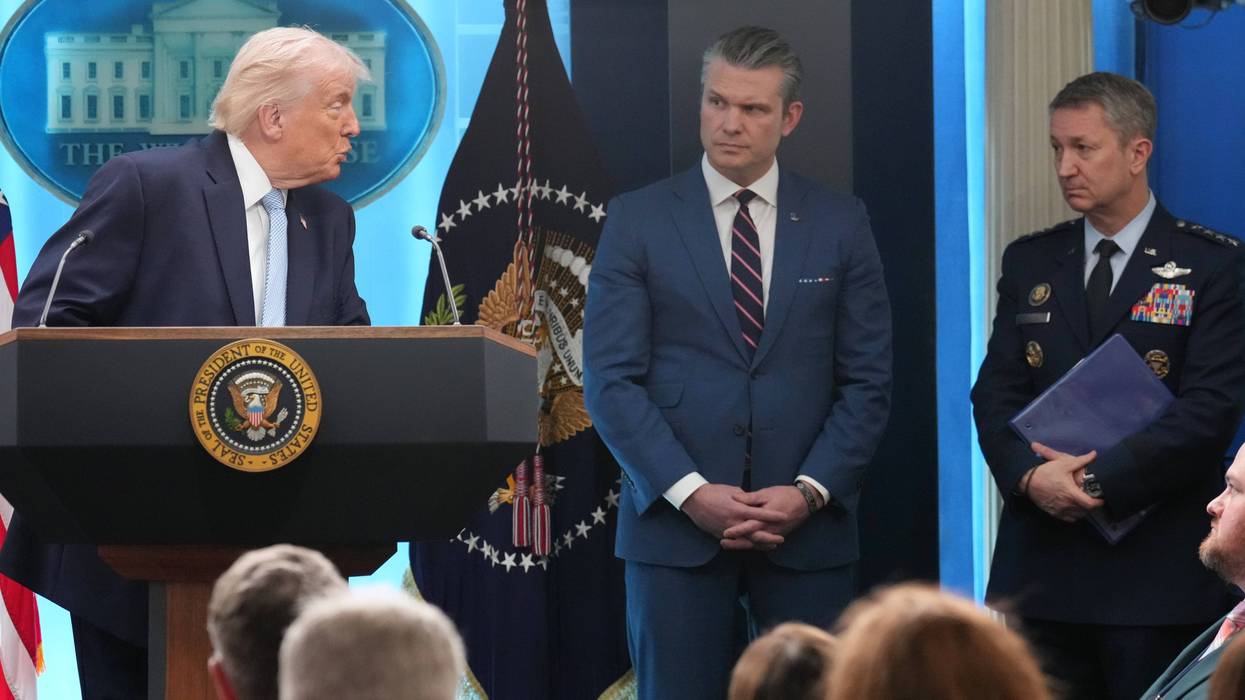

WASHINGTON (AP) — The United States relied on dozens of aircraft, hundreds of personnel, secret CIA technology and a dose of subterfuge to rescue a two-man fighter jet crew downed deep inside Iran, a risky mission that President Donald Trump and his top defense aides detailed Monday.
U.S. forces rescued the pilot within hours of the F-15E Strike Eagle going down late Thursday, surging helicopters, midair refuelers and fighter aircraft deep into Iran after confirming his location, Trump said in a valedictory news conference at the White House, describing the military operation in an unusual level of detail.
The second aviator aboard the aircraft — the weapons systems officer — was rescued nearly two days later.
Trump boasted of the military resources surged and coordination across U.S. agencies to pull off the daring mission to recover the troops in enemy territory, describing the shootdown of the jet by Iran as “a lucky hit” after claiming in a national address last week to have “beaten and completely decimated Iran.”
Another jet is downed in the rescue for the F-15 pilot
The search and rescue operation began in daylight over Iran, with helicopters and other aircraft flying low for seven hours, “at times facing very, very heavy enemy fire,” Trump said.
An A-10 Warthog, which was the attack aircraft primarily responsible for keeping in contact with the downed F-15 pilot on the ground, was hit by enemy fire while engaging Iranian forces, said Gen. Dan Caine, chairman of the Joint Chiefs of Staff.
The A-10 was “not landable,” Caine told reporters, but the pilot continued fighting before flying to a friendly country and ejecting. He was quickly rescued and is doing fine.
After rescuing the F-15 pilot, HH-60 Jolly Green II helicopters were “engaged by every single person in Iran who had a small-arms weapon, and one of the aircraft, the trailing aircraft, took several hits,” he said. The crew members received minor injuries and were going to be OK, Caine said.
The rescue of the fighter jet pilot, who was flying under the call sign Dude-44 Alpha, occurred before the Iranians could marshal a comprehensive search of their own, but finding and bringing home the weapon systems officer was an even more complicated endeavor.
An anchor on a channel affiliated with Iranian state television had been urging residents in the mountainous region of southwest Iran where the fighter jet went down to hand over any “enemy pilot” to police and promised a reward for anyone who did.
The weapon systems officer, who rode in the backseat of the F-15 under the call sign Dude-44 Bravo, was injured but followed his training to get as far from the crash site as possible.
Second airman climbs into the mountains to hide out
“Bleeding profusely,” in Trump's telling, the aviator managed to climb mountainous terrain and call for help Saturday using “a very sophisticated beeper-type apparatus.”
When a plane crashes in hostile territory, “they all head right to that site, you want to be as far away as you can,” Trump said.
CIA Director John Ratcliffe said the spy agency used “exquisite technologies that no other intelligence service” possesses to locate the aviator. At the same time, the CIA mounted a deception operation to mislead Iranians who also were trying to find him.
Ratcliffe said the search and rescue operation was “comparable to hunting for a single grain of sand in the middle of a desert.”
The CIA declined to respond to questions Monday about the kind of technology used to find the airman, but Trump colored in some details.
He said intelligence officials noticed something moving in the dead of night, in the mountains where they were surveilling. Trump said officials kept a camera on the moving object for 45 minutes and when it was no longer moving, they thought maybe they had it wrong.
But “it was the head of a human being,” the president said. “And then all of a sudden, 45 minutes later, he moved a lot, stood up, and they said, ‘We have him.’”
He added, “And that was really at the beginning of something incredible.”
Protected by an “air armada” of drones, strike aircraft and more, rescuers moved in on Sunday. Cargo planes flew in three small helicopters and assembled them near the patch of mountains where the missing airman was concealing himself inside a cave or crevice.
But when it came time to leave, the cargo planes were too weighed down by equipment and personnel to take off from the sandy terrain. The downed airman and his rescue team were picked up by three “lighter, faster aircraft” and the equipment on the ground was blown up to keep it out of Iranian hands, Trump said.
US makes several efforts to throw off Iranian forces
Many of the dozens of aircraft that were part of the operation were there for deception, Trump said.
“We were bringing them all over, and a lot of it was subterfuge,” Trump said. “We wanted to have them think he was in a different location.”
Back in Washington, national security officials coordinated on a call, keeping the phone line open for nearly two days straight.
“From the moment our pilots went down, our mission was unblinking," Defense Secretary Pete Hegseth said. “The call never dropped. The meeting never stopped, the planning never ceased.”
As Trump detailed the operation, his penchant for boasting and flair for dramatic imagery bumped up against some of his aides' instinct to protect military and intelligence secrets. At one point, Trump turned to Caine, his top military adviser, and asked, “How many men did you send altogether, approximately, for the operation?”
Caine equivocated, responding, “Uhhh, I’d love to keep that a secret, Mr. President.”
“OK, well, we are," Trump continued. "But I will tell you — the number, I’ll keep it a secret, but it was hundreds.”
___
Cooper reported from Phoenix, and Amiri from New York. Associated Press writer Josh Boak contributed to this report.