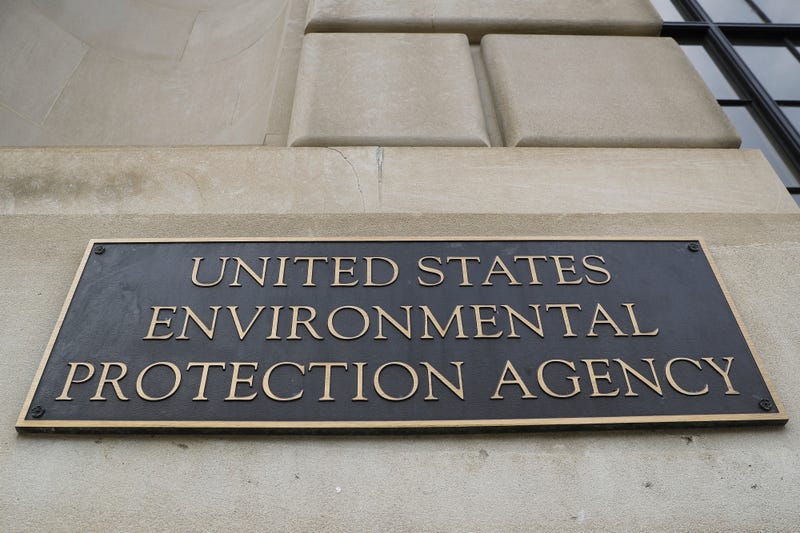
WASHINGTON (AP) — A federal appeals court on Tuesday grilled both the Trump administration and the nonprofits picked to run a $20 billion “green bank” program over the termination of their contacts, questioning whether federal officials made up reasons to block the program and whether the nonprofits were demanding access to money that wasn't technically theirs to control.
The judges on the U.S. Court of Appeals for the District of Columbia Circuit are considering the fate of the Greenhouse Gas Reduction Fund, a congressionally-authorized Biden administration-era program aimed at sparking clean energy investments that the Trump administration has targeted for cancellation. Both sides came in for sharp questioning during three hours of oral arguments.
The judges questioned the Trump administration's allegations of mismanagement and fraud by the nonprofits, which federal officials did not substantiate in earlier court filings. They also questioned whether the nonprofits could use any of the money after Congress last year repealed part of a law that established the green bank.
The full appeals court agreed to rehear the case after a three-judge panel in September said the Trump administration had broad power to cancel contracts without facing allegations in federal district court that it broke the law and violated the Constitution by allegedly terminating contracts arbitrarily and refusing to spend money Congress appropriated. It's rare for the full court to rehear cases, a process reserved for the most important.
An attorney for the Environmental Protection Agency was questioned over what one judge said were shifting reasons for canceling grants for Climate United Fund and other nonprofits. First in February 2025, the government froze the funds without detailed explanation and alleged waste and fraud, then shifted to general concerns that there wasn't enough EPA oversight over the program, according to the questioning.
“The way these were structured was fundamentally inappropriate and unacceptable and required doing them over,” responded Yaakov Roth, an attorney representing the EPA.
Roth contended the government has wide latitude on contracting decisions. Any accusations that those decisions were improper had to be handled by a different court — one that could only provide a financial award to the groups, not restore access to the funds to run the program, Roth said.
Roth also argued that it doesn't make much sense to side with the nonprofits now that Congress in July rescinded the part of the 2022 law that initially authorized the green bank.
The nonprofits are among groups tapped by then-EPA Administrator Michael Regan to receive $20 billion to finance tens of thousands of projects to fight climate change and promote environmental justice. The money was formally awarded in August 2024.
Climate United Fund and other nonprofits were chosen to run the green bank and billions of dollars had been placed in a Citibank account for their use. President Donald Trump's administration quickly targeted the bank after Trump's return to office in January 2025. EPA Administrator Lee Zeldin said he wanted to claw back the funds, alleging potential fraud and conflicts of interest.
As pressure against the green bank built, the EPA moved to freeze the funds in the Citibank account and pushed federal investigations into the groups' conduct. Then it canceled the grants.
A lawyer for the nonprofits argued that the agency had already allocated the money by putting it in the Citibank account for the program's use. But the judges questioned whether it was really in the nonprofits' control at that point, and unlawful for the government to freeze. They also wondered how they should weigh the fact that Congress had rescinded language critical to the money.
Adam Unikowsky, an attorney for Climate United Fund, said at the time Congress rescinded critical parts of the law, the EPA had already acted unlawfully.
Repealing a statute “doesn’t retroactively render an illegal action legal,” he said.
In September, a three-judge panel for the District of Columbia Circuit ruled 2-1 that federal officials have broad latitude to cancel funds appropriated by Congress without facing lawsuits in federal district court.
Writing for the majority, Judge Neomi Rao, a Trump appointee, said the dispute should be heard in federal claims court that considers contract disputes. The dissenting judge, Barack Obama appointee Cornelia Pillard, said the outcome was a loss not just for the green bank groups but for Congress’ authority to write policy and maintain traditional power of the purse.
That decision overturned one by U.S. District Judge Tanya Chutkan, an Obama appointee, that said the EPA couldn’t support Zeldin’s accusations of wrongdoing and that the nonprofits should not have their contracts terminated. Chutkan's order has been on hold pending the EPA's appeal.
___
The Associated Press receives support from the Walton Family Foundation for coverage of water and environmental policy. The AP is solely responsible for all content. For all of AP’s environmental coverage, visit https://apnews.com/hub/climate-and-environment.