


Phillip Gentry
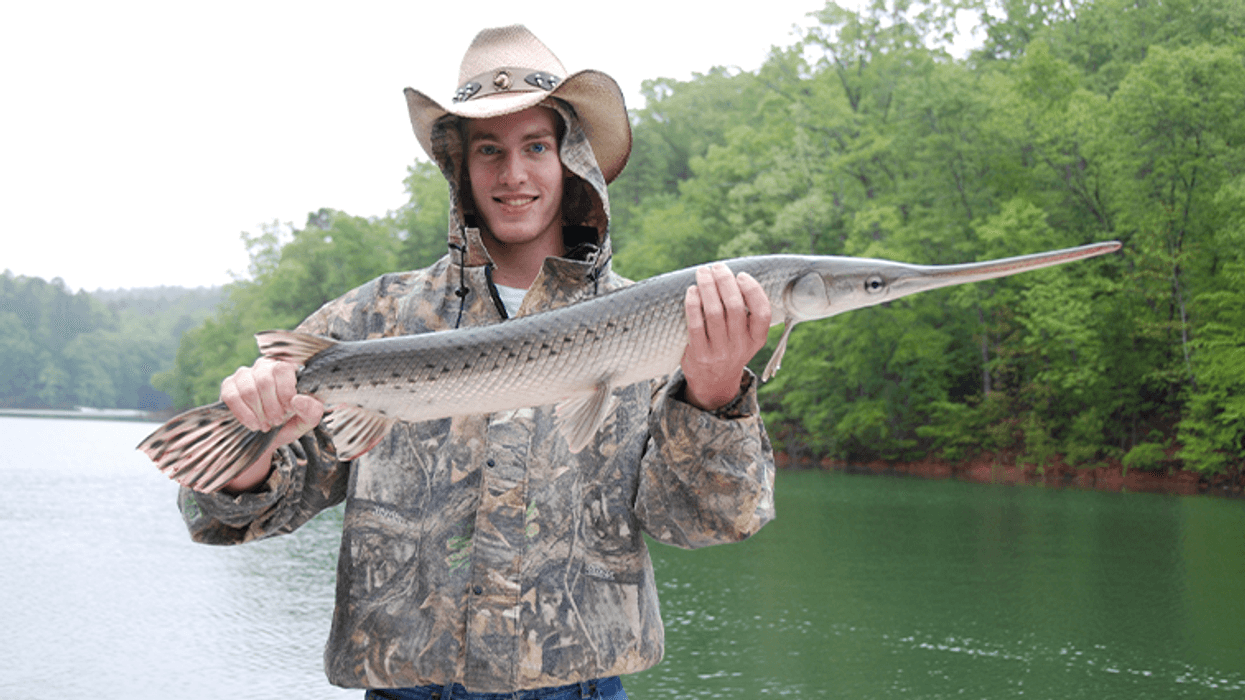
While the South Carolina Governor’s Cup Billfishing Series kicks off next week from John’s Island on the southern coast, South Carolina’s unofficial freshwater billfish is also beginning to make appearances in lakes and reservoirs around the Upstate. The official name of the inshore billfish is longnose gar, a prehistoric creature that has a long thin snout approximating 1/3 – ½ of the fish’s overall length. That snout is studded with thousands of needle sharp teeth that give the gar a more or less undeserved notoriety for fierceness.
For most of the year, longnose gar are present but not seen in our area lakes, but become more prevalent as warming waters signal that start of the spawning season.
A longnose gar female will be courted by several males who circle the female at or near the surface of the water in a ritual of jerky and sometimes erratic splashing movements. The female may 50,000 or more eggs in a season that are then fertilized by the males.
Gar belong to a primitive family of fishes dating back to the late Jurassic period. The fish are characterized by their heavily armored scales and elongated jaws full of teeth. Commonly referred to as “trash fish” by recreational anglers, most gar are harvested by bow fishing anglers who target them for sport and rarely for meat.
The latter part doesn’t sit well with Liberty, SC native Eddie Watford. Watford believes if you’re gonna kill it, you need to eat it. A late night catfishing trip several years ago only served to reinforce that belief.
“I was catfishing one night, around this time of year and kept getting bites, but no fish,” Watford explained. “Once we figured out that it was gar taking the bait and not catfish, we changed over to some wire leaders and began catching them.”
Eating gar has been somewhat of an urban legend with some folks touting the meat as a delicacy and others not so much. The first obstacle was how to clean the creature.
“I googled “How To Clean Gar” on the internet and most were using hatchets and axes, but I found that a pair of straight metal shears cuts through the armored scaled pretty easily,” he said.
Starting at the head and cutting around the gill plates, Watford then cuts down the back along the dorsal fin all the way to the tail. After that it’s just peeling the skin off and trimming the the skin off.
“I’ve heard the eggs are poisonous, I don’t know but I just don’t disturb the entrails,” he said. Once the meat along the spine is exposed, you simply fillet it out in two long pieces along the pine and rib cage and you have two nice tenderloin-esqe fillets.
Watford has never tried freezing the meet, opting to immediately soak the fillets in mustard and hot source for an hour or two, then brush the fillets off, roll them in House Autry fish meal and deep fries them.
“Just don’t overcook them,” Watford suggested. “They tend to get really tough if overcooked.”
Local fishing guide and prior skeptic Chip Hamilton of Hamilton Outfitters and Taxidermy in Easley is now a fan.
“Well for those who’ve never tried it. We all tried gar nuggets for the first time,” wrote Hamilton on his Facebook page. “And definitely will eat another gar.”
***********************
Phillip Gentry is the host of “Upstate Outdoors,” broadcast from noon to 2 p.m. Saturdays on 106.3 WORD FM or online at 989word.com.