


By Karen Abeyasekere, 100th Air Refueling Wing Public Affairs
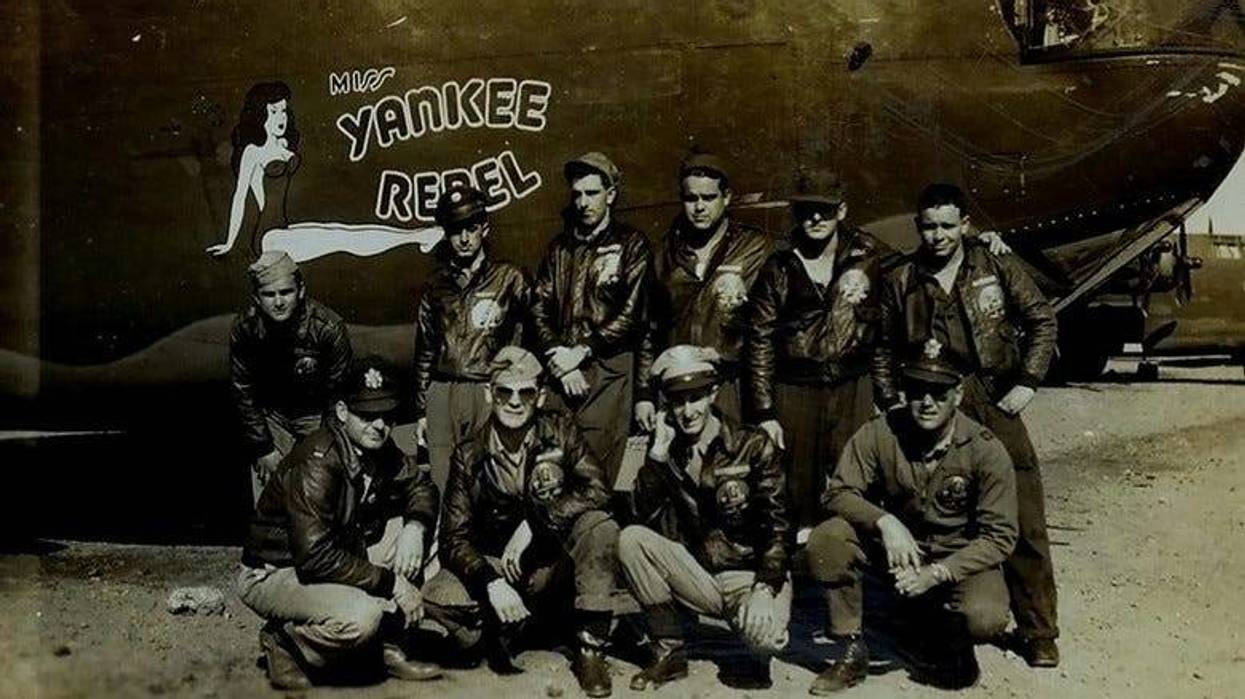
RAF MILDENHALL, England -- As his B-24 Liberator started a spiraling descent after encountering hostile anti-aircraft fire over Bulgaria, 1st Lt. John Crouchley knew what he had to do. Holding tightly onto the controls and desperately fighting with two badly damaged engines, he made sure his nine-strong crew was able to parachute to safety and escape with their lives before the aircraft hit the ground.It was June 28, 1944, and the crew of “The Miss Yankee Rebel” were on their way home from a bombing mission in Romania. Those nine Airmen lived to see another day; their pilot perished along with his aircraft.
“He coordinated everything, took us to the site every day, provided us with food, cut down trees to enable us to get to the dig site – you name it, he did it. Todor also dealt with a lot of the cultural awareness issues for us; it was a tiny village and community, and Americans were their enemy during World War II, so a lot of people who grew up in the area didn’t want to disclose a lot of information to us. But he vouched for us as ‘his people’ and that made a huge difference in their openness to reveal information that was crucial to recovery,” Ogramic said.When Crouchley perished in 1944, a young 22-year-old named Lazar Karakashev was one of the locals who pulled his body from the wreckage. Ogramic explained that taking care of the dead was important to the Bulgarian people, even though it was in the middle of World War II, and it was an enemy pilot who crashed into their territory. It was out of respect that the locals made sure he was given a proper burial, away from the burnt-out plane.More than seven decades later, Karakashev came back to help the DPAA team in their search for Crouchley’s remains. Still living in the village, it was the now-96-year-old who provided crucial information from his eyewitness accounts that helped pinpoint exactly where they should start digging – and it wasn’t at the site of the crash.“’Grandpa Lazar’ got very emotional and broke down and cried when we talked about Lt. Crouchley, and started reliving the old scenes from World War II,” Ogramic said. “But at 95 years old (at the time of the search) he still went down the mountain with us and screened heavy buckets of dirt. He got to work, wanted no help, and just acted like he was one of us.”
Above: Lazar Karakashev, a local witness emotionally recalls details of the crash as he tells the team, “together we will find him."
His role as the translator between Karakashev and the U.S. team meant a great deal to Ogramic . Being the go-between meant he was the first to hear the old man recount his stories.
“Really, when I saw him break down it really got to me, then everybody started breaking down,” he said. “You want to make sure you don’t lose anything, any of the feeling; it comes out different in English – there’s no literal translation for a lot of words, though obviously, we could see emotion flow out. People would see that and it was just amazing.“When we found pieces of what we thought were remains, the locals brought down a priest and had the grounds blessed, because we’d just dug up a human and they have a high respect for honoring the dead. That was something they did of their own free will,” Ogramic said.These were just two of the many locals who helped the team with their stories and accounts, in addition to the Bulgarian government and embassy, who gave them approval to excavate the area. Having been a Communist country for many years previously, it took a long time to work out all of the issues before the mission could begin.But through hard work and determination, and with the help of Karakashev, Hristov and other villagers, the team finally started recovering evidence that they were searching for.“Todor and Lazar dedicating their time to helping us out of the pure goodness of their hearts. To hear these gentlemen talk about Communism and the hard times they went through during World War II was amazing,” Ogramic said. “To this day they’ve never forgotten about the man who crashed into their village; they never asked for any of that and they were caught in the middle of a war, but they still took the time to bury him properly. They legitimately care and it’s so humbling to me.”One of Crouchley’s personal effects found, was a wedding ring belonging to his wife, which bore her initials.