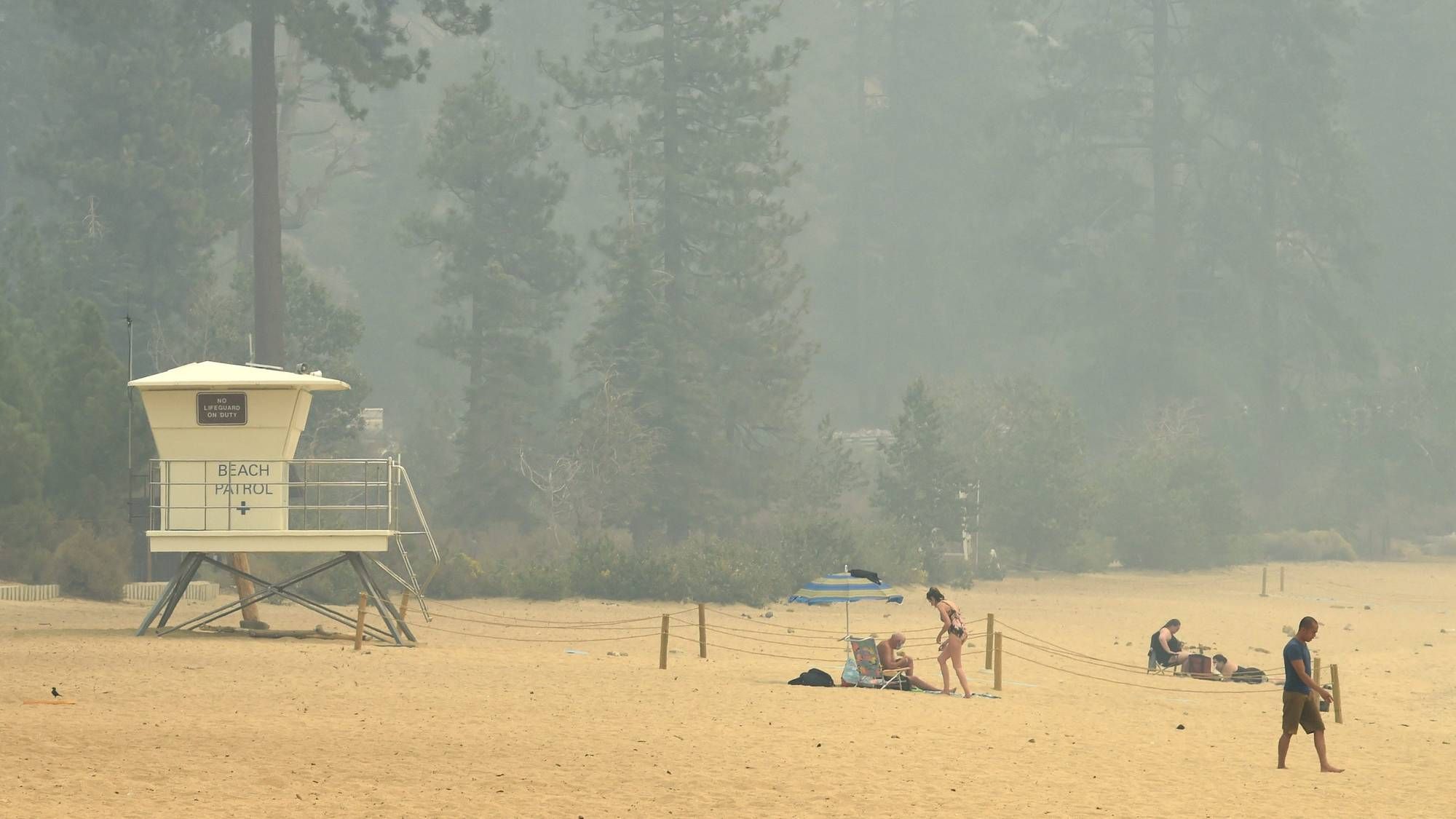



By the end of this upcoming weekend, the Bay Area will have been under an air quality advisory for the majority of August due to wildfires burning throughout Northern California.
The region will also have had at least four Spare the Air alerts this month.
The Bay Area Air Quality Management District on Friday morning upgraded its air quality advisory for Friday and Saturday to a Spare the Air Alert for those same days, forecasting unhealthy air quality for sensitive groups throughout the region.
The Bay Area has now had 17 air quality advisories this month.
Since Aug. 12, the district issued air quality advisories on all but four days: Aug. 17, 22, 25 and 26. The air district also issued the first two Spare the Air Alerts of the year due to fine particulate matter, on Aug. 19 and 20, because of a spate of wildfires in California, Oregon and Washington.
The alerts returned for this Friday and Saturday.
"What's happening today, which is different from yesterday, is that some of the smoke that was high aloft and is mixing and coming down to ground level," Ralph Borrmann, a spokesperson with the Bay Area Air Quality Management District, told KCBS Radio on Friday afternoon.
"And so that impacts parts of the North Bay, in the eastern part of the Bay Area. But that's also combining with high heat, and so it's increasing ozone in those areas as well, and in the Santa Clara Valley. So most of the Bay Area will have some impact from particles due to wildfires or ozone."
The Bay Area is nowhere near the record-setting 52 Spare the Air Alerts issued last year, as seven total have been issued in 2021. All but six of the 2020 alerts were issued due to particulate matter, the primary pollutant in wildfire smoke.
More air quality advisories and Spare the Air Alerts could be on the horizon, however, as wildfires continue to burn.
Four active Northern California wildfires have burned over 100,000 acres so far. Only one is close to full containment.
The Dixie Fire (749,713 acres and 45% containment, per CAL FIRE) is the second largest in state history, while the Monument Fire (157,557 acres, 20% containment) is nearing the top 20. The Caldor Fire (143,951 acres, 12% containment) is rapidly approaching the Lake Tahoe Basin. Firefighters made good overnight progress on the McFarland Fire (122,653 acres), which is now 93% contained.
The long-term health effects of prolonged wildfire smoke exposure are largely unknown. Harvard researchers published a study earlier this month that attributed nearly 20,000 additional COVID-19 cases and 750 deaths in 2020 to wildfires that burned up and down the West Coast.