

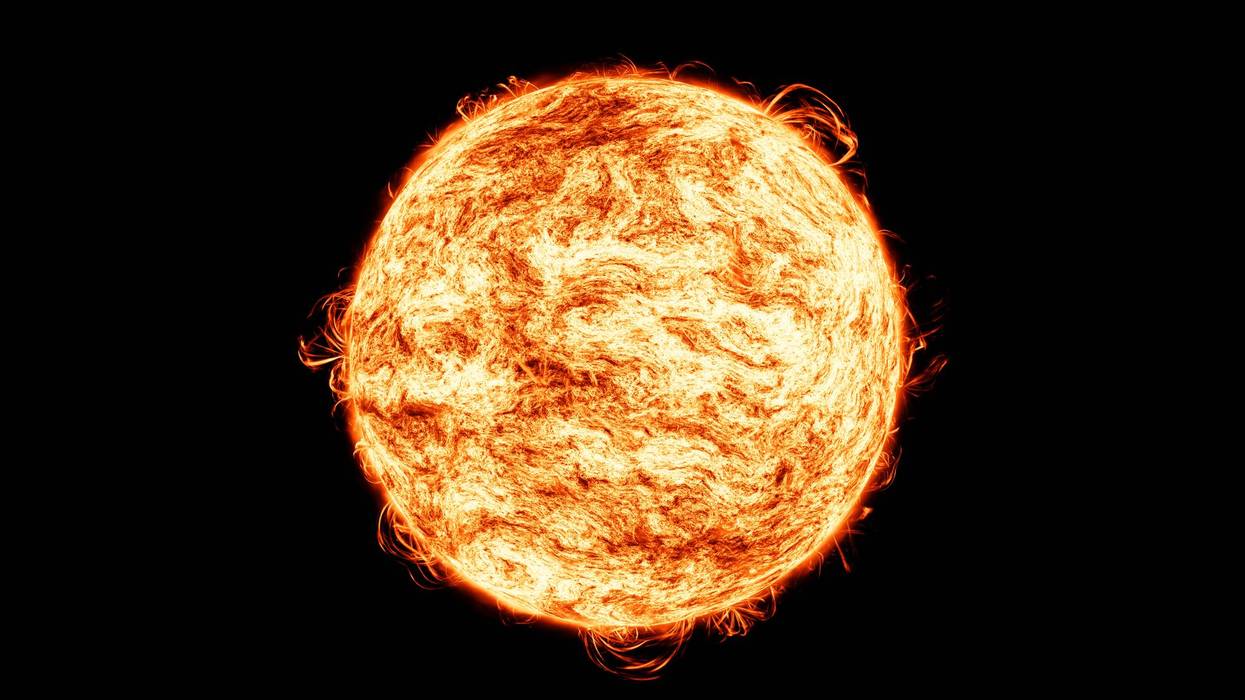

Just before 5 p.m. Tuesday, a strong solar flare emitted by the sun peaked, according to NASA. Its Solar Dynamics Observatory, captured an image of the event.
Due to the flare, parts of the U.S. might have beautiful lights in their skies heading into the weekend – and we don’t mean fireworks.
Solar flares like this one are basically bursts of energy (electromagnetic radiation) generated by the sun, usually associated with sun spots. Here on Earth, solar flares can impact radio communications, electric power grids and navigation signals. They are also the energy behind the aurora phenomenon that lights up the sky with color, and in space they pose risks to spacecraft and astronauts.
Tuesday’s flare was classified as an X1.1 flare and it caused “strong degradation of or signal loss on high frequency (HF) communication bands over much of the sunlit side of the Earth for minutes to hours, per the National Oceanic and Atmospheric Administration’s Space Weather Prediction Center. NASA explained that X-class refers to the most intense type of flares and 1.1 provides information about flare strength.
During a flare, the energy from the sun travels at the speed of light and cause radio blackouts. Space.com reported that the flare this week lasted just over eight minutes and triggered string blackouts that impacted high-frequency radio users in North America.
“The eruption also launched a coronal mass ejection (CME) – a huge cloud of magnetized solar plasma hurled into space,” said the outlet. “Initial observations suggested most of the material was traveling northward, limiting the chances of a significant Earth impact.”
Looking forward, the Space Weather Prediction Center issued a Moderate (G2) geomagnetic storm watch for July 3. Earth-directed CMEs can interact with the planet’s magnetic field and spark geomagnetic storms and produce northern lights displays, Space.com added.
NOAA said such auroras could become visible across some northern and upper Midwestern U.S. states, from New York to Idaho, if skies are dark and clear, for the July 4 weekend. Those interested in seeing the lights can learn more space weather may affect Earth, can visit NOAA’s Space Weather Prediction Center at https://spaceweather.gov/.“Exactly how impressive the display becomes will depend on the strength of the CME and, crucially, the orientation of its embedded magnetic field when it arrives,” Space.com noted.
This latest solar flare comes after another X1.0 flare was reported last month on June 3, according to NASA.