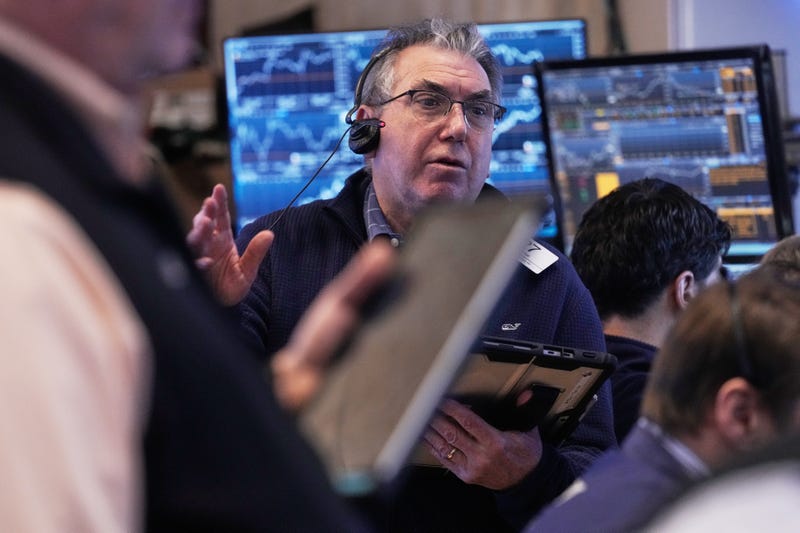
NEW YORK (AP) — Oil prices climbed, and stock markets slumped Monday as investors and households got the first chance to see what the war in the Middle East could mean for their finances.
Crude prices jumped more than 6%, which will likely translate into higher prices at gasoline pumps, because of fears that a widening war could slow the global flow of oil. More expensive fuel will also hit many U.S. companies, and sinking stocks for airlines, cruise lines and others helped drag the U.S. stock market lower.
The S&P 500 fell 0.8%. The Dow Jones Industrial Average was down 495 points, or 1%, as of 9:35 a.m. Eastern time, and the Nasdaq composite was 0.7% lower.
Prices shot up for natural gas, meanwhile, which could mean higher heating bills for the remainder of the winter, after a major supplier of liquefied natural gas to Europe said it would stop production because of the war. Gold climbed 2.2% as investors looked for safer things to own and as U.S. officials tried to persuade the world that this war will not last forever.
“This is not Iraq," U.S. Defense Secretary Pete Hegseth said Monday. “This is not endless.”
Typically, Treasury yields also fall when investors are feeling nervous. But yields instead climbed, in part because higher oil prices will put upward pressure on inflation, which is already higher than most everyone would like. That could tie the Federal Reserve’s hands and keep it from cutting interest rates.
Lower interest rates can help the economy and job market, while also worsening inflation. Higher rates can do the opposite.
Past military conflicts in the Middle East have not caused long-term drops for markets. For this war to knock down U.S. stocks in a significant and sustained way, the price of oil would perhaps need to jump above $100 per barrel, according to strategists at Morgan Stanley led by Michael Wilson. It’s still well below there.
At the moment, nevertheless, fear is rising.
Stocks of airlines were some of Monday’s sharpest losers. Not only do higher oil prices threaten their already big fuel bills, the fighting in the Middle East closed airports and left travelers stranded.
United Airlines fell 5.5%, American Airlines lost 6.7% and Delta Air Lines dropped 3.9%.
Norwegian Cruise Line Holdings fell even more, 11.3%. It needs customers to have plenty of cash to spend after paying for their gasoline bills and other essentials. The cruise operator also reported a stronger profit for the latest quarter than analysts expected, though its revenue fell short. Its forecast for profit this upcoming fiscal year was weaker than analysts expected.
Among some of Wall Street’s few winners were oil companies, which benefited from the rising prices for crude. Exxon Mobil climbed 2.2%, and Occidental Petroleum rose 2.3%.
Companies that make equipment for the military also rallied. Lockheed Martin climbed 4.3%, and RTX rallied 3.8%.
In stock markets abroad, indexes fell across much of Europe and Asia. Germany’s DAX lost 2.7%, France’s CAC 40 fell 2.3% and Hong Kong’s Hang Seng dropped 2.1% for some of the world’s larger losses.
Stocks in Shanghai were an outlier and rose 0.5%.
In the bond market, the yield on the 10-year Treasury rose to 4.01% from 3.97% late Friday.
The value of the U.S. dollar also rose against other currencies, including the euro and Japanese yen.
___
AP Business Writers Matt Ott and Elaine Kurtenbach contributed.