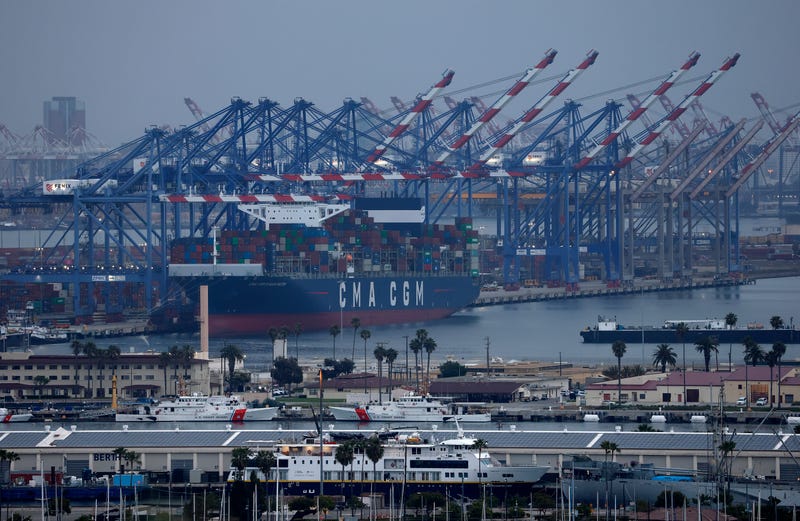

The Port of Los Angeles handled 843,000 containers in April, a 9.5% increase over the same period last year, marking the 10th straight month of year-over-year growth driven in part by a strategy to offload shipments ahead of U.S. tariffs, officials announced Monday.
Want to get caught up on what's happening in SoCal every weekday afternoon? Click to follow The L.A. Local wherever you get podcasts.
Port of Los Angeles Executive Director Gene Seroka reported Monday that imports landed at 439,230 twenty-foot equivalent units, or TEUs, a 5% increase compared to 416,929 TEUs in April 2024. Exports came in at 128,394 TEUs, a 3.5% decrease from 2024, which officials cited was a result of retaliatory tariffs in play. Movement of empty containers back across the Pacific Ocean stood at 275,183 TEUs, a 25% increase compared to 220,362 TEUs in April 2024.
The port has moved approximately 3.4 million TEUs year-to-date, a 6% increase compared to nearly 3.2 million TEUs in the same period last year.
"Initially that growth was propelled by a robust economy and high consumer confidence levels," Seroka said. "More recently, the key factor has been the push to bring cargo in ahead of today's tariffs."
He said the rapid pace of trade policy changes is making it difficult for businesses, economists and ports to make short-term forecasts, adding, "It's clear that we'll see a pullback in global trade."
In April, President Donald Trump announced his long-promised "reciprocal" tariffs -- calling for a 10% baseline tax on imports and other higher rates for U.S. trading partners that run so-called trade surpluses. The U.S. placed tariffs on Canada and Mexico by 25%, which officials offered to drop to 12% once certain demands were met. Trump similarly announced a 34% tax on imports from China, 24% on Japan and 32% on Taiwan, among others.
These levies were ultimately paused for 90 days, but Trump did impose a baseline 10% tariff on nearly all trading partners. China was the only exception -- the U.S. increased the tariff to 145% and China threatened a 125% tariff on U.S. goods.
Last week, the two nations agreed to scale back those tariffs for 90 days while negotiations continued. U.S. officials said it would reduce its tariffs on imports from China to 30%, while China said it would reduce its tariffs on U.S. goods to 10%.
"Tariffs are still elevated, and these deadlines coming up will cause a little bit of trepidation -- not knowing where we'll all land after the pauses of 90 days with respect to China and the rest of the world," Seroka said.
According to The Budget Lab at Yale University, a non-partisan policy research center, consumers face an overall average effective tariff rate of 17.8%, the highest since 1934. Additionally, tariffs disproportionately affect clothing and textiles, with consumers facing 15% higher shoe prices and 14% higher apparel prices in the short-run.
Seroka noted that there are about 80 "sailings," or cargo ships, expected to arrive in Los Angeles, with 17 cancellations already confirmed and 10 more still planned for the month of June.
"As we had been talking about, volume in the first week of May here at the Port of LA was down more than 30% on the import side of our ledger," Seroka said. "The May volume drop is likely to be substantial when we close the books on this month."
He anticipated that there may be an uptick in shipping from China, but likely not enough of a surge to overtly impact the port. Seroka also warned that less cargo means less work on the waterfront.
Seroka remained hopeful that the port's strong financial policies over the past decade will help sustain operations through the current cycle. The port has ongoing infrastructure projects on the ground, totaling more than $2 billion.
"What we see today are about 3,500 construction workers on the job every day. I want to keep those women and men out there working," Seroka added. "It may give us a chance to accelerate projects and complete them fast than once thought."
According to Seroka, the impacts of tariffs are already being felt, and affecting American consumers, good prices, good quality and speed to market.
"This story has not been fully written yet, safe to say, the volume of this cargo will probably come down," Seroka said.
"We've even seen some of the American parcel companies who do business internationally beginning to tweak their service offering, and in the case of UPS, laying off 20,000 workers, not just related to de minimis but broadly what they wee in the consumer uptake and the parcel service business coming in the months ahead."
Follow KNX News 97.1 FM
Twitter | Facebook | Instagram | TikTok