


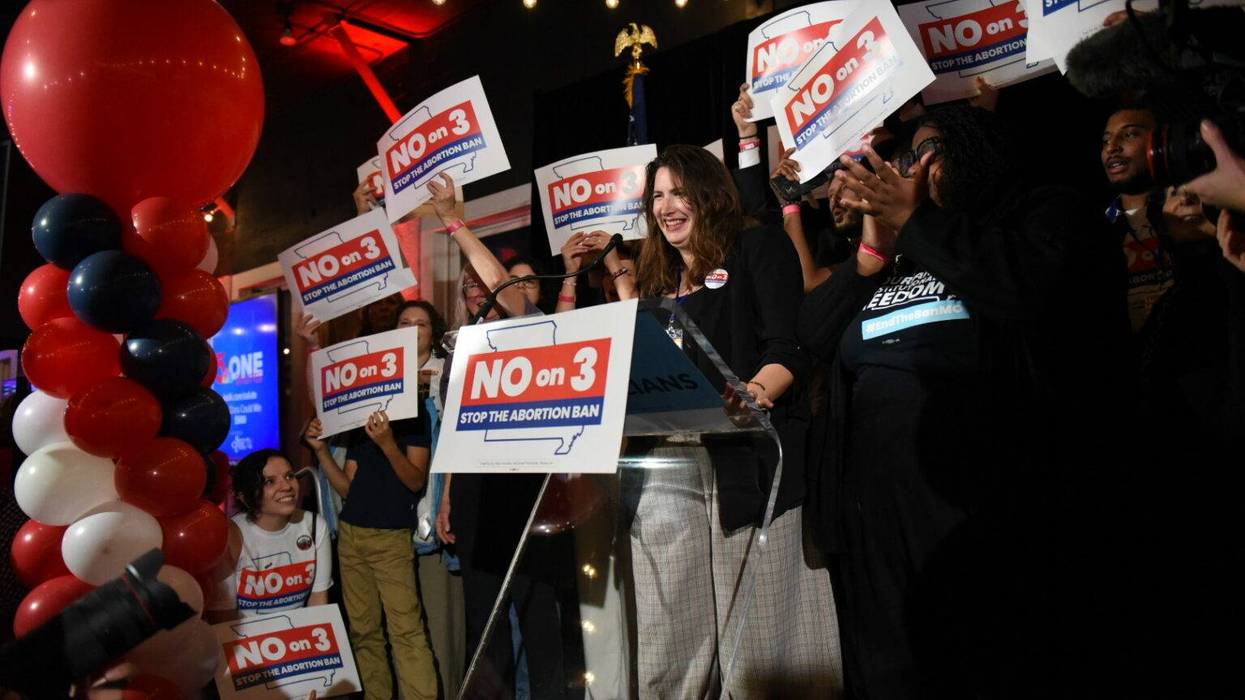

Two years after becoming the first state to overturn an abortion ban at the ballot box, Missouri voters overwhelmingly rejected an attempt Tuesday to reinstate the ban, preserving the reproductive rights protections they approved in 2024.
The defeat of Amendment 3, which won only 44% of the vote, leaves in place a constitutional right to abortion up to the point of fetal viability, rejecting an effort by Republican lawmakers to reverse the narrow abortion rights victory two years ago.
The proposed amendment would have banned nearly all elective abortions, with exceptions for medical emergencies, fetal anomalies and pregnancies resulting from rape or incest if an abortion was sought within the first 12 weeks.
It also would have placed a constitutional ban on gender-affirming care for minors.
“The anti-abortion politicians did not like the way we voted in 2024 …” Tori Schafer, a spokesperson for the Stop the Ban campaign, said during a canvassing event in September. “Amendment 3 is a power grab, one that takes the power away from you and me to make medical decisions with our families and our doctors and puts politicians and lawyers in charge of our decisions.”
The result is a setback for Missouri’s anti-abortion movement, which spent two years rebuilding its campaign after narrowly losing the 2024 vote.
This time, unlike in 2024, the effort to reinstate an abortion ban had significant and organized support from Republican lawmakers, Gov. Mike Kehoe’s office and many of the state’s largest churches.
Kehoe, who campaigned across Missouri for Amendment 3 on Monday, told supporters during a stop in Chesterfield that its defeat would be “a sad day for Missouri.”
But the proposal also faced opposition from some anti-abortion activists who argued its exceptions went too far.
Among them was Republican state Sen. Mike Moon, who publicly criticized the amendment for allowing abortions in cases of rape, incest and medical emergencies.
The campaign supporting Amendment 3, Her Health, Her Future, raised more than $7 million, but was significantly outspent by abortion rights advocates.
Ahead of Election Day, Stop the Ban had raised more than $27 million.
The abortion rights campaign drew small donations from thousands of Missourians, but much of its financial support came from wealthy out-of-state donors and progressive nonprofit organizations that are not required to disclose their donors.
Among them was the Fairness Project, a Washington, D.C.-based nonprofit and the campaign’s largest contributor.
Tuesday’s vote preserves the reproductive rights amendment that Missourians approved in 2024 with support from 51.6% of voters.
That measure overturned the near-total abortion ban Missouri enacted in 2022, immediately after the U.S. Supreme Court struck down Roe v. Wade.
Missouri was the first state to enact a trigger law banning nearly all abortions following the Supreme Court’s ruling.
Thousands of Missouri women subsequently traveled to clinics in Illinois and Kansas to obtain abortions. Others ended pregnancies using medication obtained through telehealth providers in states where abortion remained legal.
The 2024 reproductive rights amendment reached the ballot through a citizen-led initiative petition effort spearheaded by organizations including the ACLU of Missouri, Abortion Action Missouri and local Planned Parenthood affiliates.
Following its passage, abortion access slowly returned to Missouri. A handful of Planned Parenthood clinics resumed providing the procedure amid ongoing litigation over dozens of abortion restrictions that were later found unconstitutional under the reproductive rights amendment.
In 2025, the Republican-controlled legislature voted to place another abortion amendment on the ballot, seeking to reverse the decision voters had made the previous year.
The campaign to pass Amendment 3 also focused heavily on gender-affirming care for minors, which has been restricted under state law since 2023.
The statutory ban on puberty blockers and cross-sex hormones is scheduled to expire in 2027, while the prohibition on gender-affirming surgeries for minors is permanent.
Proponents argued a constitutional prohibition was necessary to make those restrictions permanent. Opponents said the proposal was designed to attract voters who supported restrictions on gender-affirming care but might otherwise oppose an abortion ban.
By rejecting Amendment 3, voters also turned down the proposed constitutional ban on gender-affirming care for minors. The existing statutory restrictions remain in place.
In the final weeks of the campaign, Stop the Ban released a television advertisement featuring Michael Wolff, a former chief justice of the Missouri Supreme Court and dean emeritus at Saint Louis University School of Law, who called the amendment’s language “misleading.”
“Don’t let politicians fool us into banning abortion again,” he said.
National anti-abortion leaders had pointed to Missouri’s amendment as a possible model for reinstating abortion bans in other states by pairing abortion restrictions with a ban on gender-affirming care for minors.
“What happens in Missouri, right here, this year in this election, is not going to stay just in Missouri,” David Bereit, executive director of the Virginia-based Life Leadership Conference, said during a virtual fundraising event in October. “When Missouri wins, every other state will learn that these bad amendments can be reversed and undone. But if it loses, no other state will likely try this again for a long time, perhaps for a generation.”
Missouri Independent is part of States Newsroom, a nonprofit news network supported by grants and a coalition of donors as a 501c(3) public charity. Missouri Independent maintains editorial independence. Contact Editor Jason Hancock for questions: info@missouriindependent.com.