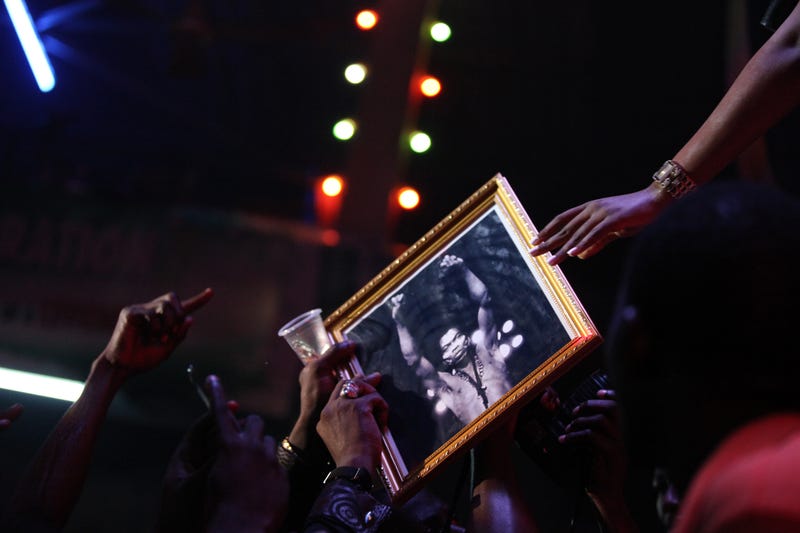
LAGOS, Nigeria (AP) — Fela Kuti became the first African to be awarded the Lifetime Achievement Award from the Recording Academy at the Grammys Special Merit Awards.
He was honored posthumously on Saturday alongside Chaka Khan, Cher, Carlos Santana and Whitney Houston.
The award underscores the artist’s contribution to music and as the inspiration of one of the most popular contemporary African music genres, Afrobeats. Nigerian music critics welcomed the recognition as a reflection of his enduring influence.
“What the recognition means locally is the inspiration Fela has provided for over 50 years," Joey Akan, a Nigerian music critic and founder of Afrobeats Intelligence, told The Associated Press.
Fela, a saxophonist and father of Afrobeat — different from Afrobeats — known more popularly by his first name, was born in 1938 in colonial Nigeria. His music career, which spanned decades between the late 1950s and up to the 1990s across multiple countries, is a signature blend of high-octane horn, jazz, and funk with Yoruba rhythms.
Fela's fight against government corruption and Western imperialism
To Nigerians, he wore many hats: a pioneering musician, an activist who was a thorn in the side of Nigeria’s successive military rulers, a cultural reference in the fight against Western imperialism, a chain-smoking serial polygamist.
But for the music part, a notable theme in his decades’ worth of work is his protest against Western cultural hegemony, which some critics say the Recording Academy is a part of. He railed against the neocolonial vestiges of British rule in Nigeria and the corrupt postcolonial leadership of his birth country, especially the military governments.
In his 1977 track “Colonial Mentality,” he sang “De ting wey black no good / Na foreign things them dey like /No be so?” (“The things that are Black are inferior / It is foreign ones they like. Is that not so?”)
In a 1989 polemic, “Beasts of No Nation,” he railed against the United Nations and almost every global leader of the time. “Dem call the place United Nations / Hear oh another animal talk / Wetin united inside United Nations?” (“They call the place United Nations / Hear another nonsense narrative / What is united in the United Nations?”)
He was jailed many times by Nigerian autocratic governments for his criticism, most notably for 20 months by Nigeria’s then-junta leader Muhammadu Buhari in 1984. In 1977, nearly 1,000 soldiers stormed his self-styled Kalakuta Republic, his residence in Lagos, and burned it down. His mother, Fumilayo Ransome-Kuti, a prominent activist, died from injuries sustained in the raid.
“Regardless of the contrast with what Fela represented and what the award represents, I think it is a net positive for African music,” Dolapo Amusat, the founder of WeTalkSound, a Nigerian creative company, told the AP. “And it shows how far Fela’s influence is and how widespread his acclaim is.”
Fela died in 1997 due to complications from AIDS. His legacy helped create one of the most successful periods in Nigerian music, with artists like Burna Boy and Wizkid often referencing Fela.
In recent years, music from Africa has gained significant recognition at the Recording Academy. In 2024, the academy introduced the Best African music performance category. Burna Boy, Tems, and South Africa's Tyla have won various awards at the ceremonies since 2020.
Many global artists, including Beyoncé, Mos Def, Nas, and J.Cole have also sampled Fela, with his songs soundtracking many Hollywood productions.