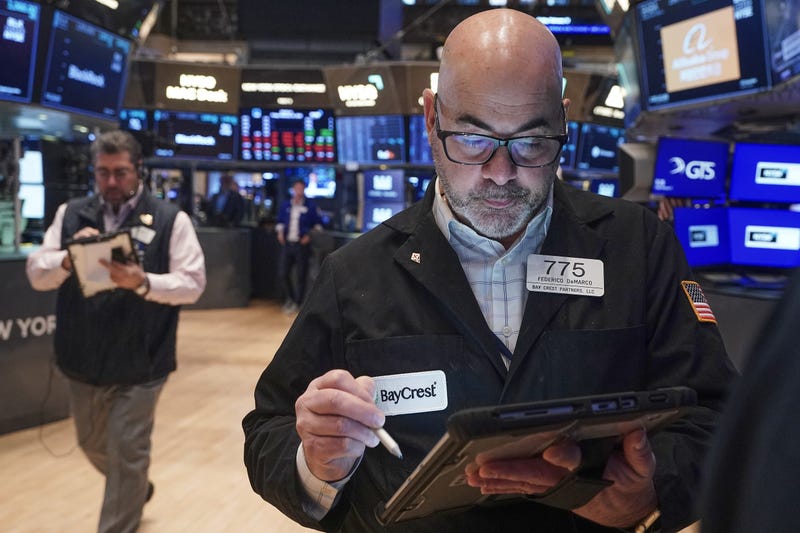
NEW YORK (AP) — The U.S. stock market is rising Friday after an encouraging update on inflation helped calm a Wall Street that’s been wracked by worries about how artificial-intelligence technology may upend the business world.
The S&P 500 rose 0.6%, a day after tumbling to one of its worst losses since Thanksgiving. The Dow Jones Industrial Average was up 205 points, or 0.4%, as of 12:30 p.m. Eastern time, and the Nasdaq composite was 0.5% higher.
Stocks got a boost from easing pressure from the bond market, where Treasury yields fell after a report showed inflation slowed last month by more than economists expected. U.S. consumers paid prices for groceries, clothes and other costs of living that were 2.4% higher overall than a year earlier.
While that’s higher than anyone would like and above the 2% target set by the Federal Reserve, it wasn’t as bad as December’s 2.7% rate. And an underlying measure that economists see as a better predictor of where inflation may be heading slowed to its least-painful level in nearly five years.
“It’s still too high, but only for now, not forever,” said Brian Jacobsen, chief economic strategist at Annex Wealth Management.
Besides helping U.S. households struggling to keep up with the cost of living, slower inflation could also give the Federal Reserve more leeway to cut interest rates, if needed. The Fed has put its cuts to interest rates on hold, but the widespread expectation is that it will resume later this year.
Lower rates would give the economy a boost and juice prices for stocks. What holds the Fed back from cuts is the threat that they can give inflation more fuel.
In the meantime, the economy seems to be in a better place than at the end of 2025. Besides the slowdown in inflation, it also saw the job market improve last month by more than economists expected.
On Wall Street, stock prices steadied somewhat for several companies that investors earlier targeted as potential losers from AI disruption.
AppLovin, for example, lost nearly a fifth of its value on Thursday even though it reported a stronger profit than analysts expected. Investors have been worried that it and other software companies could see AI-powered competitors take away customers and fundamentally change their industries.
On Friday, AppLovin climbed 3.8%.
Trucking and freight companies also tumbled on Thursday after a small company, Algorhythm Holdings, said its AI platform helps customers scale freight volumes by up to 400% “without a corresponding increase in operational headcount.” After sinking 14.5% Thursday, C.H. Robinson Worldwide rose 6.4% on Friday.
Such drops have been rolling through the market recently, targeting industries that investors decide are under threat for disruption by AI. The reactions have been so aggressive and so quick that analysts have likened it to a “shoot first, ask questions later” mindset.
Applied Materials was the strongest single force lifting the S&P 500 after rising 8.6%. The company, whose products help make chips and displays, reported a stronger profit for the latest quarter than analysts expected. CEO Gary Dickerson credited “acceleration of industry investments in AI computing.”
Moderna climbed 6.6% after the vaccine maker reported stronger results for the latest quarter than analysts expected.
On the losing end of Wall Street was DraftKings, which fell 12.8% even though its profit for the latest quarter topped analysts’ expectations. It gave a forecast for revenue this year that fell short of expectations.
Norwegian Cruise Line Holding sank 5.2% after replacing its CEO, just a few weeks before it will report its latest quarterly results. The cruise ship operator said John Chidsey, a director at the company who used to be CEO of Subway Restaurants, is replacing Harry Sommer, effective immediately.
In the bond market, the yield on the 10-year Treasury fell to 4.06% from 4.09% late Thursday. The yield on the two-year Treasury, which more closely tracks expectations for Fed action, fell more. It dropped to 3.41% from 3.47%.
In stock markets abroad, indexes fell in Asia and were more mixed in Europe. Hong Kong’s Hang Seng dropped 1.7%, and Japan’s Nikkei 225 fell 1.2% for two of the bigger moves.
___
AP Business Writers Chan Ho-him and Matt Ott contributed.