


A paddle, a kayak, and newfound camaraderie have helped two veterans reclaim their purpose and joy after unimaginable adversity, and now they are helping their fellow veterans heal.
Josh Droddy, Iraq veteran and leader of the Junction City, Arkansas Heroes On the Water chapter, and Jason Austin, a Purple Heart recipient and HOW’s national volunteer program coordinator, are working to help others experience the unique healing that comes from outdoor adventure and authentic community engagement.
Droddy grew up in south Louisiana and said the National Guard was always there to help following hurricanes and other emergencies.
"I joined while I was a junior in high school and went to basic training in Fort Benning in June of 2001,” he said. "At that time, basic training was just that, training. There were no active threats in the world. Then, while on the buddy live fire range, our drill sergeants sat us down and informed us that terrorists had taken over airplanes and attacked New York City. Training became real that day.”
When Droddy returned home that Christmas, his unit was sent ot guard the salt domes in south Louisiana from possible attacks. By 2004, Droddy was in Iraq, where his unit was in charge of route clearance and sector patrols.
“While I was deployed, I usually spent 13 hours behind the steering wheel every day doing route clearance patrols,” he said. “It consisted mainly of riding around at five mph, waiting to get blown up or shot at, pulling over Iraqis who were breaking curfew, or we were doing house-to-house searches."
As the lead driver, Droddy’s main mission was to keep moving, no matter what happened.
“Small arms fire into the windshield - keep moving. IEDs – keep moving,” he said. “There’s a big misconception about IEDs. Yes, there are some that are very large, but many are small and usually not set correctly. So, if you hit a small one while driving, the shrapnel would hit the doors and windows, tearing it to shreds, or flattening tires.”
One night while driving the rear vehicle going down a dark road in his sector, Droddy looked out of the passenger side window and said, “Now, who is shooting green roman candles... oh expletive, RPG.”
There were three Humvees in the patrol, and Droddy watched as IEDs started going off to the left and to the right, then flashes of light and more RPGs.
“Somehow, we made it through and stopped our vehicles a mile or so away and waited for reinforcements. We had a few BFVs show up to help us go back and clear the area,” he said. “As I’m walking back to my Humvee, I look down and see what I thought was a three-liter Coke bottle on the ground, so I kicked it out of the way. But it wasn’t a Coke bottle, it was an IED - a 155mm round that was wired to blow in the ambush. We called in EOD to dispose of it, and everyone walked away.”
Droddy left the National Guard after his unit returned home and he said he never saw “platoon or guys again in a military setting.”
Back home, Droddy said it was very apparent that he no longer fit in with society.
“At the time, the VA didn’t know what TBI or PTSD really was yet, so I fell through many holes in the system. At the time, I thought I was physically okay. I had a sore back and bad dreams. However, over the next few years, my battle with demons had me in and out of inpatient treatments, struggling with my mental health, along with hundreds of hours of classes, counseling therapy, and treatment programs.”
Droddy was working to build life back together when he met Austin for the first In 2015. Austin soon had Droddy out on the water.
“That experience provided me with a peace and sense of calm that I’d never felt,” said Droddy. “I was only in the kayak for about 15 minutes that first time, then I spent some time bank fishing. Jason thought I would never come back, but after that first time on the water, they couldn’t beat me away with a stick. I was there for every event. I went from being a participant to being a
helper to having my own chapter in Southwest Louisiana.”
Austin said that he would love to say he joined the Army because he wanted to serve something bigger than himself and protect freedom.
“The reality of it is, like many other veterans, it was out of necessity. Growing up in a middle-class, broken home with no real direction, I saw the military as a way out,” he said. “I enlisted in the Army and served for 19 years. During that time, I learned that I was indeed serving something bigger than myself. I learned discipline, resilience, and the value of teamwork — skills that have stayed with me ever since.”
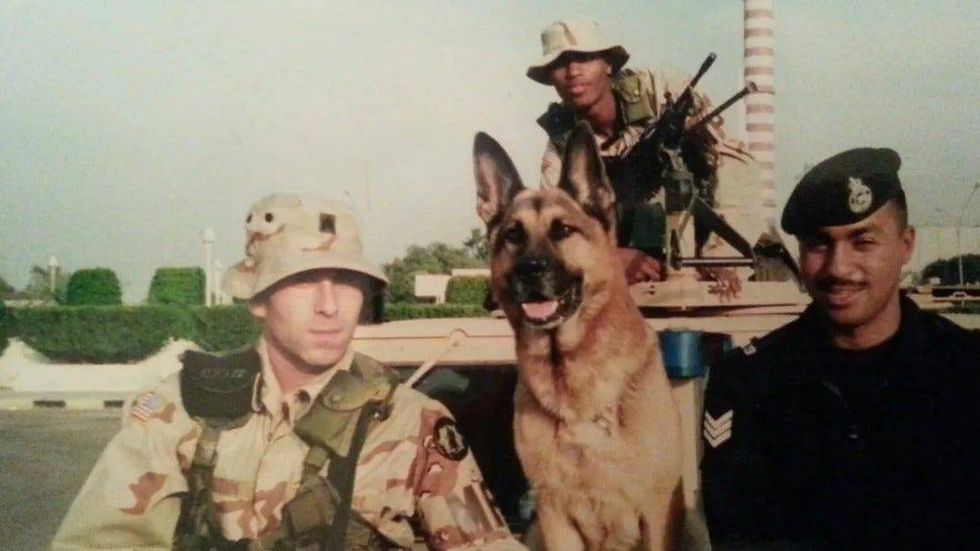 Jason Austin, left, is pictured in this undated photo while serving in Iraq.Heroes On the Water
Austin was severely injured by an IED while serving in Iraq in 2007, which he said made coming home harder than he ever expected.
“Suddenly, the structure and sense of purpose were gone,” he said. “I had so many physical injuries and a Traumatic Brain Injury. I faced challenges like isolation, anxiety, pain, anger, nightmares, and really the worst of all was facing that I was no longer relevant in this world I had dedicated my adult life to up to that point.”
Austin spent three years in medical care, undergoing surgeries, home-based health care, and Warrior Transition Units before being medically discharged.
“Now I had to start to heal physically and mentally, and start this journey to try and find where I fit in civilian life,” he said. “It's not an easy road and definitely not one that we were trained to navigate.”
Austin said he didn’t actually discover Heroes on the Water. They found him at a point in his life when he needed them the most.
“It was a chance phone call at a defining moment of my life, where I was about to become a statistic. The phone rang, and something told me to answer it, and I'm glad I did,” he said. “The chain of events from that point on brought me to this place in my life almost 15 years later. I found a way to reconnect — with nature, with myself, my family and friends, and with others who understood what I’d been through.
For Austin, it was about finding a new mission: helping others heal.
“I feel like helping the guys who were, or are, still in a place where they need some encouragement to start that journey forward, that I was that guy who had the experience, and the story to let them know that it's ok to be broken, just don't stay broken,” he said. “Don't stay a victim of yourself. Get back to being that warrior you once were, just not in a uniform anymore. Be part of something bigger again.”
Austin said that water has a way of calming the mind and opening the heart.
“It’s not just kayaking, it’s therapy without walls, without doctors or therapists. You’ll find camaraderie, laughter, and a sense of freedom that transforms lives. Give it one try. You might just find the peace you’ve been searching for. The greatest part is that even if it's not your thing, you actually took a chance on something. Use that momentum to keep going and find your place in your new life. Amazingly, we get this chance to define ourselves every day when we wake up and don't give up. I was always reminded by some guys I knew that, `the only easy day was yesterday.’ Forward progress isn't easy, but nothing worth having is.”
To learn more about Heroes On The Water, visit here.
Reach Julia LeDoux at Julia@connectingvets.com.