WASHINGTON (AP) — The Senate voted Friday to fund most of the government through the end of September while carving out a temporary extension for Homeland Security funding, giving Congress two weeks to debate new restrictions on federal immigration raids across the country.
With a weekend shutdown looming, President Donald Trump struck the spending deal with Senate Democrats on Thursday in the wake of the deaths of two protesters at the hands of federal agents in Minneapolis. Democrats said they would not vote for the larger spending bill unless Congress considers legislation to unmask agents, require more warrants and allow local authorities to help investigate any incidents.
“The nation is reaching a breaking point," Senate Democratic leader Chuck Schumer said after the vote. "The American people are demanding that Congress step up and force change.”
As lawmakers in both parties called for investigations into the fatal shootings, Trump said he didn’t want a shutdown and negotiated the rare deal with Schumer, his frequent adversary. Trump then encouraged members of both parties to cast a “much needed Bipartisan ‘YES’ vote.”
The bill passed 71-29 and will now head to the House, which is not due back until Monday. That means the government could be in a partial shutdown temporarily over the weekend until they pass it.
Speaker Mike Johnson, who held a conference call Friday with GOP lawmakers, said he expects the House to vote Monday evening. But what is uncertain is how much support there will be for the package.
Johnson's right flank has signaled opposition to limits on Homeland Security funds, leaving him reliant on Democrats who have their own objections to funding U.S. Immigration and Customs Enforcement without immediate restraints.
Two-week debate over ICE
It was unclear how involved Trump will be in the negotiations over new restrictions on immigration arrests — or if Republicans and Democrats could find any points of compromise.
Senate Democrats will not support an extension of Homeland Security funding in two weeks “unless it reins in ICE and ends violence,” Schumer said. “If our colleagues are not willing to enact real change, they should not expect Democratic votes.”
Similarly, House Democratic Leader Hakeem Jeffries told reporters that any change in the homeland bill needs to be “meaningful and it needs to be transformative.”
Absent “dramatic change,” Jeffries said, “Republicans will get another shutdown.”
Senate Majority Leader John Thune, R-S.D., said the two sides will “sit down in good faith,” but it will be “really, really hard to get anything done,” especially in such a short amount of time.
“We'll stay hopeful, but there are some pretty significant differences of opinion,” Thune said.
Democrats demand change
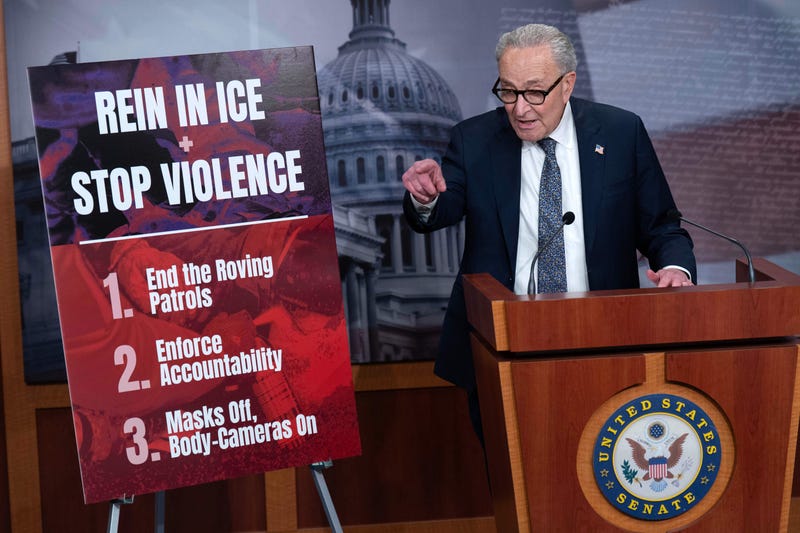
Irate Democrats have asked the White House to “end roving patrols” in cities and coordinate with local law enforcement on immigration arrests, including requiring tighter rules for warrants.
They also want an enforceable code of conduct so agents are held accountable when they violate rules. Schumer said agents should be required to have “masks off, body cameras on” and carry proper identification, as is common practice in most law enforcement agencies.
Alex Pretti, a 37 year-old ICU nurse, was killed by a border patrol agent on Jan. 24, two weeks after protester Renee Good was killed by an ICE officer. Administration officials, including Homeland Security Secretary Kristi Noem, originally said Pretti had aggressively approached officers, but multiple videos contradicted that claim.
Republican pushback
The president’s concessions to Democrats prompted pushback from some Senate Republicans, delaying the final votes and providing a preview of the coming debate over the next two weeks. In a fiery floor speech, Trump ally Sen. Lindsey Graham of South Carolina warned that Republicans should not give away too much.
“To the Republican party, where have you been?” Graham said, adding that ICE agents and Border Patrol agents have been “slandered and smeared.”
Several Republicans have said that if Democrats are going to push for restrictions on ICE, they will push for restrictions on so-called “sanctuary cities” that they say do not do enough to enforce illegal immigration.
“There no way in hell we’re going to let Democrats knee cap law enforcement and stop deportations in exchange for funding DHS,” said Missouri Sen. Eric Schmitt, R-Mo., ahead of the vote.
Still, some Republicans said they believe that changes to ICE’s operations were necessary, even as they were unlikely to agree to all of the Democrats’ requests.
“I think the last couple of days have been an improvement,” said Kentucky Sen. Rand Paul. “I think the rhetoric has been dialed down a little bit, in Minnesota.”
Last-minute promises
After Trump announced the deal with Democrats, Graham held the spending bills up for almost a day until Thune agreed to give him a vote on his sanctuary cities bill at a later date.
Separately, Graham was also protesting a repeal of a new law giving senators the ability to sue the government for millions of dollars if their personal or office data is accessed without their knowledge — as happened to him and other senators as part of the so-called Arctic Frost investigation into the Jan. 6, 2021, attack by Trump supporters at the Capitol.
The spending bill, which was passed by the House last week, would repeal that law. But Graham said Thune had agreed to consider a separate bill that would allow “groups and private citizens” who were caught up in Jack Smith’s probe to sue.
___
Associated Press writers Kevin Freking, Stephen Groves, Joey Cappelletti, Seung Min Kim, Michelle L. Price and Darlene Superville contributed to this report.