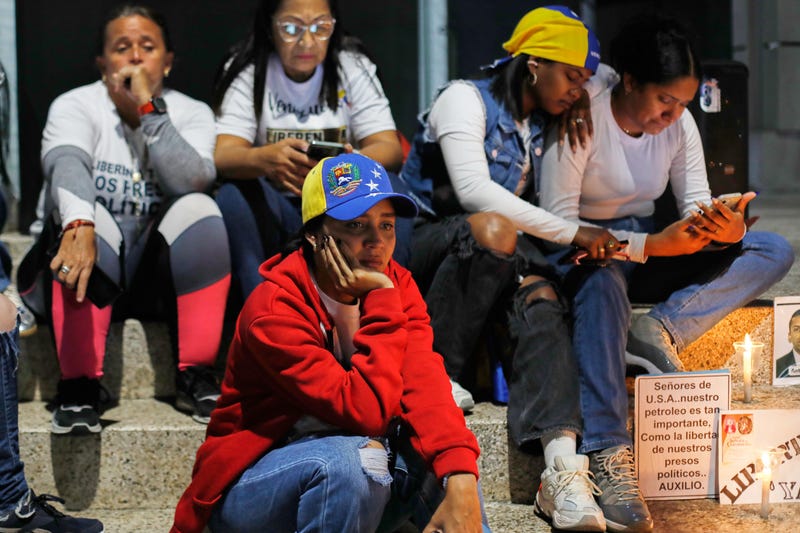
CARACAS, Venezuela (AP) — At least 1,557 people held in Venezuela for political reasons have submitted their applications under an amnesty bill that was signed into law this week and are expected to be released from prison, authorities said Saturday.
Thursday’s measure is expected to benefit opposition members, activists, human rights defenders, journalists and many others detained for months or even years.
Its approval marked a reversal for Venezuelan authorities, who for decades have denied holding any political prisoners. It follows last month’s stunning U.S. military raid in the country’s capital, Caracas, to capture then-President Nicolás Maduro.
“As of today, 1,152 new applications have been received, for a total of 1,557 that are being addressed immediately, and at this moment hundreds of releases of persons deprived of liberty who are benefiting from the Amnesty Law are already taking place,” National Assembly leader Jorge Rodríguez said on Saturday.
Earlier, the president of the special commission overseeing the amnesty law, Jorge Arreaza, said Friday night on state television that 379 amnesty requests had been received and that the applicants’ releases would take place between Friday and Saturday. Further releases could be granted within 15 days, he said.
Gonzalo Himiob, vice president of Venezuela-based prisoners’ rights group Foro Penal, told The Associated Press on Saturday that so far some have been released in the state of Barinas, in the southwest of the country, but the process of verifying releases under the amnesty was still ongoing.
The new law excludes those convicted of homicide, drug trafficking, serious human rights violations and military rebellion.
Human rights organizations are calling for the law to be applied to all prisoners held for political reasons, even if they are not listed among the beneficiaries.
“It is discriminatory and unconstitutional to exclude imprisoned military personnel and persecuted political figures,” Alfredo Romero, president of Foro Penal, said on X Saturday. Without this, “there can be no talk of national coexistence,” he said.
Rodríguez said that thousands of requests are being processed from “individuals who were under alternative measures to the system of deprivation of liberty,” and that they are likewise covered by the recently approved Amnesty Law.
Delcy Rodríguez, acting president of Venezuela since Jan. 5, said during the signing of the law that it showed that the country’s political leaders were “letting go of a little intolerance and opening new avenues for politics in Venezuela.”
The bill’s purpose is to grant people “a general and full amnesty for crimes or offenses committed” during specific periods since 1999 that were marked by politically driven conflicts in Venezuela, including “acts of politically motivated violence” in the context of the 2024 presidential election. The aftermath of that election led to protests and the arrest of more than 2,000 people, including minors.
In the days after Maduro’s Jan. 3 capture, Rodríguez’s government announced it would release a significant number of prisoners. However, relatives and human rights watchdogs have criticized the slow pace of releases and the restrictive conditions under which many have been placed after leaving prison.
Venezuela-based nonprofit Justice, Encounter and Forgiveness has tallied 459 releases of detainees held for political reasons between Jan. 8 and Feb. 20.