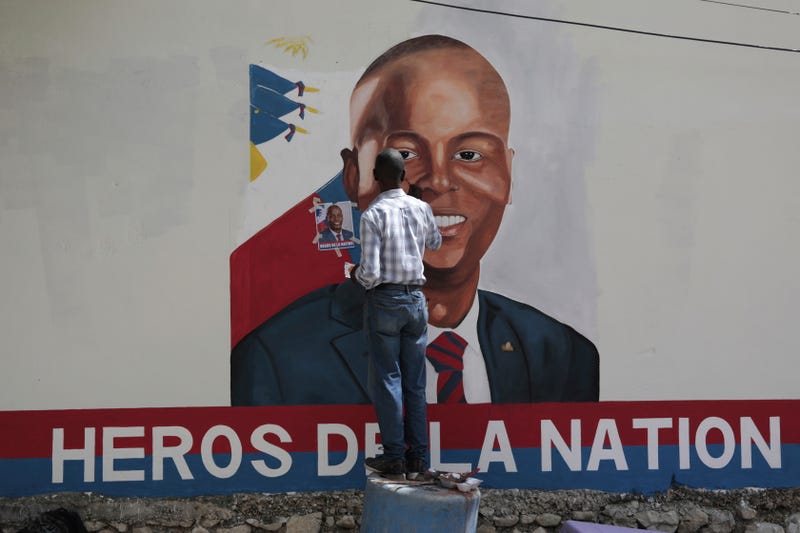
MIAMI (AP) — Greed, arrogance and power were the driving forces behind four men charged in the U.S. for the 2021 assassination of Haiti's last elected president, Jovenel Moïse, prosecutors said Tuesday during opening statements.
Federal prosecutors and defense attorneys began presenting opening statements in the trial in Miami for Arcangel Pretel Ortiz, Antonio Intriago, Walter Veintemilla and James Solages. They are charged with conspiring in South Florida to kidnap or kill Haiti’s former leader. Moïse’s assassination led to unprecedented turmoil in the Caribbean nation, where gang leaders have grown increasingly violent and empowered.
Assistant U.S. Attorney Sean McLaughlin told the jury that the case against the four men wasn't complicated: They wanted to seize power and get rich.
“So arrogant and confident in themselves, the evidence will show, and thinking so little of the Republic of Haiti and its people, they actually thought they could pull it off,” McLaughlin said.
Defense attorneys argued that the investigation initiated in Haiti was a mess and that their clients were manipulated into taking the blame for an internal coup.
“Once you get off on the wrong foot, everything that comes after is hard to trust,” Ortiz's attorney Orlando do Campo said.
Moïse was killed on July 7, 2021, when about two dozen foreign mercenaries — mostly from Colombia — attacked his home near Port-au-Prince, officials said. According to court documents, South Florida was a central location for planning and financing the plot to oust Moïse and replace him with someone of the conspirators’ choosing.
Ortiz and Intriago were principals of Counter Terrorist Unit Federal Academy and Counter Terrorist Unit Security, collectively known as CTU, and Veintemilla was a principal of Worldwide Capital Lending Group. Both companies were based in South Florida.
The three men face possible life sentences. Each has pleaded not guilty. U.S. District Judge Jacqueline Becerra has blocked out more than two months for the trial.
Investigators say the conspirators initially favored Christian Sanon, a dual Haitian-U. S. citizen, to replace Moïse. Solages was a CTU representative in Haiti who coordinated with Sanon and others, officials said.
The conspirators met in South Florida in April 2021 and agreed that, once in power, Sanon would award contracts to CTU for infrastructure projects, security forces and military equipment, investigators said. Worldwide Capital agreed to help finance the coup, extending a $175,000 line of credit to CTU and sending money to co-conspirators in Haiti to purchase ammunition, officials said.
CTU initially retained about 20 Colombian nationals with military training to provide security for Sanon. Conspirators also spent months obtaining weapons and body armor and attempting to build relationships with Haitian gangs, officials said.
By June 2021, the conspirators realized Sanon had neither the constitutional qualifications nor sufficient popular support to become president. They then backed Wendelle Coq Thélot, a former Haitian Superior Court judge. She died in January 2025 while still a fugitive.
Defense attorneys told jurors that Sanon approached their clients in early 2021 with plans to liberate Haiti from Moïse, who had overstayed his term as president and faced criticism from Haitian citizens, U.S. politicians and United Nations officials.
Emmanuel Perez, an attorney for Intriago, said the group was working with FBI agents, U.S. Embassy officials and members of the Haitian government in what they believed was the lawful arrest of an criminal president.
The defense has pointed to Joseph Félix Badio, a former Haitian government worker who was arrested in Haiti 2023, as the mastermind behind a plan to use the president's arrest to assassinate Moïse. Defense attorneys claim Moïse had already been killed by men dressed as Haitian police officers when the Colombian security force arrived to arrest him.
The group had a real arrest warrant signed by a judge, Solages' attorney Jonathan Friedman said. The judge later claimed the warrant was signed under duress.
“None of the people here on trial knew that,” Friedman said.
Marissel Descalzo, an attorney for Veintemilla, reserved the right to present her opening after the government makes its case.
Five others have previously pleaded guilty to conspiracy charges in the U.S. and are serving life sentences. A sixth person was sentenced to nine years behind bars after pleading guilty to providing body armor to the conspirators. Sanon's trial will be scheduled later.
Seventeen Colombian soldiers and three Haitian officials face charges in Haiti. Gang violence, death threats and a crumbling judicial system have stalled the investigation.