WASHINGTON (AP) — The U.S. Department of Health and Human Services on Thursday unveiled a series of regulatory actions designed to block access to gender-affirming care for minors, building on broader Trump administration restrictions targeting transgender Americans.
The sweeping proposals — the most significant moves this administration has taken so far to restrict the use of puberty blockers, hormone therapy and surgical interventions for transgender children — include cutting off federal Medicaid and Medicare funding from hospitals that provide gender-affirming care to children and prohibiting federal Medicaid dollars from being used to fund such procedures.
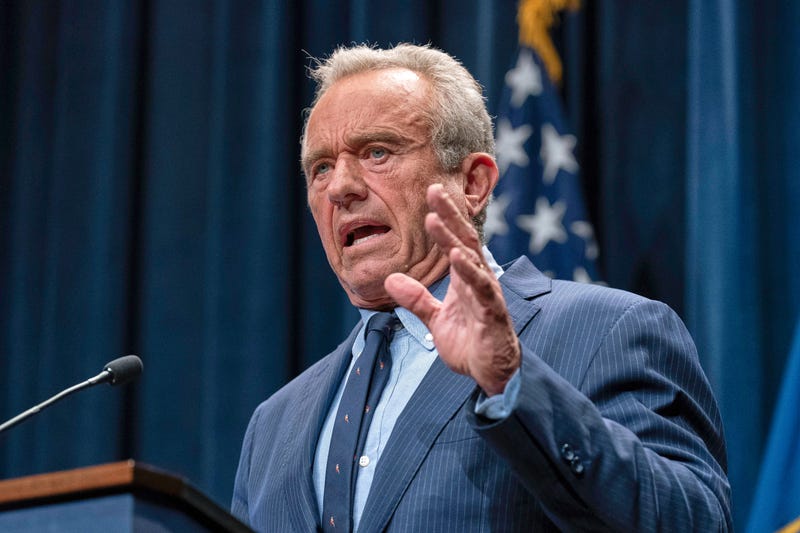
“This is not medicine, it is malpractice,” Health Secretary Robert F. Kennedy Jr. said of gender-affirming procedures in a news conference on Thursday. “Sex-rejecting procedures rob children of their futures.”
Thursday’s announcements would imperil access in nearly two dozen states where drug treatments and surgical procedures remain legal and covered by Medicaid, which is funded by federal and state dollars.
The proposals run counter to the recommendations of major U.S. medical societies. And advocates for transgender children strongly refuted the administration’s claims about gender-affirming care, saying Thursday’s moves would put lives at risk.
“The multitude of efforts we are seeing from federal legislators to strip transgender and nonbinary youth of the health care they need is deeply troubling,” said Rodrigo Heng-Lehtinen, of The Trevor Project, a nonprofit suicide prevention organization for LBGTQ+ youth.
Proposed rules would threaten youth gender-affirming care in states where it remains legal
Medicaid programs in slightly less than half of states currently cover gender-affirming care. At least 27 states have adopted laws restricting or banning the care. The Supreme Court’s recent decision upholding Tennessee’s ban means most other state laws are likely to remain in place.
The proposals announced by Kennedy and his deputies are not final or legally binding. Officials must go through a lengthy rulemaking process, including periods of public comment and document rewrites, before the restrictions become permanent. They are also likely to face legal challenges.
But the proposed rules will likely further discourage health care providers from offering gender-affirming care to children and many hospitals have already ceased such care in anticipation of federal action.
Hannah Edwards, executive director of Transforming Families, a support organization for families of transgender youth in Minnesota, said she expects some patients will still be able to get care at private clinics that don't participate in Medicaid and Medicare.
But that won’t be a solution for all kids seeking care.
Edwards has a 15-year-old transgender daughter and said that there’s a growing sense of fear because of federal government actions, even in a state that’s become a destination for families with transgender children.
“The conversation that constantly happens for my family personally is: Where is our red line when we need to flee the country?” she said.
Nearly all U.S. hospitals care for patients enrolled in Medicare and Medicaid, the federal government's largest health plans that cover seniors, people with disabilities and low-income Americans. Losing access to those payments would imperil most U.S. hospitals and medical providers.
The same funding restrictions would apply to a smaller health plan, the State Children’s Health Insurance Program, when it comes to care for people under the age of 19, according to a federal notice posted Thursday morning.
“This sets a very dangerous precedent for all areas of health care, if the government can cherry-pick one area of medicine to use to withhold necessary funding from entire groups of people,” said Dr. Scott Leibowitz, a psychiatrist and board member for the World Professional Association for Transgender Health. The group develops standards of care for transgender patients globally.
Kennedy also announced Thursday that the HHS Office of Civil Rights will propose a rule excluding gender dysphoria from the definition of a disability. Gender dysphoria is a formal medical diagnosis that describes the distress felt when someone’s gender expression does not match their sex assigned at birth.
Young people who persistently experience gender dysphoria are first evaluated by a team of professionals. Some may try a social transition, involving changing a hairstyle or pronouns. Some may later also receive hormone-blocking drugs that delay puberty, followed by testosterone or estrogen to bring about the desired physical changes sought by patients. Surgery is rare for minors.
Moves contradict advice from medical organizations and transgender advocates
Dr. Mehmet Oz, the administrator of the Centers for Medicare and Medicaid Services, on Thursday called transgender treatments “a Band-Aid on a much deeper pathology,” and suggested children with gender dysphoria are “confused, lost and need help.”
Polling shows many Americans agree with the administration’s view. An Associated Press-NORC Center for Public Affairs Research survey conducted in May found that about half of U.S. adults approved of how Trump was handling transgender issues.
Chloe Cole, a conservative activist known for speaking about her gender-transition reversal, spoke at the news conference to express appreciation. She said cries for help from her and others in her situation, “have finally been heard.”
But the approach contradicts the recommendations of most major U.S. medical organizations, including the American Medical Association, which has urged states not to restrict transgender care and services. The American Academy of Pediatrics called on HHS to reverse course Thursday, saying “children and families will bear the consequences.”
“These rules are a baseless intrusion into the patient-physician relationship. Patients, their families, and their physicians—not politicians or government officials —should be the ones to make decisions together about what care is best for them,” said Dr. Susan Kressly, AAP president.
Actions build on a larger effort to restrict transgender rights
The announcements build on a wave of actions President Donald Trump, his administration and Republicans in Congress have taken to target the rights of transgender people nationwide.
On his first day in office, Trump signed an executive order that declared the federal government would recognize only two immutable sexes: male and female. He also has signed orders barring transgender athletes from participating in girls’ and women’s sports and cutting federal spending for transition-related care, which prompted Thursday's announcement.
On Wednesday, a bill that would open transgender health care providers to prison time if they treat people under the age of 18 passed the U.S. House and heads to the Senate. Another bill under consideration in the House on Thursday aims to ban Medicaid coverage for gender-affirming care for children.
___
Shastri reported from Milwaukee. Associated Press writer Geoff Mulvihill contributed to this report.