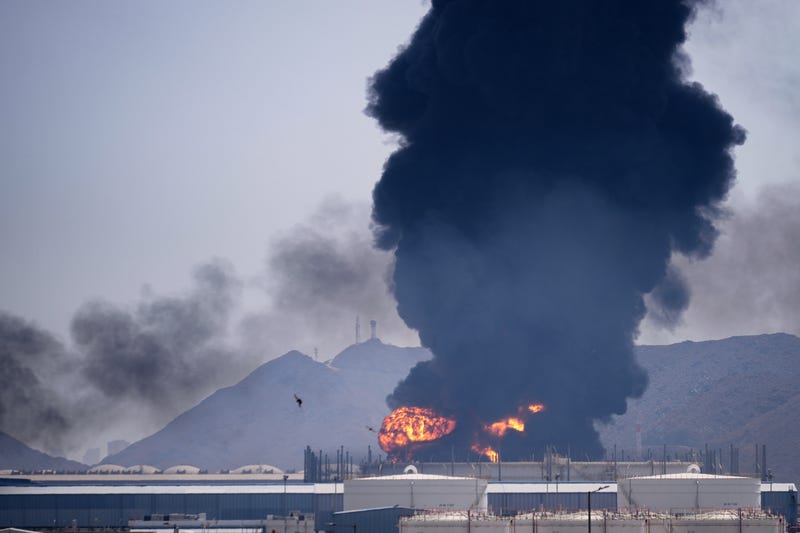
DUBAI, United Arab Emirates (AP) — A missile struck a helipad inside the U.S. Embassy compound in Baghdad and debris from an intercepted Iranian drone hit an oil facility in the United Arab Emirates as the U.S.-Israel war with Iran entered its third week Saturday.
Associated Press images showed a column of smoke rising over the embassy compound in the Iraqi capital and a fire in the Fujairah port in the UAE that broke out after what authorities said was a drone interception.
A day earlier, President Donald Trump said the U.S. destroyed military sites on an island vital to Iran’s oil network and warned that its oil infrastructure could be next if Iran continues to interfere with the passage of ships through the Strait of Hormuz.
Trump said U.S. forces on Friday “obliterated” targets on Iran’s Kharg Island, which is home to the primary terminal that handles the country’s oil exports. The speaker of the Iranian parliament had warned that such strikes would provoke a new level of retaliation.
Meanwhile, an American official said 2,500 more Marines and an amphibious assault ship are being sent to the Middle East.
Iran has continued to launch widespread missile and drone attacks on Israel and neighboring Gulf Arab states, and effectively closed the Strait of Hormuz, through which a fifth of the world’s traded oil passes, even as U.S. and Israeli warplanes pummel military and other targets across Iran.
The humanitarian crisis in Lebanon deepened, with nearly 800 people killed and 850,000 displaced as Israel launched waves of strikes against Iran-backed Hezbollah militants and warned there would be no let up.
Marines and assault ship will add to US forces
Elements from the 31st Marine Expeditionary Unit and the amphibious assault ship USS Tripoli have been ordered to the Middle East, according to the U.S. official, who spoke to The Associated Press on condition of anonymity to discuss sensitive military plans.
Marine Expeditionary Units are able to conduct amphibious landings, but they also specialize in bolstering security at embassies, evacuating civilians, and providing disaster relief. The deployment does not necessarily indicate that a ground operation is imminent or will take place.
The Wall Street Journal first reported the new Marine deployment.
The 31st Marine Expeditionary Unit, as well as the Tripoli and other amphibious assault ships carrying the Marines, are based in Japan and have been in the Pacific Ocean for several days, according to images released by the military. The Tripoli was spotted by commercial satellites sailing alone near Taiwan, putting it more than a week away from the waters off Iran.
Earlier in the week, the Navy had 12 ships, including the aircraft carrier USS Abraham Lincoln and eight destroyers, operating in the Arabian Sea. Should the Tripoli join this flotilla, it would be the second-largest ship behind the Lincoln in the region.
While the total number of U.S. service members on the ground in the Middle East is not clear, Al-Udeid Air Base alone, one of the largest in the region, typically houses some 8,000 U.S. troops in Qatar.
US strikes a key Iranian island after Tehran warning
The U.S. strikes on Iran’s Kharg Island in the Persian Gulf targeted military sites but left its oil infrastructure alone for now, Trump said in a social media post. But he warned that if Iran or anyone else interferes with the passage of ships through the Strait of Hormuz, he will reconsider his decision not to “wipe out the Oil Infrastructure.”
Iranian Parliament Speaker Mohammad Bagher Qalibaf warned on social media Thursday that attacks on the islands on Iran’s southern maritime frontier would cause Iran to “abandon all restraint,” underscoring how central they are to the country’s economy and security.
On Saturday, Iran’s joint military command reiterated its threat that it will attack the U.S.-linked oil and energy facilities in the region if the Islamic Republic's oil infrastructure is hit.
Ebrahim Zolfaghari, spokesperson for the Khatam al-Anbiya Central Headquarters, warned they will target “all oil, economic, and energy infrastructures belonging to oil companies across the region that have American shares or cooperate with America.”
The Iranian joint military command also threatened to attack cities in the UAE, saying the U.S. used “ports, docks and hideouts” there to launch strikes on the islands, without providing evidence. It called on people to evacuate those areas where it said U.S. forces were sheltering
Iran’s semiofficial Fars news agency said Saturday the U.S. strikes caused no damage to the island's oil infrastructure. The agency said at least 15 explosions followed the strikes, which it said targeted an air defense facility, a naval base, the airport control tower and an offshore oil company’s helicopter hangar.
On Saturday, the U.S. Central Command released a video on X showing the strike and said it destroyed naval mine storage facilities, missile storage bunkers and multiple other military sites.
Another attack on the US Embassy in Baghdad
No one immediately claimed responsibility for the strike on the embassy's helipad on Saturday. The sprawling embassy complex, one of the largest U.S. diplomatic facilities in the world, has been repeatedly targeted by rockets and drones fired by Iran-aligned militias.
There was no immediate comment from the embassy. On Friday, the embassy renewed its Level 4 security alert for Iraq, warning that Iran and Iran-aligned militia groups have previously carried out attacks against U.S. citizens, interests and infrastructure, and “may continue to target them.”
US says 15,000 targets struck in Iran since the start of the war
Israel earlier announced another wave of strikes in Iran targeting infrastructure, and said its air force had hit more than 200 targets in the last 24 hours, including missile launchers, defense systems and weapons production sites.
In Washington, U.S. Defense Secretary Pete Hegseth said that over 15,000 enemy targets have been struck — more than 1,000 a day since the war began.
He also sought to address concerns about the bottling of the Strait of Hormuz, telling reporters: “We have been dealing with it and don’t need to worry about it.”
___
Mednick reported from Tel Aviv, Israel; Magdy from Cairo and Toropin from Washington. Associated Press writers Sally Abou AlJoud, Kareem Chehayeb and Bassem Mroue in Beirut; Qassim Abdul-Zahra in Baghdad; Will Weissert at Joint Base Andrews, Maryland and Tia Goldenberg in Washington contributed to this report.