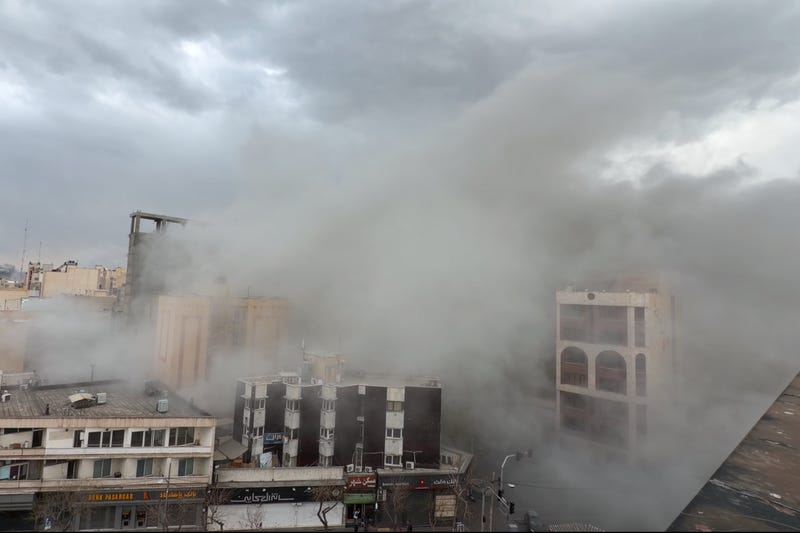
DUBAI, United Arab Emirates (AP) — Israel and the United States pounded Iran on Monday in a campaign that U.S. President Donald Trump said would likely take several weeks. Tehran and its allies hit back against Israel, Gulf states and targets critical to the world’s energy production.
The intensity of the attacks, the killing of Iranian Supreme Leader Ayatollah Ali Khamenei and the lack of any apparent exit plan set the stage for a prolonged conflict with far-reaching consequences. Safe havens in the Mideast like Dubai have seen incoming fire; hundreds of thousands of airline passengers are stranded around the globe; oil prices shot up; and U.S. allies pledged to help stop Iranian missiles and drones.
With no sign of the conflict abating, Trump said operations are likely to last four to five weeks but that he was prepared “to go far longer than that.”
In a sign of concern over the potential for spiraling violence, the State Department on Monday urged U.S. citizens to leave more than a dozen Middle Eastern countries due to safety risks.
“The hardest hits are yet to come from the U.S. military,” Secretary of State Marco Rubio told reporters. “The next phase will be even more punishing on Iran than it is right now.”
Trump said the military campaign's objectives are to destroy Iran’s missile capabilities, wipe out its navy, prevent it from obtaining a nuclear weapon and ensure that it cannot continue to support allied groups like Lebanon's Hezbollah, which fired missiles at Israel on Monday.
The chaos of the conflict became apparent when the U.S. military said Kuwait had “mistakenly shot down” three American F-15E Strike Eagles while Iran was attacking with aircraft, ballistic missiles, and drones. U.S. Central Command said all six pilots ejected safely.
As several airstrikes hit Iran’s capital, Tehran, the top security official Ali Larijani vowed on X: “We will not negotiate with the United States.”
Iran expands attacks to regional energy facilities
World markets were rattled as the fighting expanded across a region vital to energy supplies.
Saudi Arabia’s Ras Tanura oil refinery came under attack from drones, but its defenses downed the incoming aircraft, a military spokesman told the state-run Saudi Press Agency. The refinery has a capacity of over half a million barrels of crude oil a day.
“The attack on Saudi Arabia’s Ras Tanura refinery marks a significant escalation, with Gulf energy infrastructure now squarely in Iran’s sights,” said Torbjorn Soltvedt, an analyst at the risk intelligence company Verisk Maplecroft.
The Gulf state of Qatar said its air force shot down two Iranian Sukhoi Su-24 bombers, and QatarEnergy said it would stop producing liquefied natural gas indefinitely, taking one of the world’s top suppliers off the market. European natural gas prices surged by 40% in response.
Several ships have been attacked in the Strait of Hormuz, the narrow mouth of the Persian Gulf through which a fifth of all oil traded passes and where Iran has threatened attacks.
The Gulf is also a hub for air travel. Passengers have been stranded around the world as carriers based there grounded flights. Long-haul carriers Etihad and Emirates restarted limited flights Monday.
Iran says nuclear site was targeted
Reza Najafi, Iran’s ambassador to the International Atomic Energy Agency, told reporters that airstrikes targeted the Natanz nuclear enrichment site on Sunday.
“Their justification that Iran wants to develop nuclear weapons is simply a big lie,” he said.
Israel and the U.S. have not acknowledged strikes at the site, which the U.S. bombed in the 12-day war between Iran and Israel in June. Israel has said it is targeting the “leadership and nuclear infrastructure.”
Iran has said it has not enriched uranium since June, though it has maintained its right to do so while saying its nuclear program is peaceful.
The death toll grew on all sides
The Iranian Red Crescent Society said the U.S.-Israeli operation has killed at least 555 people. In Israel, where several locations were hit by Iranian missiles, 11 people were killed. Israel’s retaliatory strikes against Hezbollah killed dozens of people in Lebanon.
The U.S. military announced that two previously unaccounted for American service members have been confirmed dead, bringing the total to six. Three people were reported killed in the United Arab Emirates, and one each in Kuwait and Bahrain.
Iran’s top diplomat on Monday shared an aerial photo showing rows of graves that he said were for more than 160 girls killed during a U.S.-Israeli strike on an elementary school in Minab. “Their bodies were torn to shreds,” Abbas Araghchi, the country’s foreign minister, said on X.
In Israel, three young siblings killed by an Iranian strike were being laid to rest at the Mount of Olives in Jerusalem on Monday night. Yaakov, 16, Avigail 15, and Sarah Biton, 13, were among the nine killed Sunday when a missile slammed into a shelter located in a synagogue in Beit Shemesh.
Hezbollah fires on Israel, prompting massive response
Hezbollah said it fired missiles on Israel early Monday in response to Khamenei’s killing and “repeated Israeli aggressions.” It was the first time in more than a year the militant group has claimed an attack.
There were no reports of injuries or damage.
Israel retaliated with strikes on Lebanon. The country's Health Ministry reported at least 52 people were killed and 154 wounded in overnight strikes in the Beirut suburbs and southern Lebanon. Associated Press journalists in Beirut were jolted awake by loud explosions that shook buildings and shattered windows.
Lt. Gen. Eyal Zamir, the Israeli army chief of staff, said the military would not end its offensive against Hezbollah “before the threat from Lebanon is eliminated.” An Israeli military spokesman, Brig. Gen. Effie Defrin, said Israel is keeping “all options on the table,” including a potential ground invasion of Lebanon.
The Israeli military said it had completed a wave of strikes targeting branches of al-Qard al-Hasan, a charity operating outside the Lebanese financial system that Israel says is used to fund Hezbollah's military wing. An Israeli airstrike in Beirut heavily damaged a building, as the military said it targeted a senior Hezbollah official.
No end in sight to the US-Israeli campaign
The U.S. military, which has used B-2 stealth bombers to strike Iran’s ballistic missile facilities with 2,000-pound bombs, said Monday that it had taken out 11 Iranian warships. Trump has said the Iranian navy's headquarters had been “largely destroyed.”
While Danny Danon, the Israeli ambassador to the U.N., said the conflict would continue “as long as it takes,” Defense Secretary Pete Hegseth told reporters Monday that the U.S. is not engaged in a nation-building effort, saying, “This is not Iraq. This is not endless."
Trump sought to more clearly define the administration's objectives on Monday following an earlier statement — as the attack was unfolding Saturday — in which he listed various grievances dating to Iran's 1979 Islamic Revolution and urged Iranians to “take over” their government.
There have been no signs yet of any such uprising.
Trump has also signaled an openness to dialogue with Iran's new leadership, which could be chosen soon.
Tehran's streets are deserted
Tehran’s streets have been largely deserted with people sheltering during airstrikes. The paramilitary Basij force, which has played a central role in crushing recent nationwide protests, set up checkpoints across the city, witnesses said.
In the northern Iranian city of Babol, a student, speaking anonymously over concerns of retribution, told the AP that armed riot police were on the streets Saturday night and into the early hours of Sunday after the death of Khamenei.
“We don’t know whether to be happy about the elimination of the criminals who oppress us or to remain silent in the face of the U.S. and Israel’s war against the country and its interests and the terror that is taking place,” he said.
___
Lidman reported from Tel Aviv, Israel and Magdy from Cairo. Associated Press writers Bassem Mroue and Sally Abou AlJoud in Beirut, Suzan Fraser in Ankara, Turkey, Farnoush Amiri in New York and Lisa Mascaro, Mary Clare Jalonick and Matt Lee in Washington contributed to this report.